


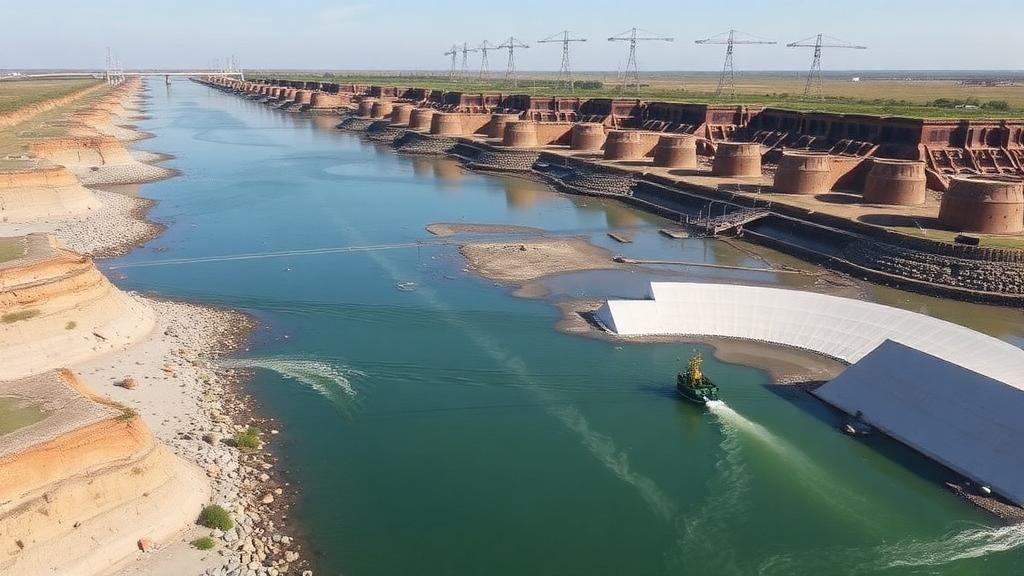
In the industrial zone of Setif, a city perched on the high plains of northeastern Algeria, the wastewater flowing out of classified factories has been quietly rewriting the chemistry of an entire river system. A new three-year assessment, published in Environmental Monitoring and Assessment, has tracked the physico-chemical and biological characteristics of these effluents from 2021 to 2023, and the picture that emerges is stark. The Oued Bouaroua, the watercourse that threads its way directly through the industrial zone, is receiving discharges so acidic, so oxygen-starved, and so laden with organic matter that researchers describe the receiving environment as a highly acidic hydroecosystem. The findings arrive at a moment when water scarcity and industrial growth are colliding across North Africa, making the detailed diagnosis offered by this study both timely and uncomfortable.
The research team, led by S. Naïli of Setif-1 University Ferhat Abbas together with colleagues from the Urban Project City and Territory Laboratory and the Valorisation of Natural Biological Resources Laboratory, set out with two linked goals. The first was to chart how key water quality parameters evolve over time in the industrial effluents themselves. The second was to evaluate the seasonal variability of those effluents and to trace the repercussions downstream, into the water quality of the Oued Bouaroua. This dual framing matters, because industrial pollution is rarely a static problem. Concentrations of pollutants rise and fall with production cycles, rainfall, temperature, and the dilution capacity of the receiving river, and a snapshot taken in a single season can dramatically understate or overstate the true burden on an ecosystem.
What the monitoring revealed is a system under pronounced seasonal stress, with summer and autumn emerging as the most critical windows. During these periods, water temperatures climbed to 20.8 degrees Celsius, and dissolved oxygen collapsed to a mere 0.13 milligrams per liter. To put that figure in perspective, healthy freshwater systems typically sustain dissolved oxygen levels many tens of times higher, and fish and most aquatic invertebrates begin to suffer when concentrations fall below a few milligrams per liter. Oxygen at 0.13 milligrams per liter approaches anoxic conditions, the kind of environment in which aerobic life cannot persist and in which anaerobic microbial processes take over, often releasing further toxic compounds into the water column.
The organic pollution indicators recorded in the study are equally alarming. Five-day biochemical oxygen demand, a standard measure of the oxygen consumed by microbes as they decompose organic material, reached 490 milligrams per liter. Chemical oxygen demand, which captures a broader suite of oxidizable substances, peaked at 1740.77 milligrams per liter. Suspended solids climbed to 660.51 milligrams per liter, and turbidity hit 658 milligrams per liter. Each of these values signals an effluent carrying an enormous load of organic and particulate matter relative to what municipal treatment systems and natural waterways are designed to absorb. When such discharges enter a river, the decomposition of that organic load strips oxygen from the water, the suspended particles smother benthic habitats and reduce light penetration, and the entire food web, from algae to invertebrates to fish, is placed under compounding pressure.
Perhaps the most striking single number in the dataset is the pH. The mean pH of the effluents did not exceed 2.5, placing the water firmly in the range of strong acidity, comparable to acid mine drainage rather than ordinary industrial washwater. At such low pH, metals that are normally locked into sediments or particulates become soluble and mobile, biological treatment processes collapse because the microbial communities that underpin activated sludge and biofiltration cannot survive, and the corrosive character of the water threatens infrastructure as well as ecosystems. The study’s authors note that the receiving hydroecosystem is highly acidic, a designation that reflects not an occasional excursion but a persistent chemical regime. Electrical conductivity, a proxy for the total dissolved ionic load, reached a maximum of 16,980 microsiemens per centimeter, a value far above the thresholds generally associated with freshwater and indicative of a heavy burden of dissolved salts and mineral acids.
Sulfate chemistry adds another dimension to the problem. The highest sulfate concentration recorded was 1831.26 milligrams per liter, observed during the winter of 2021. Elevated sulfate in industrial wastewater is often associated with processes such as metal finishing, tanning, and the use of sulfuric acid, and its environmental significance is twofold. Directly, high sulfate concentrations alter the ionic balance of receiving waters and can harm freshwater organisms adapted to low-salinity conditions. Indirectly, in oxygen-depleted sediments, sulfate fuels the activity of sulfate-reducing bacteria, which convert sulfate to hydrogen sulfide, a compound that is toxic to aquatic life and produces the characteristic rotten-egg odor of badly degraded waterways. The combination of high sulfate, low oxygen, and extreme acidity in the Setif effluents creates a chemical cocktail that closely mirrors the dynamics documented in acid drainage environments elsewhere in the world.
Nutrient dynamics in the effluents displayed remarkable spatio-temporal variation, pointing to episodic and uneven sources of nitrogen across the industrial zone. The highest nitrate concentration, 35.57 milligrams per liter, was recorded during the spring of 2021, while nitrite reached a very significant 3.95 milligrams per liter. Nitrite is particularly noteworthy because it is an intermediate in the nitrogen cycle, typically present at low concentrations in well-functioning aquatic systems, and it is toxic to fish at concentrations far below those of nitrate because it interferes with oxygen transport in the blood. The co-occurrence of elevated nitrate and nitrite suggests that nitrogen transformations within the effluent network are incomplete and unstable, likely reflecting fluctuating organic loads and the erratic oxygen conditions documented in the study.
Iron measurements told a story of their own. Rather than showing a steady baseline, iron levels were irregular, a pattern the researchers interpret as evidence of episodic local contamination. At their peak, these levels exceeded the Algerian regulatory limit by more than 300 percent. Episodic metal releases of this kind are notoriously difficult to police with routine sampling, because a monitoring program that samples monthly can easily miss a discharge event that lasts a day. The Setif data therefore highlight a broader challenge in industrial pollution control: the average concentrations that appear in annual reports may conceal short-lived but severe excursions that do most of the ecological damage. Iron itself, while an essential element, becomes a stressor when it precipitates as orange hydroxide flocs that coat riverbeds and smother the surfaces where aquatic insects live and fish spawn.
The regulatory context of the study is grounded in Algerian law, specifically Executive Decree No. 06-141 of 2006, which establishes the conditions under which liquid effluents may be discharged, and Executive Decree No. 11-219 of 2011, which sets quality objectives for surface and groundwater intended for public supply. The exceedances documented in the Setif industrial zone, from the extreme acidity to the iron levels more than three times the legal ceiling, indicate a gap between the regulatory framework on paper and the quality of what actually reaches the Oued Bouaroua. The authors acknowledge the support of the Directorate of Environment of Setif Province and the National Office of Sanitation of Aïn Oulmène, whose laboratory staff contributed to the analytical work, underscoring that the study was conducted in direct collaboration with the local institutions responsible for environmental oversight.
The recommendations that flow from the findings are pointed. The researchers call for enhanced control of effluents during the summer months, when the combination of high temperatures and low flows produces the most critical conditions, through integrated water management, sustained monitoring, and effective industrial wastewater treatment. Each element of that prescription addresses a specific failure mode revealed by the data. Integrated management recognizes that the industrial zone, the river, and downstream users form a single connected system. Sustained monitoring, ideally with sufficient frequency to capture episodic events, is the only way to detect the kind of irregular contamination the iron data exposed. And effective treatment, whether through neutralization of acidic streams, electrocoagulation, bioaugmentation, or targeted sulfate removal, is the prerequisite for any meaningful recovery of the Oued Bouaroua. As cities across the region industrialize under tightening water budgets, the Setif study offers both a warning and a template: with rigorous, seasonal, multi-parameter monitoring, the true state of industrial rivers can be made visible, and with visibility comes the possibility of repair.
Subject of Research: Physico-chemical and biological assessment of industrial wastewater quality and its seasonal impact on the Oued Bouaroua river in the Setif industrial zone, Algeria
Article Title: Assessment of industrial wastewater quality from classified facilities in the Setif industrial zone, Algeria
Article References: Naïli, S., Boucenna, M., Nouar, H., & Sadrachi, I. (2026). Assessment of industrial wastewater quality from classified facilities in the Setif industrial zone, Algeria. Environmental Monitoring and Assessment, 198(10), Article 1102. https://doi.org/10.1007/s10661-026-15937-3
Image Credits: AI Generated
DOI: 10.1007/s10661-026-15937-3
Keywords: industrial wastewater, water quality, Setif, Algeria, Oued Bouaroua, seasonal variability, organic pollution, dissolved oxygen, pH acidity, sulfate, nitrate, iron contamination
Cite Scienmag News
Violet Maxwell. (October 5, 2026). Acidic Industrial Effluents Push Algerian River to the Brink, Three-Year Study Finds. Scienmag. https://scienmag.com/acidic-industrial-effluents-push-algerian-river-to-the-brink-three-year-study-finds/
Violet Maxwell. "Acidic Industrial Effluents Push Algerian River to the Brink, Three-Year Study Finds." Scienmag, 5 October 2026, https://scienmag.com/acidic-industrial-effluents-push-algerian-river-to-the-brink-three-year-study-finds/. Accessed 5 October 2026.
Violet Maxwell. "Acidic Industrial Effluents Push Algerian River to the Brink, Three-Year Study Finds." Scienmag. October 5, 2026. https://scienmag.com/acidic-industrial-effluents-push-algerian-river-to-the-brink-three-year-study-finds/


