


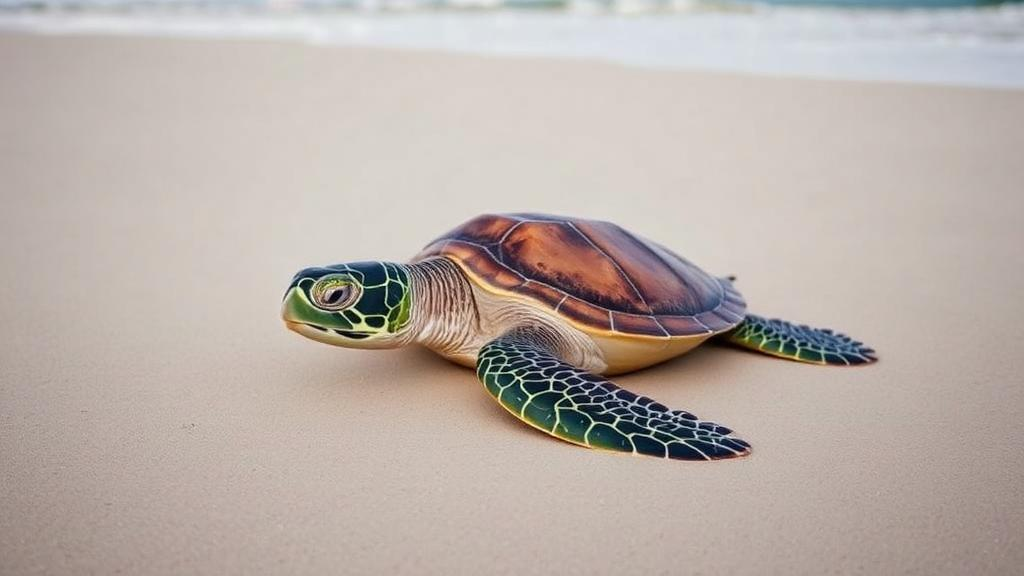
On a warm August night in 2021, researchers patrolling a nesting beach on Breem Island in Saudi Arabia’s Al Wajh Lagoon encountered a female green turtle (Chelonia mydas) in the final stages of egg-laying. The team fitted her with two titanium flipper tags, coded RS-032 and RS-033, and attached a satellite transmitter to follow her movements after she left the nesting beach. Three years later, almost to the day, the same turtle hauled out onto the very same stretch of sand. The recapture, documented on 8 August 2024 and reported in the journal Discover Oceans, marks the first inter-seasonal recapture of a nesting green turtle ever recorded within Al Wajh Lagoon, and it offers a rare longitudinal window into the growth, site fidelity, and remigration behavior of one of the ocean’s most iconic long-distance travelers.
The original tagging operation took place at 4:57 a.m. on 27 August 2021, on a nesting beach at Breem Island (25.62 N, 36.50 E), an island within the lagoon where The Red Sea Project, one of Saudi Arabia’s large-scale coastal development initiatives, is being built. At the time of first capture, the turtle’s curved carapace length, measured from the notch to the tip of the shell, was 100.7 centimeters. The satellite tag, a Wildlife Computers Platform Terminal Transmitter with the code 200112, tracked her for 212 days, revealing a remarkable journey that connected two countries across the northern Red Sea.
After completing her nesting activity, the turtle departed Breem Island and swam roughly 19 days to a foraging ground inside Wadi el Gemal National Park in Egypt, arriving on 15 September 2021. She then remained resident within that Egyptian feeding area for the next 197 days, with her home range and core area of use mapped in detail by the tracking data. The route confirmed what earlier satellite tracking studies had suggested: the Saudi Arabian Red Sea serves as a critical migratory corridor linking nesting rookeries with foraging areas as far away as Egypt, Sudan, and Eritrea. For this individual, the connection between a Saudi nesting beach and an Egyptian seagrass meadow was not hypothetical but a documented, round-trip reality.
When the field team found her again on 8 August 2024, 1,077 days after the original tagging, she was nesting on the same beach at Breem Island, within the same island and beach sector where she had first been encountered. The curved carapace length was remeasured at 101.4 centimeters, an increase of just 0.7 centimeters over three years, equivalent to a growth rate of roughly 0.23 centimeters per year. That figure may sound trivially small, but it is exactly what biologists expect from a sexually mature adult female green turtle. Growth in sea turtles is rapid during juvenile stages and slows dramatically after maturity, when energy is diverted from somatic growth into the enormous energetic costs of egg production and long-distance migration between nesting and foraging habitats.
The authors caution that such a small absolute change in carapace length should be interpreted carefully, given the inherent variability in measuring a live, wriggling animal on a dark beach. Even so, the calculated rate falls squarely within the range reported for adult green turtles elsewhere in the Indian Ocean basin, and the turtle’s overall carapace size is consistent with measurements from Red Sea rookeries. The individual appeared healthy at recapture, with no visible injuries, no signs of entanglement, and no residual marks from the satellite transmitter she had carried in 2021. One of her two original flipper tags, RS-033, was missing, a common fate for external tags over multi-year periods, but the other, RS-032, remained intact and undamaged. The team replaced the lost tag with a new one coded RSPSEZ0210, ensuring that future encounters can continue to build her life-history record.
The behavioral story is arguably more significant than the biometric one. Green turtles are famous for natal homing, the tendency of mature females to return to nest on the beaches where they themselves hatched, a behavior supported by genetic studies dating back to the early 1990s. This turtle’s return to the identical beach sector after a three-year absence provides direct, individual-level confirmation of strong site fidelity at Breem Island. Her three-year absence between nesting seasons also fits within the known range of remigration intervals for the species, the period a female spends recharging her energy reserves at foraging grounds before undertaking another breeding season. Such intervals typically span two to four years, and each documented interval adds a scarce data point to a demographic parameter that remains poorly constrained across much of the Red Sea.
That scarcity is precisely why this single recapture matters. As the authors note, marine turtle research in the Red Sea has historically been transient and patchy, with few long-term standardized monitoring programs, leaving persistent gaps in knowledge about remigration intervals, growth rates, and site fidelity for regional populations. Individual recapture records are among the most valuable tools for filling those gaps, because they convert abstract population statistics into concrete life histories. Mark-recapture techniques, including flipper tagging and photo identification, remain the backbone of such efforts, particularly at index nesting beaches where repeated surveys can generate the encounter histories needed to estimate survival, growth, and breeding frequency.
The timing of the research is also tied to a broader transformation of the Saudi coastline. Monitoring efforts in the region have expanded in recent years through conservation initiatives associated with major development projects, including The Red Sea Project, AMAALA, and NEOM. The Saudi Red Sea hosts critical green turtle habitats, including the mainland nesting beach at Ras Baridi and a network of island sites such as Breem, Waqqadi, Ataweel, Al Numann, Shushah, Walah, and Jadir, alongside extensive seagrass feeding grounds. Balancing development with the protection of these habitats requires exactly the kind of baseline demographic data that long-term tagging programs generate, and the Breem Island recapture demonstrates that sustained fieldwork in the area can yield results with direct management value.
There is also a warning embedded in the data. Recent studies have reported declining adult body sizes in parts of the Indian Ocean, a trend that may signal environmental or nutritional stress affecting growth trajectories, potentially linked to the degradation of foraging habitats and climate-driven change. Because adult size reflects decades of accumulated growth and foraging success, shifts in size distributions can serve as an early indicator of population-level trouble. The authors argue that continued monitoring of size distributions across Red Sea green turtle populations is critical to detect such demographic shifts before they become crises, and that findings like this recapture, combined with similar data from other individuals, can inform decisions aimed at protecting key habitats, mitigating habitat destruction, and reducing fisheries interactions.
For now, the turtle tagged as RS-032 has returned to the business of being a green turtle, likely shuttling once more between her Egyptian foraging grounds and her Saudi nesting beach. Her story underscores the quiet power of patient, long-term field biology: a pair of titanium tags, a satellite transmitter, and three years of waiting transformed a single night’s encounter into evidence about growth rates, migration corridors, and the enduring pull of a natal beach. In a region undergoing rapid change, that kind of evidence is the foundation on which the future of Red Sea green turtles will be built, and every subsequent recapture will add another chapter to a life history that researchers, and the public, are only beginning to read.
Subject of Research: Inter-seasonal recapture and site fidelity of a nesting green turtle at Al Wajh Lagoon, Saudi Arabian Red Sea
Article Title: First inter-seasonal recapture of a green turtle (Chelonia mydas) at Al Wajh Lagoon, Saudi Arabian Red Sea
Article References: Barrios-Garrido, H., Al-Attas, O., Al-Ansari, A., Boksmati, T., Al-Johani, M. O., Jabby, K., Wildermann, N. E., Williams, I. D., & Duarte, C. M. (2026). First inter-seasonal recapture of a green turtle (Chelonia mydas) at Al Wajh Lagoon, Saudi Arabian Red Sea. Discover Oceans, 3(1), Article 7. https://doi.org/10.1007/s44289-026-00120-w
Image Credits: AI Generated
DOI: 10.1007/s44289-026-00120-w
Keywords: green turtle, Chelonia mydas, Red Sea, Al Wajh Lagoon, Breem Island, mark-recapture, flipper tagging, site fidelity, remigration interval, satellite tracking, sea turtle conservation, Saudi Arabia
Cite Scienmag News
Margaret Porter. (October 5, 2026). Tagged Green Turtle Returns to Same Saudi Beach Three Years Later. Scienmag. https://scienmag.com/tagged-green-turtle-returns-to-same-saudi-beach-three-years-later/
Margaret Porter. "Tagged Green Turtle Returns to Same Saudi Beach Three Years Later." Scienmag, 5 October 2026, https://scienmag.com/tagged-green-turtle-returns-to-same-saudi-beach-three-years-later/. Accessed 5 October 2026.
Margaret Porter. "Tagged Green Turtle Returns to Same Saudi Beach Three Years Later." Scienmag. October 5, 2026. https://scienmag.com/tagged-green-turtle-returns-to-same-saudi-beach-three-years-later/


