Climate change is already imposing measurable costs on California’s economy, and those costs are rising, rippling across sectors and falling unevenly across the state, according to a new statewide report led by University of California San Diego researchers. From heat-related illness and deaths to lost work hours and higher insurance and utility bills, the economic consequences of a warming climate are no longer a distant projection but a present-day reality, the report concludes. And in San Diego, the analysis warns, the community will need to prepare for large-scale adaptation to much warmer conditions in the decades ahead.
The report, titled “Climate Impacts to the Economy,” is one of four statewide topical reports in California’s Fifth Climate Change Assessment, a multi-year research effort led by the Governor’s Office of Land Use and Climate Innovation with state, academic, tribal and community partners. The statewide report was led by Gordon McCord and Teevrat Garg of the UC San Diego School of Global Policy and Strategy. Alongside the statewide analysis, a separate regionally focused component report examined San Diego County’s climate future in detail, led by Scripps Oceanography climate scientists Julie Kalansky and Tom Corringham. The San Diego Regional Report was produced by a team of roughly 80 authors, including more than 30 from UC San Diego.
The statewide report finds that the largest monetized damages from climate change fall in the categories of health and labor. But the economic effects can extend well beyond the initial shock, as disruptions in one sector raise costs in others and compound losses across the economy. “The interconnections are important,” said McCord, a teaching professor at the UC San Diego School of Global Policy and Strategy. “Large impacts on agriculture translate to food prices for households and businesses. What happens in one part of the economy can spread into others.”
Those losses are also unevenly distributed, with some regions, communities and industries facing much greater risks than others. Inland counties in the Central Valley, Inland Empire and southeastern desert face disproportionate economic burdens, according to the report. Low-income households, outdoor workers, tribal and rural communities, older adults, young children and people with pre-existing conditions are among those most vulnerable to climate-related harms. Rather than offering a single bottom-line figure, the report brings together evidence to show where climate change is taking the greatest economic toll and on whom. “Understanding where the impacts are greatest and who is most exposed can help us make better decisions about where to focus our efforts,” said Garg, an associate professor of economics at the UC San Diego School of Global Policy and Strategy. “That’s useful for policymakers, but also for communities and the public trying to prepare for what’s ahead.”
Drawing on published research, the report brings together estimates of current climate-related costs and projections of how those costs may grow. Among the most striking findings is the projected toll of extreme heat on human health. By 2050, California could see about 560 additional heat-related deaths each year, representing roughly $7.7 billion in annual economic impact. Wildfire smoke carries even larger projected health costs: by 2050, under a high-warming scenario, smoke exposure is projected to cause about 5,060 additional deaths in California each year, representing about $68.8 billion annually. The projections underscore that the health burden of a warming climate extends beyond heat itself to the air quality consequences of fire-prone conditions.
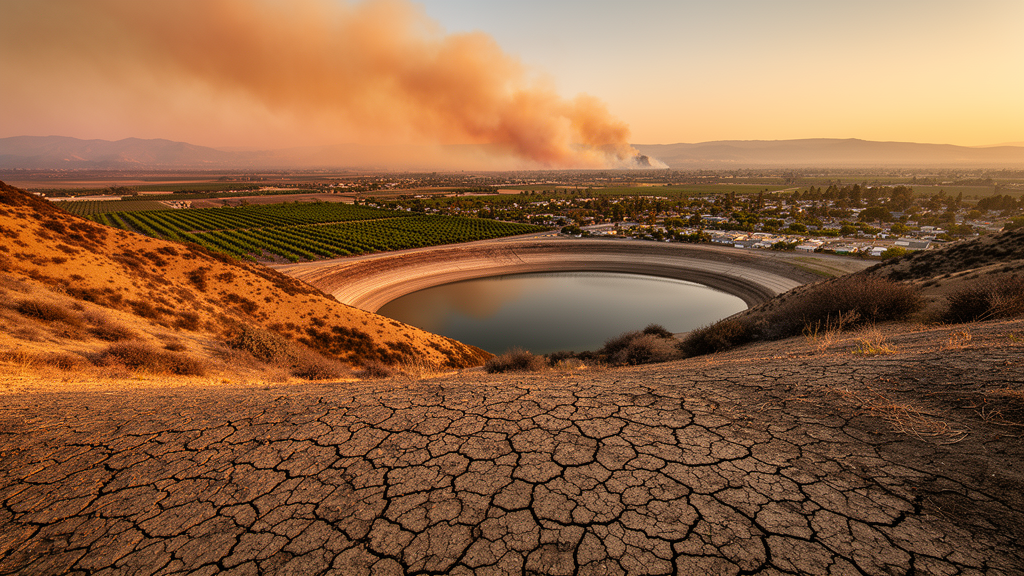
The economic effects of heat also reach into the labor market. By 2050, workers in highly exposed sectors could lose 5 to 10 work hours a year in the Central Valley and 15 to 20 hours a year in southeastern California, according to the report’s projections. Drought poses a parallel threat to the state’s agricultural sector: by the early 2040s, drought-related water shortages could cause $2.7 billion to $5.1 billion in direct agricultural losses each year. Sea-level rise adds another dimension of risk, with roughly 20 inches of rise, which could occur as soon as 2050, potentially inundating an estimated $17.9 billion worth of residential and commercial buildings statewide.
For households, those broader economic impacts can become very personal. The report points to higher food, energy and water costs; rising insurance premiums; health expenses; and the cost of making homes more resilient to heat and wildfire. A national estimate cited by the researchers puts lifetime climate-related costs for an American born in 2024 at $500,000 to $1 million. California’s insurance market offers one example of how those pressures are already showing up: the amount of property insured through the California FAIR Plan, the state’s insurer of last resort, grew from about $50 billion in insured exposure in 2018 to roughly $750 billion as of March 2026, a dramatic expansion of the state-backed backstop for properties that private insurers will not cover.
The companion San Diego Regional Report, led by Kalansky and Corringham of Scripps Oceanography, takes a closer look at the county’s climate future. According to the report, climate models project that San Diego’s temperatures will increase by approximately 4 degrees Fahrenheit, or 2.2 degrees Celsius, by mid-century, defined as 2041 to 2070, compared with the 30-year period that ended in 2010. The warming will be most acute in spring and fall, effectively extending the summer season and increasing the number of days with extreme heat. Interior regions are likely to warm by at least 0.56 degrees Celsius, or 1 degree Fahrenheit, more than the coast by mid-century, according to the report’s executive summary. The study noted where climate change will impact a wide range of sectors, as well as the many efforts needed to build resilience to climate extremes throughout the region, and highlighted that climate adaptation throughout the region needs to continue to adapt to warmer conditions, higher sea levels and more intense precipitation.
The San Diego report covered a range of potential consequences across sectors. The amount of precipitation the county will receive in the future is much less certain, but forecast models consistently find that what rain does fall will be concentrated more often in short, intense storms. Sea level in San Diego is expected to rise by 0.32 to 0.49 meters, or 1.0 to 1.6 feet, by 2075, similar to the rest of the California coast. Added heat will stress the power supply as San Diego’s iconic mild weather gives way to warmth, and the report notes that local utilities and Tribes are beginning to invest in microgrids, battery storage, distributed solar and undergrounding. Major wildfire risk will remain linked to autumn and early winter Santa Ana wind events. On biodiversity, climate change will act as a threat multiplier to native species and habitats, compounding existing pressures from development, habitat fragmentation and invasive species. Climate-related hazards also pose significant public health threats, with rising temperatures, wildfires and extreme precipitation events increasing cases of heat-related illness, respiratory conditions and more, especially among vulnerable populations.
To Corringham, the relative certitude of the report’s conclusions were both impressive and compelling. “In coordinating the San Diego Regional Report, we were struck by how complete a picture we have of the risks our region faces and of the policies that work,” Corringham said. “The costs of inaction are high. Well-designed investments in adaptation will pay for themselves many times over. What we need now is sustained support to put that knowledge into practice.” Kalansky noted the challenges of translating science into local action across a region of varied terrain. “San Diego has a complex topography and microclimates which makes adaptations across the region varied and challenging, but we are fortunate to work in a region with many dedicated to advancing climate research and using the information to build resilience,” said Kalansky, who helped lead the team of roughly 80 authors. The full reports are available as part of California’s Fifth Climate Change Assessment, along with a press release from the Governor’s Office of Land Use and Climate Innovation.
Subject of Research: The economic impacts of climate change in California, as assessed in the state's Fifth Climate Change Assessment
Article Title: What climate change is costing California
Article References: What climate change is costing California. Original publication (Bibliographic details unavailable.)
Image Credits: AI Generated
DOI: Not provided
Keywords: climate change, California, economics, extreme heat, wildfire smoke, drought, sea-level rise, San Diego, Fifth Climate Change Assessment, adaptation, public health, insurance
Cite Scienmag News
Sloane Callahan. (October 28, 2026). Climate change is already costing California billions, new statewide assessment finds. Scienmag. https://scienmag.com/climate-change-is-already-costing-california-billions-new-statewide-assessment-finds/
Sloane Callahan. "Climate change is already costing California billions, new statewide assessment finds." Scienmag, 28 October 2026, https://scienmag.com/climate-change-is-already-costing-california-billions-new-statewide-assessment-finds/. Accessed 28 October 2026.
Sloane Callahan. "Climate change is already costing California billions, new statewide assessment finds." Scienmag. October 28, 2026. https://scienmag.com/climate-change-is-already-costing-california-billions-new-statewide-assessment-finds/