


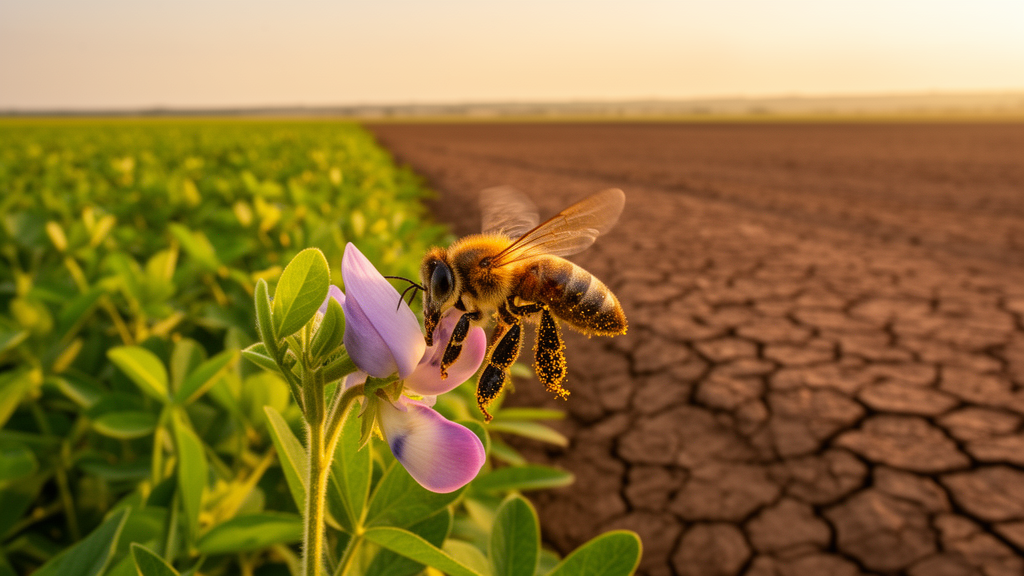
Climate change could quietly unplug one of agriculture’s most essential services: the transfer of pollen from bee to flower. A new modeling study published in Frontiers in Bee Science projects that by 2090, three economically important Brazilian food plants and their main bee pollinators will lose large swaths of suitable habitat — and, critically, the areas where plant and pollinator still overlap will shrink even faster than the ranges of either partner alone. For crops that cannot set fruit without a bee’s visit, that decoupling could mean pollination failure on a scale with direct consequences for food production and food security.
The research team, led by Willams Oliveira of the Universidade Federal de Pernambuco together with colleagues in Recife and at the University of East Anglia, focused on three native Brazilian crops chosen for a shared vulnerability: they are all self-incompatible, meaning they depend on cross-pollination to produce fruits and seeds, and yields collapse by at least 90% in the absence of pollinators. The trio comprises passionfruit (Passiflora edulis), the Brazil-nut tree (Bertholletia excelsa) and pitanga, also known as Brazilian cherry (Eugenia uniflora). Each was paired with its main effective pollinator: the large carpenter bee Xylocopa frontalis for passionfruit, the orchid bee Eulaema mocsaryi for Brazil-nut, and the European honeybee Apis mellifera for pitanga.
The stakes are considerable. Passionfruit carries an estimated annual Economic Value of Pollination of roughly US$284.5 million in Brazil, Brazil-nut about US$75.6 million, and pitanga around US$264,600. Brazil ranks among the world’s largest agricultural producers and exporters, and 60% of its crops depend on animal pollinators. Yet the country returned to the FAO hunger map in 2021, with more than 60 million people facing moderate to severe food insecurity in 2020 — a backdrop that makes any threat to pollination services a matter of national concern rather than an abstract ecological worry.
Technically, the study rests on species distribution modeling, a family of statistical approaches that relate georeferenced occurrence records to environmental variables to map where a species’ climate niche is currently suitable — and where it will remain suitable under future climates. The team compiled 3,479 plant and 2,241 pollinator occurrence coordinates from the Global Biodiversity Information Facility, the REFLORA virtual herbarium and the BIEN plant database. Climate surfaces came from WorldClim 2.1 at 2.5-minute resolution, covering the contemporary baseline of 1970–2000 and the 2081–2100 window drawn from the Coupled Model Intercomparison Project Phase 6, which the authors note exhibits heightened climate sensitivity compared with its predecessors.
Rather than betting on a single emissions trajectory, the researchers ran projections under three Shared Socioeconomic Pathways: SSP2-4.5, the optimistic
…continues SSP1-2.6, which assumes strong emissions reductions and roughly 1.8 degrees Celsius of warming by 2100; SSP2-4.5, an intermediate pathway in which emissions peak around mid-century before declining; and SSP5-8.5, a fossil-fuel-intensive scenario associated with warming approaching 4 degrees Celsius or more. Running the same models across all three pathways allowed the researchers to bracket the plausible range of futures rather than stake their conclusions on a single trajectory, and the negative signal held in every case.
The modeling machinery behind these projections deserves a closer look, because species distribution models are only as trustworthy as their construction. The team used an ensemble approach, combining multiple algorithms rather than relying on any single method, and validated each model against held-out occurrence data before projecting into future climates. Ensemble modeling matters because different algorithms can disagree about where a niche is suitable; averaging across them, and across the multiple global climate models available for each emissions scenario, smooths out the idiosyncrasies of any one method. The researchers also accounted for spatial autocorrelation in the occurrence records, a common pitfall that can inflate measures of model performance when nearby records share similar environmental conditions.
What emerged from the projections was a consistent pattern of contraction. Under all three scenarios, every one of the six species — three plants and three bees — was projected to lose suitable habitat, with losses intensifying as emissions rose. But the more consequential finding concerned overlap: the areas where a plant and its pollinator would both still find suitable conditions shrank more than either species’ range alone. For the Brazil-nut tree and its orchid bee pollinator Eulaema mocsaryi, the projected loss of shared suitable habitat reached 76 percent, the steepest of the three pairings. Passionfruit and the carpenter bee Xylocopa frontalis lost 51.5 percent of their overlapping area, while pitanga and the honeybee Apis mellifera lost 54 percent.
That asymmetry between individual range loss and joint range loss is the study’s central insight, and it stems from a simple geometric reality. When two species respond differently to changing climate — shifting their ranges in different directions, at different speeds, or contracting around different refugia — the zone where both persist is squeezed from both sides simultaneously. A plant might retain habitat in one region while its pollinator retains habitat in another, leaving each species biologically viable in isolation but reproductively stranded where it matters. For self-incompatible species, this is the crux: a population of passionfruit vines surviving in a climatically suitable pocket is of little use if the carpenter bees that move pollen between flowers have vanished from the same landscape.
The three pollinators themselves represent very different biologies, which strengthens the generality of the findings. Xylocopa frontalis is a large carpenter bee that buzz-pollinates, vibrating flowers at specific frequencies to shake pollen loose from pores — a service that passionfruit flowers, with their enclosed anthers, structurally demand. Eulaema mocsaryi is an orchid bee, a group of long-tongued, often solitary bees renowned for the males’ collection of fragrances, and it serves as the principal effective pollinator of the Brazil-nut tree, whose flowers are enclosed in a hooded structure that only sufficiently strong and appropriately shaped visitors can access. Apis mellifera, the European honeybee, is the world’s most managed pollinator and the backbone of commercial pollination services. The study’s finding that even this generalist, human-subsidized species faces substantial habitat contraction under future climates is particularly sobering, since managed hives cannot easily compensate when the underlying climate envelope of a region shifts beyond the species’ tolerance.
The Brazil-nut case carries implications beyond agriculture. Bertholletia excelsa is a canopy giant of Amazonian forests, and its regeneration depends on large-bodied bees capable of traversing the distances between widely scattered flowering trees. Orchid bees are also sensitive to deforestation, and the same landscapes that will lose climatic suitability for Eulaema mocsaryi are already under pressure from logging and land conversion. A 76 percent contraction in the area where tree and bee co-occur suggests that natural regeneration of one of the Amazon’s most economically and culturally significant trees could falter even in areas where the trees themselves might otherwise persist — a reminder that climate-driven mismatches can undermine forest dynamics, not just orchard yields.
Several caveats temper the projections. Species distribution models assume that current occurrence records reflect climatic tolerances, yet bees and plants may adapt physiologically or behaviorally to warming over decadal timescales. The models also treat each species independently, without explicitly simulating dispersal, competition, or the phenological timing of flowering and bee flight seasons — mismatches in seasonal timing, as distinct from geographic mismatch, represent an additional layer of risk the modeling framework cannot capture. Occurrence records for tropical insects are also sparser than for plants, which can widen uncertainty in pollinator niche estimates. The authors frame their results as plausible scenarios rather than deterministic forecasts, and the direction of the signal — consistent negative responses across all species and scenarios — is arguably more robust than any single percentage figure.
For agricultural planning, the practical implications point toward protecting and restoring climatic refugia where plant-pollinator overlap is projected to persist, maintaining habitat connectivity so that bees can track shifting suitable zones, and diversifying the pollinator communities associated with vulnerable crops so that no single species’ decline is catastrophic. The study adds to a growing body of evidence that the unit of conservation concern for pollination services is not the species but the interaction — and that interactions, being doubly exposed to the independent climate responses of two organisms, may be the most fragile link in the chain from flower to food.
Subject of Research: Science
Article Title: Climate change will lead to local extinctions and mismatched range contractions disrupting bee-dependent crop pollination
Article References: Oliveira, W., Cruz-Neto, O., Silva, J. L. S., Tabarelli, M., Peres, C. A., & Lopes, A. V. (2025). Climate change will lead to local extinctions and mismatched range contractions disrupting bee-dependent crop pollination. Frontiers in Bee Science, 3, Article 1510451. https://doi.org/10.3389/frbee.2025.1510451
Image Credits: AI Generated
DOI: 10.3389/frbee.2025.1510451
Keywords: climate change, pollinators, bees, food security, species distribution modeling, Brazil, pollination, biodiversity, Climate, change, will, lead
Cite Scienmag News
Sloane Callahan. (October 17, 2026). Climate change could tear Brazil’s crops from their bees, new models warn. Scienmag. https://scienmag.com/climate-change-could-tear-brazils-crops-from-their-bees-new-models-warn/
Sloane Callahan. "Climate change could tear Brazil’s crops from their bees, new models warn." Scienmag, 17 October 2026, https://scienmag.com/climate-change-could-tear-brazils-crops-from-their-bees-new-models-warn/. Accessed 17 October 2026.
Sloane Callahan. "Climate change could tear Brazil’s crops from their bees, new models warn." Scienmag. October 17, 2026. https://scienmag.com/climate-change-could-tear-brazils-crops-from-their-bees-new-models-warn/


