


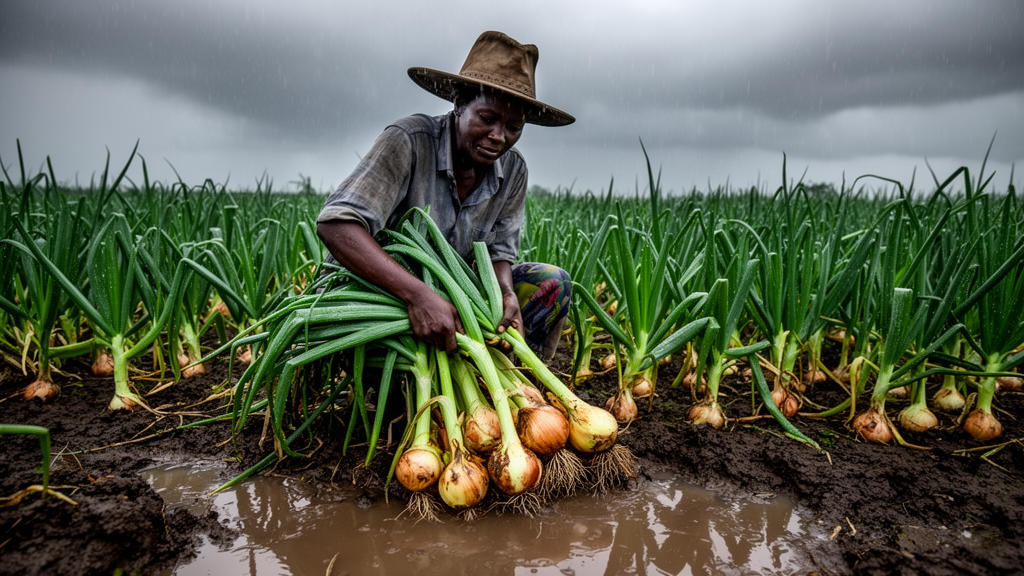
Onion is the second most widely produced and consumed vegetable on Earth, grown in at least 146 countries and yielding roughly 136 million tons annually. Yet in West Africa, where the crop anchors farmer incomes and food security from Nigeria and Niger to Mali, Senegal, Ghana and Burkina Faso, the rainy season has long been a genetic dead zone for onion cultivation. Temperatures routinely exceed 30 degrees Celsius, moisture saturates sandy-clay soils, and wind and rain accelerate the spread of disease, causing severe yield losses. Now a team of researchers from the World Vegetable Center and partner institutions has produced hard evidence that hybrid breeding can crack this problem, identifying F1 onion crosses that outperform their parents by as much as 105 percent under exactly the conditions that normally devastate the crop.
The study, published in Frontiers in Horticulture, was conducted at the World Vegetable Center research station in Samanko-Bamako, Mali, in the Sudan Savanna zone where annual rainfall ranges from 800 to 1,100 millimeters and the rainy season prevails from May to October. The researchers selected five genetically diverse onion genotypes: Prema 178, an East-West commercial variety tolerant to both heat and high moisture; EW001, sourced from the Indian Agricultural Research Institute and also tolerant to both stresses; Violet d’Abeche from Chad; Violet de Galmi, the regional control variety from Niger; and AC980 from the WorldVeg-Mali seed repository. The last three lines are locally adapted with high yields and short production cycles but are susceptible to heat and high moisture, making them valuable recurrent parents for testing hybrid combinations.
Using a half-diallel mating design of five by five excluding reciprocals, the team manually emasculated and pollinated the parental lines during the humid seasons of 2022 and 2023 to produce ten F1 hybrids. The trials were then implemented during the 2023 and 2024 rainy seasons using a randomized complete block design with three replications. Seeds were sown in seedbeds in June of each year, and one-month-old seedlings were transplanted individually into plots measuring one square meter. Prior to transplantation, PROFEBA compost was applied at a rate of five tons per hectare, and 300 kilograms per hectare of inorganic fertilizer was applied at three, six, and nine weeks after transplanting. The field was maintained through hoeing, weeding, and draining beds after rains to ensure adequate drainage.
Twelve morphological, physiological, and agronomic traits were evaluated on individual plants across the two growing seasons. The survival rate was determined by counting dead plants in each plot at 21 days after transplanting. Plant height, neck thickness, and the number of functional leaves per plant were measured on ten randomly selected seedlings per plot tagged at transplanting. Leaf Area Index was recorded 65 days after transplanting during active leaf development using an LAI-2200C Plant Canopy Analyzer, which captures light readings above and below the canopy at multiple angles. Chlorophyll content was measured in fully expanded leaves using a SPAD-502Plus meter. To assess how well leaves handle humidity, samples were collected from ten randomly selected plants after harvesting, and their fresh weight, turgid weight after 24 hours of immersion in distilled water, and dry weight after 24 hours at 80 degrees Celsius were recorded to calculate relative water content. Root volume was determined using the water displacement method based on Archimedes’ principle.
The analysis of variance, performed using AGD-R software version 5.0 following Griffing’s method 2 model 1, revealed substantial genetic variability among the genotypes for most traits. Genotype effects were significant for percent survival rate, plant vigor, plant height, leaf area index, bulb length, numbers of bulbs, bulb yield, chlorophyll content, and relative water content. The partitioning of variance into general combining ability and specific combining ability components demonstrated that both additive and non-additive gene effects were significant for plant survival rate, plant vigor, plant height, numbers of bulbs, and bulb yield. Significant GCA effects alone were found for bulb length and chlorophyll content, while significant SCA effects alone governed leaf area index, number of leaves, and relative water content. Traits like root volume and plant neck diameter showed no significant GCA or SCA effects.
The coefficient of variation indicated that root volume, relative water content, and leaf area index showed large variation between genotypes, signaling substantial room for genetic improvement. These traits are directly linked to nutrient and water absorption and to plant vigor and productivity, making them advantageous indirect selection criteria for stress resistance and resource-use efficiency. Conversely, plant height, plant neck diameter, and bulb length were more stable and less affected by genotype, suggesting tighter genetic control. At the five percent significance level, differences exceeding thresholds of 9.54 and 10.55 for plant survival, 10.38 and 8.56 for numbers of bulbs, and 29.83 and 30.37 for chlorophyll content were statistically significant across the two years.
The best general combiner was Parent P1, Prema 178, which recorded significant positive GCA effects on plant survival rate with values of 5 and 4.98 across the two years, plant height with 2.36 and 2.53, numbers of bulbs with 5.82 and 3.38, and bulb yield with 2.09 and 2.44. High GCA indicates that a parent reliably passes on favorable genes for a specific trait to its offspring, confirming Prema 178 as a key source of additive alleles for rainy-season adaptation. Parent P2, EW001, recorded substantial positive GCA effects exclusively on chlorophyll content with values of 11.95 and 12.46, indicating its role as a physiological parameter increaser rather than a direct yield contributor. Parent P3, Violet d’Abeche, showed significant negative GCA effects on survival rate, plant height, bulb length, numbers of bulbs, and bulb yield, while Parent P4, Violet de Galmi, had a significant negative effect only on the number of leaves per plant.
The specific combining ability analysis revealed that particular parental combinations significantly influenced hybrid performance. The hybrid P1xP5, combining Prema 178 with AC980, recorded significant positive SCA values for plant survival rate with 9.69 and 9.20, numbers of bulbs with 9.17 and 5.22, and bulb yield with 3.82 and 2.67 across the two seasons. The hybrid P4xP5, combining Violet de Galmi with AC980, demonstrated substantial positive SCA effects on plant vigor with 0.57 and 0.71, plant height with 10.39 and 5.74, bulb length with 0.82, numbers of bulbs with 7.69 and 4.55, and relative water content with 37.2 and 34.91. These findings indicate positive epistatic interactions between parental genes, where non-additive gene action produces performance gains beyond what either parent could achieve alone. Conversely, the hybrid P1xP3 showed significant negative SCA effects for survival rate, plant vigor, numbers of bulbs, and bulb yield, indicating genetic incompatibility between those parental lines.
The heterosis analysis corroborated the combining ability findings and revealed a wide range of hybrid vigor among the ten crosses. The hybrid P4xP5 recorded the highest and most desirable heterosis values across most evaluated traits, showing mid-parent heterosis of 94.17 percent for plant survival rate, 118.56 percent for numbers of bulbs, 105.26 percent for bulb yield, and 100.65 percent for relative water content. Better-parent heterosis values were equally impressive at 48.87 percent for survival, 65.18 percent for bulb numbers, and 94.56 percent for bulb yield. The hybrid P3xP5 ranked second for overall heterotic expression, showing very high heterosis for relative water content at 30.27 percent over the mid-parent and 30.26 percent over the better parent, and for root volume at 120.87 percent and 96.43 percent respectively. The hybrid P1xP5 also performed well with mid-parent heterosis of 59.36 percent for plant survival, 54.55 percent for bulb numbers, 43.38 percent for bulb yield, and 48.72 percent for root volume.
These results demonstrate that the hybrids P4xP5, P1xP5, and P3xP5 are strong candidates for multilocation testing in high heat and high moisture prone conditions across West Africa. The simultaneous significance of both GCA and SCA variances for key traits suggests that the optimal breeding strategy would combine hybrid breeding with recurrent selection for line development to fully exploit heterosis. Parent P1, Prema 178, emerges as a superior general combiner and source of additive alleles, while the specific combinations with AC980 unlock non-additive gene action that produces extraordinary yield gains under stress. Additional evaluation of these hybrids under heat and moisture conditions would help assess their stability and support variety recommendations for release, potentially extending the onion growing season for West African farmers with less loss and greater food security.
Subject of Research: Onion hybrid breeding for rainy-season adaptation in West Africa
Article Title: Genetic analysis and heterotic potential of onion (Allium cepa L.) for some physiological and agronomic traits under rainy-season cultivation
Article References: Traore, A. S., Tignegre, J. B. D. L. S., Kiebre, Z., Ayenan, M. A. T., Sawadogo, M., & Schafleitner, R. (2026). Genetic analysis and heterotic potential of onion (Allium cepa L.) for some physiological and agronomic traits under rainy-season cultivation. Frontiers in Horticulture, 5, Article 1844120. https://doi.org/10.3389/fhort.2026.1844120
Image Credits: AI Generated
DOI: 10.3389/fhort.2026.1844120
Keywords: onion breeding, heterosis, combining ability, Allium cepa, rainy season, West Africa, hybrid vigor, Frontiers in Horticulture, Genetic, analysis, heterotic, potential
Cite Scienmag News
Lucy Donovan. (October 17, 2026). Onion Hybrids Show Dramatic Yield Boost Under West Africa’s Harsh Rainy Season. Scienmag. https://scienmag.com/onion-hybrids-show-dramatic-yield-boost-under-west-africas-harsh-rainy-season/
Lucy Donovan. "Onion Hybrids Show Dramatic Yield Boost Under West Africa’s Harsh Rainy Season." Scienmag, 17 October 2026, https://scienmag.com/onion-hybrids-show-dramatic-yield-boost-under-west-africas-harsh-rainy-season/. Accessed 17 October 2026.
Lucy Donovan. "Onion Hybrids Show Dramatic Yield Boost Under West Africa’s Harsh Rainy Season." Scienmag. October 17, 2026. https://scienmag.com/onion-hybrids-show-dramatic-yield-boost-under-west-africas-harsh-rainy-season/


