


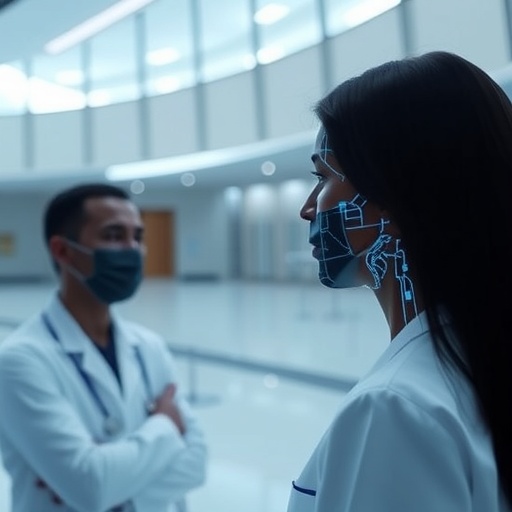
Ambient artificial intelligence is moving from experimental clinic rooms into the infrastructure of major health systems, and Cleveland Clinic is presenting a new model for making that transition happen at enterprise scale. In a report published in npj Health Systems, Merlino, Blue, Boose and colleagues describe how the organization worked with an industry partner to accelerate the deployment of an ambient AI scribe across a large, complex clinical network. The system is designed to listen to clinician–patient conversations, transform speech into structured medical documentation and return a draft note for review, potentially reducing the administrative burden that has become one of the most persistent sources of frustration and burnout in modern medicine. Rather than treating the technology as a small software trial, Cleveland Clinic approached it as a health-system transformation project involving clinical operations, information technology, compliance, patient safety and vendor engineering from the beginning.
Ambient AI scribes differ from conventional dictation tools because they are intended to operate in the background of a clinical encounter. With appropriate consent, the system captures conversation through a mobile device or workstation, separates the interaction into clinically meaningful sections and uses speech-recognition and language-generation models to create documentation. A large language model can infer that a patient’s description of worsening shortness of breath belongs in the history of present illness, while a clinician’s discussion of medication changes may appear in the assessment and plan. The resulting note is not supposed to become an autonomous medical record. It is a generated draft that must be checked, edited and signed by the clinician. That human-in-the-loop design is essential because conversational language is ambiguous, accents and background noise can affect transcription, and a plausible-sounding generated sentence can still be medically incorrect.
The Cleveland Clinic experience highlights why deploying such a system across an enterprise is substantially harder than proving that it can produce an impressive note in a demonstration. A health system includes hospitals, outpatient practices, emergency departments, specialty services and clinicians with very different workflows. Each setting generates distinct documentation requirements, uses different terminology and places different demands on speed and accuracy. The implementation therefore required more than connecting an AI application to an electronic health record. It involved defining how clinicians would launch a session, how patients would be informed, where generated notes would appear, how corrections would be made and what would happen when the system failed. These operational details determine whether an AI tool becomes a useful part of care or another layer of technology that clinicians must manage.
The partnership model described by the authors was built around shared responsibility. The health system contributed clinical expertise, workflow knowledge, governance structures and direct access to the people who would use the technology. The industry partner supplied the ambient recording platform, artificial-intelligence models, product development capacity and technical support. This arrangement allowed the two sides to iterate more quickly than either could have worked alone. Clinicians could identify problems that would not be visible in laboratory testing, such as notes that were technically complete but organized in an unfamiliar way, while engineers could rapidly adjust interfaces, prompts and processing pipelines. The approach also created a channel for continuous feedback after deployment, when unexpected use cases and safety concerns often emerge.
At the technical level, an ambient scribe typically combines several stages of machine processing rather than relying on a single model. Audio is first converted into text through automatic speech recognition, often with speaker diarization to distinguish the patient from the clinician. Natural-language-processing systems then identify medical concepts, temporal relationships and the intent behind statements. A generative model uses that information, together with a requested note format, to draft sections such as symptoms, examination findings, diagnoses and plans. Some platforms apply additional safeguards, including terminology normalization, restricted output templates and checks designed to flag missing or contradictory information. The final note is inserted into the electronic health record through an integration layer, allowing clinicians to review it within familiar documentation workflows. Each stage introduces potential error, which is why technical performance must be evaluated alongside clinical usability and safety.
Privacy and security were central to the deployment challenge. An ambient scribe processes highly sensitive conversations that may include diagnoses, medications, family history and personal information unrelated to the immediate complaint. A responsible implementation must establish when recording begins and ends, how consent is obtained, where audio and transcripts are stored, who can access them and how long they are retained. It must also clarify whether recordings are used for product improvement and under what contractual and regulatory conditions data may be processed. These questions become more complicated when the technology is used across thousands of encounters and by multiple specialties. Cleveland Clinic’s approach placed governance and risk review alongside product development, rather than treating compliance as a final approval step after the system had already been built.
The researchers also emphasize that adoption depends on human behavior as much as algorithmic performance. Clinicians need to understand what the system can and cannot do, how to correct an inaccurate note and how to speak naturally while an AI tool is listening. Patients may have concerns about being recorded or may worry that the clinician is paying more attention to a device than to the conversation. Clear explanations and visible consent processes can help preserve trust. Training, peer support and local clinical champions can make the difference between reluctant experimentation and routine use. The implementation model gave clinicians opportunities to test the tool, report problems and influence improvements, helping convert the technology from an external product into a shared component of clinical practice.
The potential benefit is not simply faster note production. By reducing the need to type or compose documentation during and immediately after a visit, ambient AI could allow clinicians to spend more attention looking at patients, asking follow-up questions and explaining decisions. It may also help reduce the “pajama time” many clinicians spend completing records after their scheduled workday. However, the authors frame these benefits as outcomes that must be measured rather than assumed. Useful evaluation includes documentation time, note completion rates, clinician workload, patient experience, adoption across specialties and the frequency of corrections. Safety monitoring is equally important: organizations must look for omitted information, hallucinated findings, incorrect attribution of statements and systematic performance differences related to language, accent or clinical context.
Cleveland Clinic’s experience offers a broader lesson for health systems racing to adopt generative AI. Enterprise deployment is not achieved by purchasing a model and switching it on; it requires a durable partnership in which clinical, technical and governance teams jointly redesign the path from conversation to medical record. Ambient scribes may become one of the first widely visible applications of generative AI in everyday healthcare because they address a clear and costly pain point, but their success will depend on disciplined implementation. The report suggests that the fastest route is not to bypass scrutiny, but to build evaluation, transparency and clinician control into the deployment itself. If that model holds, the quietest participant in a patient visit—the AI listening in the background—could become a powerful tool for changing how medical work is documented without removing the human judgment on which care depends.
Cite Scienmag News
Denise Maddox. (August 13, 2026). Cleveland Clinic Unveils Novel Partnership Model to Scale Ambient AI Medical Scribes. Scienmag. https://scienmag.com/cleveland-clinic-unveils-novel-partnership-model-to-scale-ambient-ai-medical-scribes/
Denise Maddox. "Cleveland Clinic Unveils Novel Partnership Model to Scale Ambient AI Medical Scribes." Scienmag, 13 August 2026, https://scienmag.com/cleveland-clinic-unveils-novel-partnership-model-to-scale-ambient-ai-medical-scribes/. Accessed 3 September 2026.
Denise Maddox. "Cleveland Clinic Unveils Novel Partnership Model to Scale Ambient AI Medical Scribes." Scienmag. August 13, 2026. https://scienmag.com/cleveland-clinic-unveils-novel-partnership-model-to-scale-ambient-ai-medical-scribes/


