


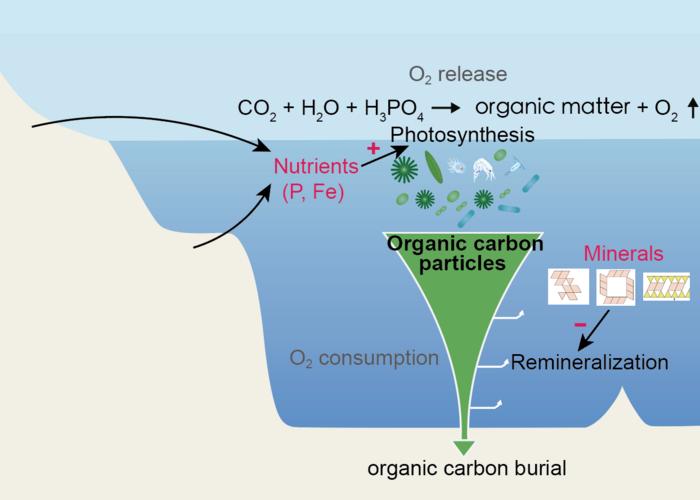
According to a new study published in Science Advances, scientists have used new lithium isotope (δ7Li) data to show that continental clay export promoted organic carbon burial and thus atmospheric oxygenation during the Cambrian period.

Credit: IGGCAS
According to a new study published in Science Advances, scientists have used new lithium isotope (δ7Li) data to show that continental clay export promoted organic carbon burial and thus atmospheric oxygenation during the Cambrian period.
Animals depend on oxygen for respiration. Thus, the emergence and proliferation of early animals from the late Neoproterozoic to the early Paleozoic era (~600–500 million years ago or mya) has traditionally been attributed to a significant increase in marine oxygen levels. However, geochemical tracers and numerical models suggest that both atmospheric and marine oxygen levels during the Late Neoproterozoic–Early Paleozoic were significantly lower than today, with highly variable marine redox states.
During this period, marine oxygenation occurred under conditions of low atmospheric oxygen, attributed to an enhanced marine biological pump. However, the role of other factors, such as the mineral carbon pump promotion of organic matter burial by mineral protection, has not been thoroughly explored for this epoch.
To address this gap, Prof. WEI Guangyi of Nanjing University and Prof. ZHAO Mingyu of the Institute of Geology and Geophysics of the Chinese Academy of Sciences (IGGCAS), together with their collaborators, developed δ7Li in marine siliciclastic sediments, such as mudstones, to track the proportions of continentally derived clays preserved in continental shelf sediments.
During chemical weathering, isotopically light lithium is preferentially taken up by secondary silicate minerals (i.e., clays), resulting in more negative δ7Li values in highly weathered products. In contrast, primary silicate minerals and weakly weathered products (e.g., feldspar and mica) exhibit higher δ7Li signatures similar to those of the average upper continental crust.
In addition, marine authigenic clays formed by marine reverse weathering generally exhibit higher δ7Li values due to seawater-derived lithium. Therefore, the δ7Li values of marine mudstones serve as potentially reliable indicators of the proportions of different types of silicate minerals preserved in ancient continental shelf sediments.
The researchers collected about 600 mudstone samples spanning the late Neoproterozoic to mid-Cambrian (~660–500 mya) and analyzed their lithium isotope compositions alongside potassium relative to aluminum (K/Al) ratios to track changes in continental silicate weathering and clay mineral composition during this interval. Significant decreases in δ7Li and K/Al ratios of marine mudstones after the Early Cambrian (~525 mya) indicate increased continental silicate weathering and clay mineral preservation in marine sediments.
Furthermore, the new mudstone δ7Li database was compared with phosphorus (P), total organic carbon (TOC), and uranium (U) contents in marine siliciclastic sediments from the Sedimentary Geochemistry and Paleoenvironments Project compilations. Synchronous occurrences of decreased δ7Li and increased P, TOC, and U in marine sediments provide compelling evidence for correlations between continental clay formation, marine P reservoirs, organic carbon burial flux, and marine oxygenation levels.
Results from a global biogeochemical model suggest that increased continental clay influx into marine sediments have drove increased atmospheric and deep marine oxygen levels, particularly under initial conditions of low atmospheric oxygen.
Journal
Science Advances
Method of Research
Meta-analysis
Subject of Research
Not applicable
Article Title
Lithium isotopic constraints on the evolution of continental clay mineral factory and marine oxygenation in the earliest Paleozoic Era
Article Publication Date
29-Mar-2024
Cite Scienmag News
Russell Cooper. (April 12, 2024). Clay-assisted organic carbon burial induced early Paleozoic atmospheric oxygenation. Scienmag. https://scienmag.com/clay-assisted-organic-carbon-burial-induced-early-paleozoic-atmospheric-oxygenation/
Russell Cooper. "Clay-assisted organic carbon burial induced early Paleozoic atmospheric oxygenation." Scienmag, 12 April 2024, https://scienmag.com/clay-assisted-organic-carbon-burial-induced-early-paleozoic-atmospheric-oxygenation/. Accessed 3 September 2026.
Russell Cooper. "Clay-assisted organic carbon burial induced early Paleozoic atmospheric oxygenation." Scienmag. April 12, 2024. https://scienmag.com/clay-assisted-organic-carbon-burial-induced-early-paleozoic-atmospheric-oxygenation/

