


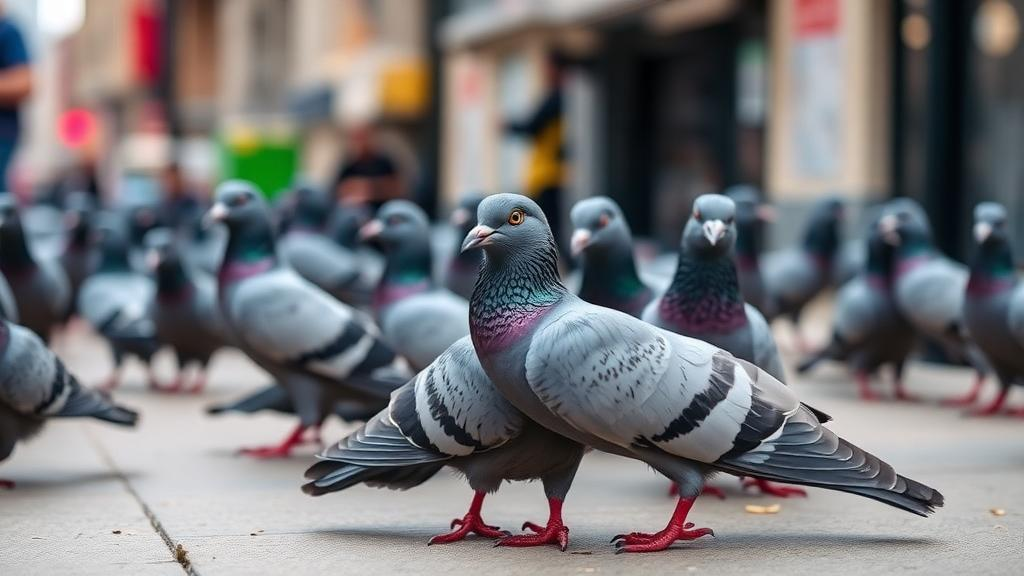
The feral pigeon is one of the most familiar animals on Earth, a bird that thrives in the concrete heart of nearly every major city. Yet despite its ubiquity, surprisingly little has been known about the trillions of microbes living in its gut and how the urban environment shapes them. A new study published in the journal Microbial Ecology now offers one of the most detailed portraits to date of the pigeon gut microbiome, and its findings challenge a long-standing assumption about what happens to microbial diversity when animals crowd together in cities.
A team of researchers led by Maciej Kamiński and Piotr Minias of the University of Lodz in Poland set out to answer a deceptively simple question: does living at high density in heavily urbanized habitats change the diversity and composition of a bird’s gut bacteria? The feral pigeon, Columba livia domestica, was an ideal candidate. These birds form some of the densest aggregations of any urban wildlife species, sometimes numbering hundreds of individuals at a single site. According to classic ecological theory, such crowding should promote horizontal transmission of microbes between individuals, which in turn should boost the diversity of the gut microbiome. If density matters anywhere, it should matter in pigeons.
To test this idea, the researchers collected faecal samples from 200 individual pigeons across study plots situated within five large Polish cities. Crucially, the plots varied along two independent axes: the degree of habitat urbanization, measured by the character of the surrounding built environment, and the local density of the pigeon population itself. This two-dimensional design allowed the team to disentangle the effects of the physical environment from the effects of social crowding, a distinction that many previous urban microbiome studies had failed to make.
The laboratory work relied on high-throughput sequencing of the 16S rRNA gene, the standard molecular tool for cataloguing bacterial communities without needing to culture them. The results were striking in their sheer scale. Across all samples, the team detected nearly 35,000 Amplicon Sequence Variants, or ASVs, which are the finest-resolution units in modern microbiome science, roughly equivalent to individual bacterial strains. These variants belonged to 561 bacterial families and could be grouped into 75 distinct functional categories, reflecting the metabolic roles the bacteria perform. For a bird often dismissed as a city pest, the feral pigeon carries a remarkably rich internal ecosystem.
The first major finding concerned urbanization. The researchers detected a clear negative relationship between habitat urbanization and taxonomic richness of the gut microbiome: the more urbanized the surroundings, the fewer bacterial types the pigeons carried. The authors suggest a likely mechanism rooted in habitat heterogeneity. Highly urbanized areas tend to be simplified environments, with uniform food sources, limited green space, and fewer ecological niches. Pigeons foraging in such settings encounter a narrower range of environmental microbes and dietary substrates, and their gut communities reflect that impoverishment. In contrast, pigeons living in less urbanized plots, with more varied habitats and food webs, harboured more diverse bacterial assemblages.
The second major finding concerned function rather than identity. When the researchers classified the bacteria by what they do rather than by what they are called, a consistent pattern emerged along the urbanization gradient. Bacteria known as commensals of the human and mammalian gut became more abundant in pigeons from highly urbanized plots, as did bacteria classified as human pathogens and nitrate-reducers, a functional group involved in processing nitrogen compounds. This shift is consistent with a phenomenon that microbiologists have dubbed the humanization of the gut microbiome in urban wildlife. In essence, pigeons living closest to people increasingly carry the microbial signature of people themselves, likely acquired through shared environments, contaminated food and water, and the general microbial fallout of dense human settlement.
The presence of human-associated pathogens in urban pigeon guts is the aspect of the study most likely to capture public attention, though the researchers frame it carefully. The findings do not establish that pigeons are significant disease vectors; they show instead that the boundary between human and animal microbial worlds becomes more permeable in cities. Urban wildlife shares our sidewalks, our refuse, and our wastewater, and the microbial consequences of that intimacy are now measurable at scale. For public health and urban planning, this makes pigeons a useful sentinel species, a living indicator of how human activity reshapes microbial circulation in the environment.
Perhaps the most surprising result, however, was what the study did not find. Despite the theoretical expectation that high population density should fuel microbial exchange and elevate microbiome diversity, the researchers detected no association between pigeon density and either taxonomic or functional microbiome diversity. Crowding, at least in this species and at the densities studied, did not translate into richer gut communities. This null result matters because it forces a rethinking of how sociality and transmission shape microbiomes. It may be that horizontal transmission saturates at relatively low densities, or that host physiological regulation, diet, and environmental filtering override the effects of contact rates. Whatever the explanation, the study suggests that density alone is a poor predictor of gut microbial diversity in urban birds.
Diversity, however, is only one dimension of the story. When the researchers examined the overall composition of the microbiome, which species and functions are present and in what proportions, they found evidence of significant turnover among study plots characterized by different urbanization levels and population densities. In other words, pigeon communities in different parts of the city carry measurably different gut ecosystems, even when their overall diversity levels are similar. This turnover implies that local environmental conditions leave a detectable fingerprint on the gut microbiome, and that composition may be a more sensitive indicator of urbanization than richness alone.
The study is among the first to address the links between population density and gut microbiome diversity in an urban context, and its implications extend well beyond pigeons. As cities expand and wildlife increasingly shares urban space with humans, understanding how the built environment modulates the microbial communities of animals becomes a question with consequences for conservation, animal welfare, and even human health. The authors point to potential fitness consequences of these microbiome modulations: gut bacteria influence digestion, immune function, and disease resistance, so shifts in community composition along urban gradients could ultimately affect the survival and reproduction of urban wildlife. For an urban exploiter like the feral pigeon, which has already solved the problem of thriving alongside humans, the gut microbiome appears to be both a record of that coexistence and, possibly, a factor in its continued success. What the pigeons carry inside them, it turns out, tells the story of the city outside.
Subject of Research: Effects of urbanization and population density on the gut microbiome diversity of feral pigeons
Article Title: Linking Taxonomic and Functional Microbiome Diversity with Population Density and Habitat Urbanization in an Urban Exploiter Bird
Article References: Kamiński, M., Jeziorski, S., Skóra, M., Strapagiel, D., & Minias, P. (2026). Linking Taxonomic and Functional Microbiome Diversity with Population Density and Habitat Urbanization in an Urban Exploiter Bird. Microbial Ecology. https://doi.org/10.1007/s00248-026-02870-8
Image Credits: AI Generated
DOI: 10.1007/s00248-026-02870-8
Keywords: gut microbiome, feral pigeon, urbanization, 16S rRNA sequencing, microbial diversity, urban wildlife, population density, humanization, Microbial Ecology, ASVs, bacterial pathogens, urban ecology
Cite Scienmag News
Morgan Morrow. (October 1, 2026). City Life Reshapes the Gut Microbes of Urban Pigeons, Large-Scale Study Finds. Scienmag. https://scienmag.com/city-life-reshapes-the-gut-microbes-of-urban-pigeons-large-scale-study-finds/
Morgan Morrow. "City Life Reshapes the Gut Microbes of Urban Pigeons, Large-Scale Study Finds." Scienmag, 1 October 2026, https://scienmag.com/city-life-reshapes-the-gut-microbes-of-urban-pigeons-large-scale-study-finds/. Accessed 4 October 2026.
Morgan Morrow. "City Life Reshapes the Gut Microbes of Urban Pigeons, Large-Scale Study Finds." Scienmag. October 1, 2026. https://scienmag.com/city-life-reshapes-the-gut-microbes-of-urban-pigeons-large-scale-study-finds/


