


In the rolling uplands of the Bohemian-Moravian Highlands, where the great drainage basins of the North Sea and the Black Sea nearly touch, one of Europe’s most quietly charismatic freshwater fishes is staging a comeback. The crucian carp (Carassius carassius), a golden-bronzed native of small ponds, oxbows and flooded quarries, has collapsed across much of its range in recent decades, vanishing from water bodies it once shared with newts, water beetles and sunbleak. In Czechia the species is now officially critically endangered, yet it has never appeared in European Union conservation legislation, largely because its decline unfolded below the radar of commercial fisheries and popular attention. A new Regional Action Plan developed for the Vysočina Region, published in the journal Nature Conservation, describes a comprehensive framework for pulling the species back from the brink, combining citizen science, mitochondrial genetics, hydrological logic and hands-on fish translocation.
The threats facing crucian carp are deceptively simple and stubbornly persistent. Freshwater ecosystems are experiencing the greatest biodiversity loss of all ecosystems on Earth, driven by river regulation, canalisation, agricultural land use, pollution, overexploitation and invasive species. Historic modifications of European rivers destroyed the oxbows and floodplain pools that stagnophilic fishes such as the crucian carp, European weatherfish and mudminnow depend on. At the same time, the invasion of the gibel carp (Carassius gibelio), a polyploid member of the same genus and arguably the most successful invasive fish in Europe, has placed crucian carp under intense competition for food and space. The topmouth gudgeon (Pseudorasbora parva) compounds the pressure by squeezing the feeding niche further and potentially reducing reproductive success. Hybridisation with invasive Carassius species was long suspected as an additional threat, although recent evidence suggests its overall impact may be limited.
What makes conservation of the crucian carp genuinely complicated is its hidden genetic architecture. Across Europe the species exists in two highly divergent phylogenetic lineages separated by roughly 2.16 million years of evolution. The northern lineage occupies northern, central and part of eastern Europe, including the Elbe and Oder river basins, while the Danubian lineage is associated with the Danube catchment. Czechia straddles the divide: rivers in the western and northern part of the country flow to the Elbe and Odra, while the southeast drains into the Danube. The two lineages therefore occur naturally in close proximity in certain border zones of the country, particularly where the Danube-Elbe and Danube-Oder watersheds meet. Intensive aquaculture and transfers by recreational anglers have, however, mixed the lineages in some places and moved them into watersheds where they do not belong, which means effective conservation requires treating each lineage as a distinct conservation unit.
The Regional Action Plan was designed for the Vysočina Region, a 7,790 square kilometre upland area administered by the Vysočina Regional Authority together with the Žďárské vrchy and Železné hory Protected Landscape Areas. The plan sets out four goals: secure existing populations through protection and re-population of suitable small water bodies; maintain both naturally occurring phylogenetic lineages; keep populations free of invasive fish by working with fully drainable ponds; and use crucian carp as an umbrella species whose protected habitats also benefit other endangered fauna such as sunbleak and newts. The first step was to find the fish. A citizen-science project called Save the Crucian Carp, launched in August 2021, invited volunteers to register on a web portal, complete a short questionnaire and submit tips about crucian carp sightings, describing the habitat type, the fish community and the apparent status of each population. Tips were marked on Google Maps, automatically populating the database with GPS coordinates.
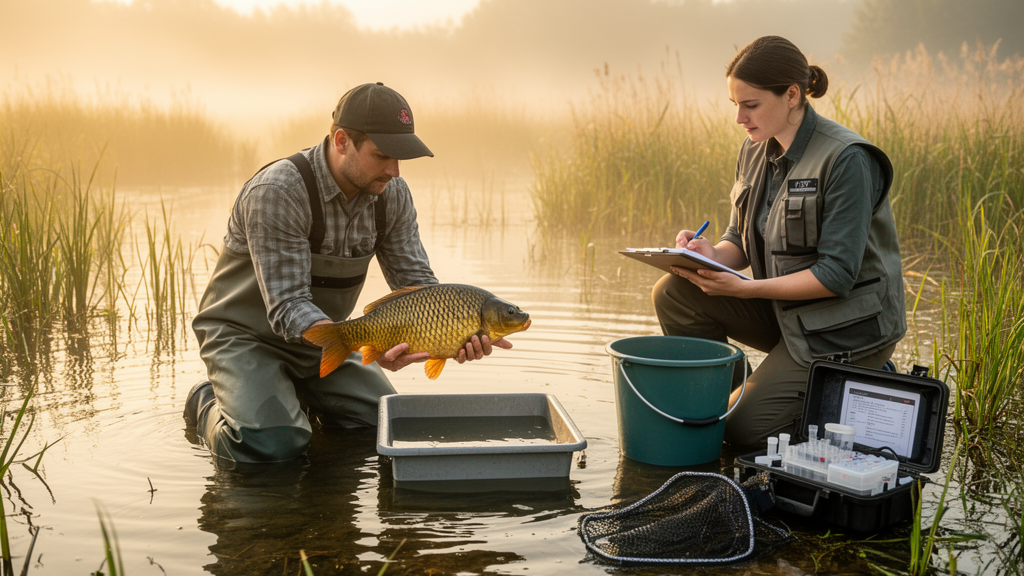
Between 2021 and 2024 the research team sampled 66 sites across the region, verifying citizen tips according to habitat characteristics, administrative status and landowner permission. Standardised sampling relied on five umbrella nets deployed overnight in the littoral zone and baited with dog food pellets and bread slices, a combination shown by earlier research to maximise capture success. Part of each trap was kept above the surface so that newts and amphibians could breathe. Captured fish were identified morphologically, measured for standard length and weight, and a small piece of pelvic fin tissue was preserved in 98 percent ethanol at minus 20 degrees Celsius. In the laboratory, DNA was extracted with a silica-based kit, the mitochondrial cytochrome b gene was amplified with specific primers and sequenced, and sequences were aligned with reference data from GenBank, including northern and Danubian crucian carp and the common carp as an outgroup, to infer phylogenetic relationships by Maximum Likelihood analysis.
The survey results were sobering but hopeful. Crucian carp were confirmed at 21 of the 66 sites, and 171 genetic samples were collected. At half of the occupied sites only native species were recorded, while the remainder also harboured invaders such as gibel carp and topmouth gudgeon. Five sites dominated by invasive species were excluded from genetic testing altogether. Genetic analysis ultimately confirmed eleven surviving populations suitable for conservation use, and critically, none of these contained visible hybrids with a maternal lineage from non-native Carassius species. Of the characterised populations, five belonged to the northern lineage, eight to the Danubian lineage and three were mixtures of the two. Roughly 38 percent of the populations found in the region were either mixed or so reduced by invasion that they could not serve as conservation units or stocking sources.
Armed with lineage assignments, the team initiated repatriations, moving genetically verified fish from source populations into newly established sites within their respective watersheds and as close as possible to the original locations. At least 100 individuals were used to found each new population, or 50 with additional fish to follow, in order to preserve genetic diversity. Three northern and four Danubian populations were successfully repatriated. Northern-lineage fish from the Jednička and Dvojka quarries were stocked into Polský pond, Dubinka and U buku, while Danubian-lineage fish from Olšoveček-Sklepy and the pond U Komárovic went to Jihlava Zoo, Olšoveček, Skokan and Augustov ponds. Verification sampling the following year confirmed natural recruitment, defined as catches of more than 50 individuals including juveniles under 50 millimetres, at Augustov, Dubinka, Olšoveček, Polský and Skokan. Repopulation failed at Jihlava Zoo and U buku, likely due to wastewater spillover and a flash flood respectively.
Choosing safe receptor sites was as important as choosing the right fish. Selected ponds were deliberately built as the first water body on their stream, a configuration that prevents invasive fish from drifting downstream when upstream ponds are drained. Ponds also had to be fully drainable so they could be completely harvested and left dry for a month, a management practice that periodically clears habitats of invasive fish. The plan acknowledges remaining risks: gibel carp eggs can survive, with low success, in the digestive tracts of waterfowl, and unauthorised releases by humans remain a pathway that informational signage can help mitigate. Notably, the mixing of lineages found in some populations may not be purely anthropogenic. Headwater streams between the Sázava and Jihlava rivers have historically shifted their drainage between the two basins, so some genetic mixtures may reflect natural biogeographical processes rather than careless stocking, and the authors argue such mixtures deserve conservation consideration in their own right.
The wider significance of the Vysočina plan extends well beyond a single species. Crucian carp ponds tend to support higher invertebrate and amphibian diversity than ponds invaded by gibel carp, with more newt populations and greater densities of Dytiscus water beetles, making the fish a genuine umbrella species for small, non-productive wetlands. Sunbleak have already been introduced to five ponds within the plan, thriving in four. The species’ legendary resilience to harsh and fluctuating conditions, a key advantage over more specialised fish such as the Devil’s Hole pupfish, makes translocation a practical conservation tool, and growing scientific momentum from Hungary, Croatia, Slovakia and Czechia suggests crucian carp is finally receiving the attention it deserves. The authors caution that success depends on converting scientific evidence into practice, informing anglers and citizens who breed the fish about priority populations, and convincing state enterprises and private landowners to provide new sites. If those conditions are met, the golden ghost of the highland ponds may swim again across both the Elbe and Danube watersheds, each lineage in its rightful place.
Subject of Research: Conservation of critically endangered crucian carp through a lineage-based Regional Action Plan in Czechia
Article Title: Establishment of Regional Action Plan for conservation of critically endangered crucian carp in Czechia
Article References: Establishment of Regional Action Plan for conservation of critically endangered crucian carp in Czechia. (n.d.). https://doi.org/10.3897/natureconservation.65.186764
Image Credits: AI Generated
DOI: 10.3897/natureconservation.65.186764
Keywords: crucian carp, Carassius carassius, gibel carp, invasive species, conservation genetics, citizen science, Czechia, Vysočina, phylogenetic lineages, repatriation, wetland conservation, Regional Action Plan
Cite Scienmag News
Juliet Wilcox. (October 15, 2026). Citizen Sleuths and Genetics Rescue Czechia’s Critically Endangered Crucian Carp. Scienmag. https://scienmag.com/citizen-sleuths-and-genetics-rescue-czechias-critically-endangered-crucian-carp/
Juliet Wilcox. "Citizen Sleuths and Genetics Rescue Czechia’s Critically Endangered Crucian Carp." Scienmag, 15 October 2026, https://scienmag.com/citizen-sleuths-and-genetics-rescue-czechias-critically-endangered-crucian-carp/. Accessed 15 October 2026.
Juliet Wilcox. "Citizen Sleuths and Genetics Rescue Czechia’s Critically Endangered Crucian Carp." Scienmag. October 15, 2026. https://scienmag.com/citizen-sleuths-and-genetics-rescue-czechias-critically-endangered-crucian-carp/


