


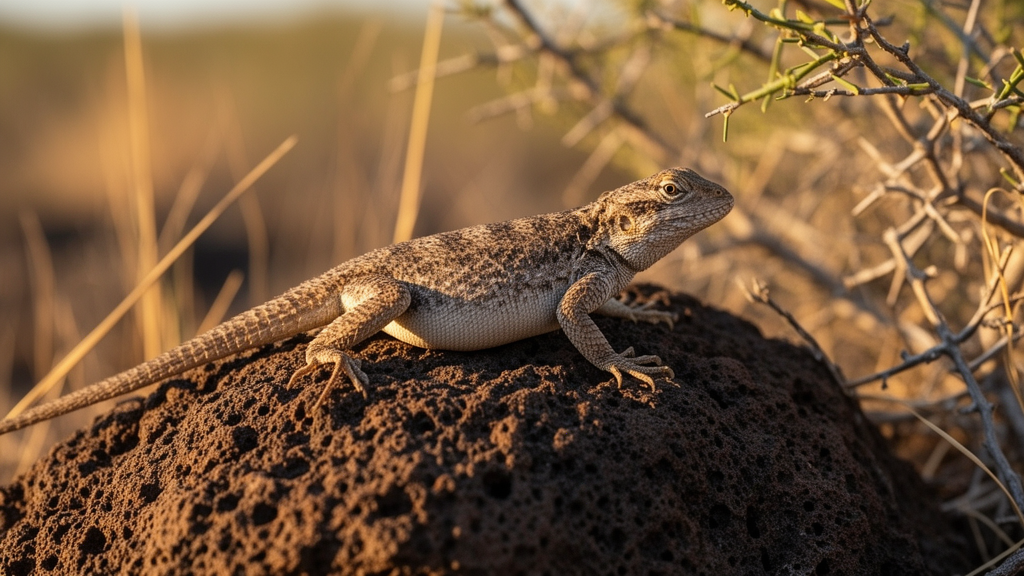
In the high grasslands of central Mexico, a small spiny lizard is quietly rewriting what scientists thought they knew about the price of motherhood. The Mesquite Lizard, Sceloporus grammicus, is a viviparous reptile that carries its embryos for more than six months before giving birth in the spring, one of the longest gestation periods among lizards of its kind. A new field study conducted at 2,605 meters above sea level near Toluca, in the Estado de México, has now tracked females through the final stretch of pregnancy and into the weeks after birth, measuring how their bodies and thermal habits shift between these two contrasting life stages. The findings, published in the journal Herpetozoa, reveal that pregnancy leaves a measurable imprint not only on a female’s mass but also on the way she interacts with the thermal landscape around her.
The research team captured pregnant females in late March, when embryos were near full development, and returned in early May to capture females in the postpartum period. In total, 28 females were sampled during pregnancy and 23 during the postpartum stage, with 32 percent of the postpartum females being recaptured individuals already marked during the first sampling event. This capture-mark-recapture design is what sets the study apart from most earlier work: rather than comparing entirely different groups of females, the researchers could partially follow the same individuals across reproductive states, allowing intra-individual comparisons that reduce the noise created by variation among animals. Each lizard was marked with a unique combination of cauterized scales on the lower jaw, a permanent identification method that enabled reliable recognition months later.
For every captured female, the team recorded body mass with a precision scale, snout-vent length as a measure of body size, and three separate temperatures: the lizard’s own body temperature, taken by inserting a fine probe five millimeters into the cloaca within thirty seconds of capture; the temperature of the substrate where the animal was first seen; and the shaded air temperature immediately above the same spot. Only active females, those outside their shelters basking, feeding, or perching, were included in the thermal analysis, and any individual whose body temperature could not be recorded within the thirty-second window was excluded to avoid contamination by the warmth of the researcher’s hands. Reproductive condition was determined by gentle abdominal palpation, a standard non-invasive technique in lizard studies.
The results on body mass were clear-cut. After statistically controlling for body size, pregnant females were on average 3.60 grams heavier than postpartum females, a significant difference confirmed by a linear mixed model that also incorporated individual identity as a random effect to account for repeated measures. The model including snout-vent length fit the data far better than one without it, and the mass advantage of pregnant females held across the entire size range of the sampled animals. This extra weight is largely the embryonic load itself: previous work on viviparous sceloporine lizards has shown that each embryo can increase its mass by up to 268 percent over the course of gestation, meaning a female carrying several near-term offspring is hauling a substantial biological cargo.
Crucially, the researchers ruled out the possibility that this mass change was simply a seasonal phenomenon. To do so, they measured adult males at the same locality in March and May of the following year, using identical protocols. Male body mass did not differ significantly between the two months, suggesting that the decline observed in females after birth was tied to their reproductive condition rather than to population-wide seasonal fluctuations in food availability or climate. This seasonal reference group strengthens the causal interpretation of the female data, a level of control that few field studies of lizard reproduction have achieved.
The thermal results were, if anything, more surprising. Despite carrying a heavy load of heat-generating, metabolically active embryos, pregnant females maintained body temperatures averaging 30.0 degrees Celsius, which was actually 2.6 degrees lower than the 32.6 degrees Celsius recorded in postpartum females. When air and substrate temperatures were included as covariates in a general linear model, the difference between reproductive stages remained statistically significant. In other words, the extra mass of pregnancy did not translate into extra warmth; instead, pregnant females ran cooler than their recently delivered counterparts, pointing to a deliberate shift in thermoregulatory behavior rather than a passive consequence of body mass.
Even more intriguing was the way each group related to its environment. Postpartum females showed a stronger dependence on substrate temperature, indicating a mainly thigmothermic strategy in which the animal gains heat through direct contact with warm surfaces. Pregnant females, by contrast, displayed a stronger relationship with air temperature, suggesting a shift in the thermal microenvironments they occupy. This pattern differs from what was reported in an earlier study of a Mexico City population, where pregnant females showed a tendency toward thigmothermy, highlighting how habitat structure, climate, and perhaps predation pressure can shape divergent strategies among populations of the same species. The authors caution that such discrepancies may reflect local conditions rather than universal rules of gestation.
Why would a pregnant lizard deliberately cool down? One leading hypothesis concerns offspring quality. Experiments in related viviparous species have shown that higher gestation temperatures produce lighter and smaller newborns, so females may thermoregulate at lower temperatures to avoid compromising the development of their young. An alternative explanation is behavioral constraint: the added mass of pregnancy reduces locomotor performance and increases vulnerability to predators, which may limit a female’s ability to reach her preferred temperature or to occupy exposed basking sites. Preliminary data from the study population found no significant difference in tail-loss rates between pregnant and postpartum females, hinting that predation pressure did not differ strongly between stages, but the timing of tail loss is difficult to determine and the question remains open.
The body temperatures recorded in this population also fit into a broader elevational picture. The 30.0 degrees Celsius mean for pregnant females at 2,605 meters closely matches the 30.42 degrees Celsius reported for a population near Mexico City at roughly 2,240 meters, yet both are lower than the 31.9 degrees Celsius observed in a population at 3,400 meters in the same state. Comparisons with other species reinforce the pattern: pregnant female Sceloporus jarrovi in related studies maintained body temperatures around 32 degrees Celsius. Together, these comparisons suggest that thermal ecology in S. grammicus varies along elevational gradients, and that any assessment of the energetic costs of reproduction must account for both inter- and intrapopulation variation rather than assuming a single strategy for the species as a whole.
The study’s authors note that in other lizard species, such as the collared lizard Crotaphytus collaris and the striped plateau lizard Sceloporus virgatus, pregnant females employ behavioral mechanisms that compensate for the locomotor burden of gestation, and they propose that female Mesquite Lizards in Toluca may do the same, perhaps by spending more time thermoregulating or adjusting their foraging schedules during the final weeks of pregnancy. Future experiments, they suggest, should place pregnant and postpartum females in controlled thermal gradients in the laboratory to separate behavioral choice from environmental constraint, and to test directly whether the cooler temperatures chosen by pregnant mothers translate into measurable differences in the size, mass, and fitness of their offspring. For now, the message from the mountains of central Mexico is that pregnancy in these lizards is a genuine physiological balancing act, one in which mothers adjust both their mass and their thermal behavior to navigate the competing demands of producing healthy young and staying alive themselves.
Subject of Research: Effects of reproductive condition on body mass and thermal ecology in female Mesquite Lizards
Article Title: Effects of reproductive condition on body mass and thermal ecology in the female Mesquite Lizard, Sceloporus grammicus , in a population from central Mexico
Article References: Colin-Medina, K. N., Oviedo-Hernández, E., Suárez-Varón, G., Granados-González, G., & Hernández-Gallegos, O. (2026). Effects of reproductive condition on body mass and thermal ecology in the female Mesquite Lizard, Sceloporus grammicus, in a population from central Mexico. Herpetozoa, 39, 373-379. https://doi.org/10.3897/herpetozoa.39.e190456
Image Credits: AI Generated
DOI: 10.3897/herpetozoa.39.e190456
Keywords: Sceloporus grammicus, Mesquite Lizard, viviparity, thermoregulation, body mass, reproductive condition, lizards, ecophysiology, central Mexico, gestation, body temperature, capture-mark-recapture
Cite Scienmag News
Harold Sullivan. (October 15, 2026). Pregnant Lizards Run Cooler: Body Mass and Thermal Trade-offs in Mexico’s Mesquite Lizard. Scienmag. https://scienmag.com/pregnant-lizards-run-cooler-body-mass-and-thermal-trade-offs-in-mexicos-mesquite-lizard/
Harold Sullivan. "Pregnant Lizards Run Cooler: Body Mass and Thermal Trade-offs in Mexico’s Mesquite Lizard." Scienmag, 15 October 2026, https://scienmag.com/pregnant-lizards-run-cooler-body-mass-and-thermal-trade-offs-in-mexicos-mesquite-lizard/. Accessed 15 October 2026.
Harold Sullivan. "Pregnant Lizards Run Cooler: Body Mass and Thermal Trade-offs in Mexico’s Mesquite Lizard." Scienmag. October 15, 2026. https://scienmag.com/pregnant-lizards-run-cooler-body-mass-and-thermal-trade-offs-in-mexicos-mesquite-lizard/


