


A gerontologist at George Mason University has received a $75,000 grant to bring a family-driven, network-centered model of dementia care to the United States for the first time. Li-Mei Chen, of the Department of Social Work in the university’s College of Public Health, was awarded the funding by Virginia Commonwealth University’s Virginia Center on Aging for a project titled Circles of Care: Adapting the Family and Group Conferencing Model to care families of persons living with dementia. The award marks the beginning of what researchers hope will be a significant shift in how American families organize and sustain the care of relatives living with Alzheimer’s disease and related dementias.
The project, which began in July 2026 and will run through late June 2027, will introduce and evaluate Circles of Care, described as the first U.S. adaptation of the Family Group Conferencing model for dementia care. Family Group Conferencing is a structured decision-making approach that originated in child welfare and family services, in which a trained coordinator convenes the members of a person’s family and wider social network to plan together for that person’s wellbeing. Chen’s study will test whether the same principles can be applied to the distinct challenges posed by progressive cognitive decline, when care decisions multiply over years and the emotional and logistical burdens on families intensify.
Although approaches of this kind have shown promise in other countries, including the Netherlands and the United Kingdom, this will be the first study to evaluate how a social network-centered approach can strengthen dementia care in the United States. That gap matters, researchers argue, because dementia care in America has traditionally been organized around the individual caregiver, most often a spouse or adult child, rather than around the family system and community that surrounds the person living with the disease. The result, in many households, is a single overwhelmed caregiver carrying responsibilities that could be distributed more sustainably across a wider circle of relatives, friends and neighbors.
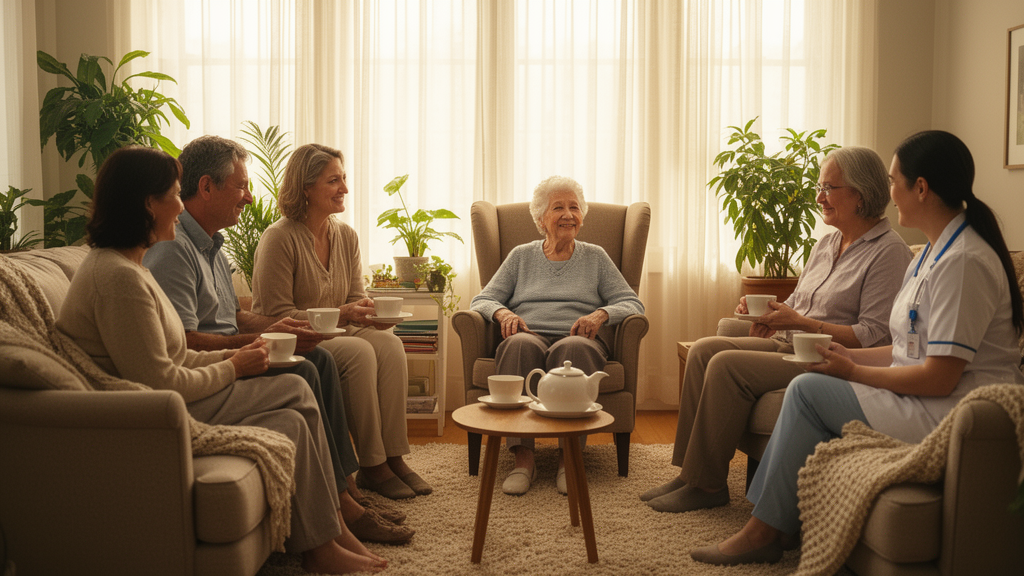
Guided by a trained coordinator, Circles of Care brings together family members and trusted members of a person’s social network to develop a shared care plan, strengthen supportive relationships and coordinate caregiving responsibilities. The coordinator’s role is central to the model. Rather than prescribing solutions, the facilitator prepares participants for the meeting, ensures that the voice and preferences of the person living with dementia remain at the center of the conversation, and helps the group translate its discussion into concrete, actionable arrangements, from transportation and respite schedules to decisions about medical appointments and future planning.
The technical logic of the model rests on a growing body of social science indicating that caregiving outcomes depend not only on the amount of help available but on how that help is organized. When responsibilities are negotiated explicitly among network members, rather than assumed by default by one person, caregivers report lower strain and families report better communication. Structured conferencing formalizes that negotiation, creating a documented plan and a recurring forum in which it can be revised as the disease progresses. For dementia, a condition that can span a decade or more, that built-in adaptability is a crucial design feature.
The project will evaluate whether Circles of Care is feasible and acceptable for diverse families, a question of particular importance in a country as demographically varied as the United States. Cultural norms shape who is expected to provide care, how decisions are made within families, and how comfortable relatives are discussing difficult topics such as driving, finances and residential transitions. A model imported from European practice cannot simply be transplanted; it must be adapted so that facilitation, meeting structures and planning tools resonate with families from different cultural, linguistic and socioeconomic backgrounds. Chen’s team will treat acceptability across diverse populations as a core outcome, not an afterthought.
Beyond feasibility and acceptability, the study will measure whether the intervention enhances confidence, empowerment through supportive relationships, collaboration and social connectedness, while reducing caregiver burden and isolation. These outcomes reflect a dual theory of change. First, the conferencing process is expected to distribute practical tasks more evenly, easing the measurable burden carried by primary caregivers. Second, and perhaps more distinctively, the process is expected to strengthen the relational fabric of the network itself, so that caregivers feel less alone and participants feel more empowered to offer help. Social isolation among dementia caregivers is a well-documented risk factor for depression, burnout and even premature placement of the person with dementia in residential care, making connectedness an outcome worth measuring in its own right.
The stakes of this research are considerable. Tens of millions of Americans provide unpaid care to adults with dementia, and that informal workforce is the backbone of the national long-term care system. As the population ages, the number of people living with Alzheimer’s disease and related dementias is projected to rise sharply, placing escalating pressure on families, health systems and public budgets. Interventions that mobilize existing social networks, rather than requiring new professional resources for every family, offer a potentially scalable path forward. If Circles of Care proves feasible and effective, the model could be adopted by area agencies on aging, social work practitioners and community organizations across the country.
The grant also reflects a broader shift in gerontological research toward strengths-based and person-centered approaches. Rather than framing families primarily as stressed systems in need of clinical management, network-centered models treat them as reservoirs of capacity, knowledge and commitment that simply lack a structure for coordination. The conferencing format supplies that structure: a protected space, a neutral facilitator and a clear expectation that the family, not an outside authority, owns the plan. Advocates of the approach argue that plans produced this way are more durable, because the people who must carry them out are the people who designed them.
For Chen and her team, the year-long funding period will be devoted to building the U.S. adaptation, working with families, and generating the preliminary evidence needed to determine whether a larger trial is warranted. By harnessing the power of social relationships, the project has the potential, in the words of the university’s announcement, to transform how dementia care is supported in communities across the United States. If the promise holds, the future of dementia care may look less like a single exhausted caregiver and more like a circle: a coordinated, resilient network of the people who know and love the person living with the disease, equipped with a shared plan and the confidence to carry it forward together.
Subject of Research: Adapting the Family Group Conferencing model to support families of persons living with dementia in the United States
Article Title: Chen adapting the family and group conferencing model to care families of persons living with dementia
Article References: Chen adapting the family and group conferencing model to care families of persons living with dementia. (n.d.). Original publication
Image Credits: AI Generated
DOI: Not provided
Keywords: dementia care, Family Group Conferencing, Circles of Care, Li-Mei Chen, George Mason University, caregiver burden, social networks, gerontology, social work, Virginia Center on Aging, caregiving, family-centered care
Cite Scienmag News
Cassandra Pierce. (October 17, 2026). Circles of Care: Social Network Model Reimagines Dementia Support for US Families. Scienmag. https://scienmag.com/circles-of-care-social-network-model-reimagines-dementia-support-for-us-families/
Cassandra Pierce. "Circles of Care: Social Network Model Reimagines Dementia Support for US Families." Scienmag, 17 October 2026, https://scienmag.com/circles-of-care-social-network-model-reimagines-dementia-support-for-us-families/. Accessed 17 October 2026.
Cassandra Pierce. "Circles of Care: Social Network Model Reimagines Dementia Support for US Families." Scienmag. October 17, 2026. https://scienmag.com/circles-of-care-social-network-model-reimagines-dementia-support-for-us-families/


