


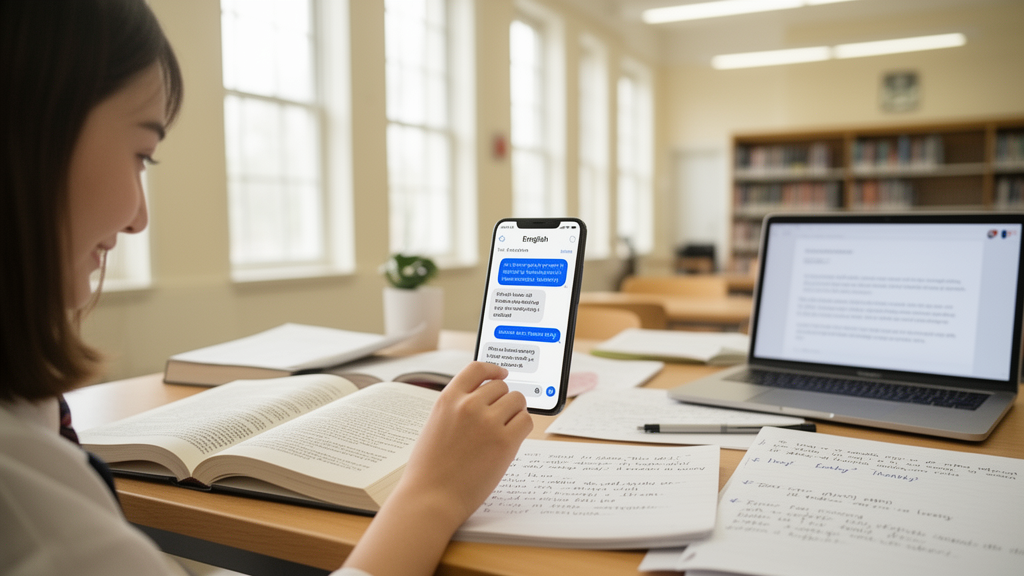
When Chinese universities moved online during the COVID-19 pandemic, one app became the unlikely backbone of English language education: WeChat. A new systematic review published in SN Social Sciences suggests that this instant messaging platform, best known for voice messages and group chats, has quietly reshaped how university students in English as a Foreign Language (EFL), English as a Medium of Instruction (EMI), and English for Academic Purposes (EAP) contexts read, translate, and stay motivated. The review, conducted by Wan Xuelian and Megat Aman Zahiri bin Megat Zakaria at University Technology Malaysia, synthesizes sixteen peer-reviewed empirical studies published between 2015 and 2025, offering one of the most comprehensive pictures to date of how social media-mediated learning supports English language development at the university level.
The researchers applied PRISMA-based selection criteria, screening studies from databases including Scopus, Web of Science, JSTOR, and Google Scholar. Only peer-reviewed empirical work made the cut, and a thematic synthesis was then used to identify patterns across the findings. This methodological rigor matters because systematic reviews are only as reliable as the criteria used to include or exclude studies. By anchoring the process in PRISMA, the Preferred Reporting Items for Systematic Reviews and Meta-Analyses, the authors ensured that the sixteen studies represent a transparent, reproducible evidence base rather than a cherry-picked collection of favorable results.
The clearest signal from the synthesis concerns reading. Across the reviewed studies, platforms like WeChat enhanced reading engagement and comprehension through three mechanisms: authentic texts, peer interaction, and multimodal input. Authentic texts refer to real-world materials that learners encounter outside the classroom, from news articles to social media posts, rather than simplified textbook passages. Peer interaction allows students to negotiate meaning together, asking questions and clarifying misunderstandings in real time. Multimodal input, meanwhile, combines text with images, voice messages, and video, engaging multiple channels of processing simultaneously. Together, these affordances create what the authors describe as interactive environments that support deeper comprehension than traditional reading assignments alone.
These findings align with established theories of second language acquisition. The review draws on Vygotskian ideas of social interaction as a driver of learning, suggesting that the group chat format of WeChat functions as a digital zone of proximal development, where learners scaffold one another’s understanding. Related work in mobile-assisted language learning, or MALL, has documented similar effects for platforms like WhatsApp, with studies showing measurable gains in L2 reading comprehension. The WeChat evidence extends this pattern to a platform with different technical affordances, including voice messaging, official accounts that push curated content, and robust group management tools that instructors can repurpose for pedagogical ends.
Translation learning tells a more complicated story. The review found that evidence for translation outcomes is limited and uneven, focusing mainly on vocabulary support and informal practices, with little emphasis on structured pedagogy. In other words, students use WeChat and similar platforms to look up words, share machine translation outputs, and practice translation informally, but instructors rarely integrate these activities into systematic translation instruction. One study of Saudi translation teachers and students found that WeChat was viewed as a useful supplementary tool for teaching translation, yet the platform’s role remained supplementary rather than central. This gap between informal use and structured pedagogy is one of the review’s most important contributions, highlighting where future research and curriculum design should focus.
Machine translation on social media platforms raises additional questions. The reviewed literature includes evaluations of the accuracy of machine translation systems embedded in social media language environments, alongside studies of how students perceive and use these tools. Research on Instagram’s translation feature, for example, examined whether it helps students learn Arabic-Indonesian translation, while other work explored how computer self-efficacy influences college students’ intention to use translation technologies, with learning motivation and cognitive engagement playing mediating roles. These studies suggest that the psychological factors surrounding translation technology use are as important as the technology itself, a finding that has implications for how instructors introduce machine translation into language classrooms.
Learner motivation emerges as the thread connecting reading, translation, and engagement across the review. The authors identify autonomy, social presence, and interactive environments as the primary drivers of motivation in WeChat-mediated learning. Autonomy refers to learners’ ability to control when, where, and how they engage with English content, a form of self-directed learning that informal digital environments uniquely support. Social presence captures the feeling of being connected to real people rather than studying in isolation, which reduces language anxiety and increases willingness to communicate. Interactive environments provide immediate feedback and dynamic content, keeping learners engaged over time. This motivational framework echoes the L2 Motivational Self System, a widely cited model in applied linguistics that links learners’ ideal selves to their language learning behavior.
The review’s novelty lies in integrating reading, translation, and motivation into a single analytical frame, highlighting the link between platform affordances and pedagogical choices. Rather than treating WeChat as a generic learning tool, the authors show that specific technical features, such as group chats, voice messages, and official accounts, map onto specific learning outcomes. This affordance-based perspective has practical implications for instructors deciding how to incorporate social media into their courses. A reading class might leverage official accounts to push authentic content, while a translation course might use group chats for peer feedback on translation drafts. The alignment between feature and outcome is what separates purposeful integration from haphazard adoption.
However, the authors are candid about the limitations of the evidence base. The reviewed studies used heterogeneous designs, relied heavily on self-reported data, and included only a small number of translation-focused studies, all of which limit generalizability. Self-reported measures, such as surveys and interviews, capture learners’ perceptions but not necessarily their actual behavior or learning gains. The small number of translation studies means that conclusions about translation learning rest on a thin foundation. The authors also note that the review did not generate or analyze datasets, reflecting its synthesis-based approach rather than a meta-analysis of quantitative effects.
Despite these limitations, the review arrives at a moment of rapid change in language education. The COVID-19 pandemic accelerated the adoption of digital tools in higher education, and studies of WeChat groups in China during the pandemic documented how these platforms supported not only language learning but also broader academic and social needs. As universities worldwide grapple with the role of social media in teaching and learning, this review offers a rigorous, evidence-based starting point. It suggests that WeChat and similar platforms are neither panaceas nor distractions, but tools whose effectiveness depends on how well instructors align platform affordances with pedagogical goals. For the millions of university students learning English through their phones, that alignment may make the difference between scrolling and studying.
Subject of Research: WeChat emerges as a powerful ally for university English learners, systematic review finds
Article Title: The role of WeChat in supporting university-level English language learning: a systematic review on reading, translation, and learner motivation
Article References: Xuelian, W., & bin Megat Zakaria, M. A. Z. (2026). The role of WeChat in supporting university-level English language learning: a systematic review on reading, translation, and learner motivation. SN Social Sciences, 6(9), Article 360. https://doi.org/10.1007/s43545-026-01611-5
Image Credits: AI Generated
DOI: 10.1007/s43545-026-01611-5
Keywords: role, WeChat, supporting, university-level, English, language, learning, systematic, review, reading, translation, learner
Cite Scienmag News
Courtney Benton. (October 17, 2026). WeChat emerges as a powerful ally for university English learners, systematic review finds. Scienmag. https://scienmag.com/wechat-emerges-as-a-powerful-ally-for-university-english-learners-systematic-review-finds/
Courtney Benton. "WeChat emerges as a powerful ally for university English learners, systematic review finds." Scienmag, 17 October 2026, https://scienmag.com/wechat-emerges-as-a-powerful-ally-for-university-english-learners-systematic-review-finds/. Accessed 17 October 2026.
Courtney Benton. "WeChat emerges as a powerful ally for university English learners, systematic review finds." Scienmag. October 17, 2026. https://scienmag.com/wechat-emerges-as-a-powerful-ally-for-university-english-learners-systematic-review-finds/


