


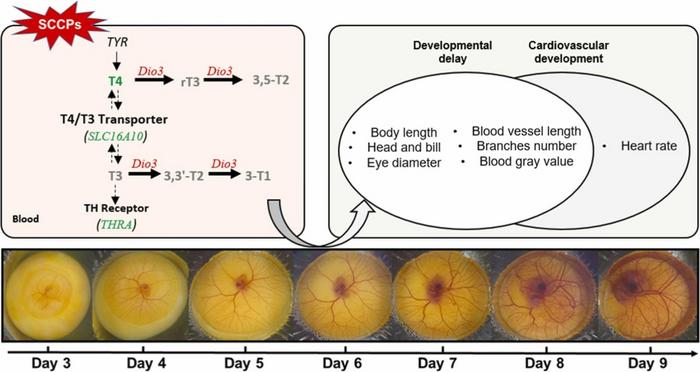
Short-chain chlorinated paraffins (SCCPs) were listed under the category of globally controlled persistent organic pollutants (POPs) by the Stockholm Convention in 2017. However, SCCPs toxicity, particularly its developmental toxicity in avian embryos, has not been well studied. In this study, we observed the early development of chicken embryos (Gallus gallus domesticus) by applying a shell-less (ex-ovo) incubation system developed in our previous studies. After exposing embryos at the Hamburger Hamilton stage (HHS) 1 to SCCPs (control, 0.1 % DMSO; SCCPs-L, 200 ng/g; SCCPs-M, 2,000 ng/g; SCCPs-H, 20,000 ng/g), we observed the development of embryos from the 3rd to 9th incubation day. Exposure to SCCPs-M and -H induced a significant reduction in survival, with an LD50 of 3,100 ng/g on the 9th incubation day. Significant dose-dependent decreases in body length were observed from days 4 to 9. We also found on the 4th incubation day that SCCPs-H decreased the blood vessel length and branch number. Additionally, SCCPs-H significantly reduced the heart rate on the 4th and 5th incubation days. These findings suggest that SCCPs may have potential of developmental and cardiovascular toxicity during the early stages of chicken embryo development. Quantitative PCR of the mRNA of genes related to embryonic development showed that the SLC16A10 (a triiodothyronine transporter) level decreased in the SCCPs-H group, showing a significant positive correlation with the body length of embryos. The THRA level, a thyroid hormone receptor, was significantly decreased in the SCCPs-H group, whereas that of the DIO3 level, a deiodinase, was significantly increased. These results suggest that SCCPs exposure induces developmental delays via the thyroxine signaling pathway. Analysis of thyroid hormones in blood plasma also indicated a significant reduction in thyroxine (T4) levels in the SCCPs-H group on the 9th incubation day of embryos. In conclusion, SCCPs induce developmental toxicity by disrupting thyroid functions at the early-life stage of chicken embryos.

Credit: Center for Marine Environmental Studies (CMES), Ehime University
Short-chain chlorinated paraffins (SCCPs) were listed under the category of globally controlled persistent organic pollutants (POPs) by the Stockholm Convention in 2017. However, SCCPs toxicity, particularly its developmental toxicity in avian embryos, has not been well studied. In this study, we observed the early development of chicken embryos (Gallus gallus domesticus) by applying a shell-less (ex-ovo) incubation system developed in our previous studies. After exposing embryos at the Hamburger Hamilton stage (HHS) 1 to SCCPs (control, 0.1 % DMSO; SCCPs-L, 200 ng/g; SCCPs-M, 2,000 ng/g; SCCPs-H, 20,000 ng/g), we observed the development of embryos from the 3rd to 9th incubation day. Exposure to SCCPs-M and -H induced a significant reduction in survival, with an LD50 of 3,100 ng/g on the 9th incubation day. Significant dose-dependent decreases in body length were observed from days 4 to 9. We also found on the 4th incubation day that SCCPs-H decreased the blood vessel length and branch number. Additionally, SCCPs-H significantly reduced the heart rate on the 4th and 5th incubation days. These findings suggest that SCCPs may have potential of developmental and cardiovascular toxicity during the early stages of chicken embryo development. Quantitative PCR of the mRNA of genes related to embryonic development showed that the SLC16A10 (a triiodothyronine transporter) level decreased in the SCCPs-H group, showing a significant positive correlation with the body length of embryos. The THRA level, a thyroid hormone receptor, was significantly decreased in the SCCPs-H group, whereas that of the DIO3 level, a deiodinase, was significantly increased. These results suggest that SCCPs exposure induces developmental delays via the thyroxine signaling pathway. Analysis of thyroid hormones in blood plasma also indicated a significant reduction in thyroxine (T4) levels in the SCCPs-H group on the 9th incubation day of embryos. In conclusion, SCCPs induce developmental toxicity by disrupting thyroid functions at the early-life stage of chicken embryos.
Journal
Ecotoxicology and Environmental Safety
Cite Scienmag News
Drew Townsend. (July 16, 2024). Chlorinated flame retardants affect avian embryonic development. Scienmag. https://scienmag.com/chlorinated-flame-retardants-affect-avian-embryonic-development/
Drew Townsend. "Chlorinated flame retardants affect avian embryonic development." Scienmag, 16 July 2024, https://scienmag.com/chlorinated-flame-retardants-affect-avian-embryonic-development/. Accessed 4 September 2026.
Drew Townsend. "Chlorinated flame retardants affect avian embryonic development." Scienmag. July 16, 2024. https://scienmag.com/chlorinated-flame-retardants-affect-avian-embryonic-development/

