


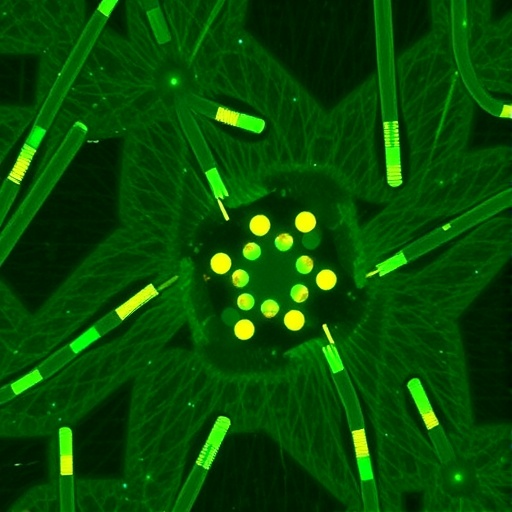
In a groundbreaking development poised to redefine the landscape of optical microscopy, researchers have unveiled a novel chip-based optical system that achieves super-resolution imaging without the need for fluorescent labels or coherent light sources. This pioneering technology promises to revolutionize biomedical imaging, materials science, and numerous fields that rely heavily on high-resolution visualization by offering a compact, cost-effective, and label-free alternative to traditional methods.
Conventional super-resolution microscopy typically demands fluorescent tagging of samples and relies on coherent laser illumination to surpass the diffraction limit, constraining experimental scenarios and increasing complexity. However, the innovative approach introduced by Jayakumar and colleagues leverages incoherent light—a type of illumination commonly regarded as less favorable for high-resolution imaging—to attain resolution beyond the classical diffraction boundary. This unique method dismantles preexisting notions about the limitations imposed by incoherent light sources and label-dependent imaging.
Central to this breakthrough is the integration of sophisticated optical components onto a chip-scale platform, miniaturizing and consolidating the operational framework into a compact footprint. By employing an advanced design that manipulates incoherent light through specialized interference and computational reconstruction strategies, the system captures fine structural details previously accessible only by more cumbersome and chemically invasive techniques.
At the heart of the technology lies an ingenious mechanism that manipulates and encodes the incoherent light information as it interacts with the sample. This encoded data is then computationally processed to reconstruct images with resolution surpassing the diffraction limit. Unlike traditional fluorescence microscopy, which relies on the emission of light at specific wavelengths from fluorescent molecules, this label-free approach sidesteps sample preparation challenges, preserves native biological conditions, and reduces phototoxicity—a critical factor for live-cell imaging.
The researchers achieved this by implementing on-chip photonic elements that control light propagation with high precision. These elements facilitate the formation of complex illumination patterns and enable the extraction of phase information from incoherently scattered light, which is typically considered lost in conventional imaging setups. This phase information is vital for resolving sub-wavelength features and contributes to the improved resolution seen in the generated images.
Moreover, the incoherent illumination enables safer and more versatile imaging conditions, since such light sources are less prone to inducing photodamage or photobleaching, which commonly plague fluorescence-based techniques. The chip-based format also enhances system stability and integration potential, making it feasible to incorporate into portable diagnostic devices or high-throughput screening platforms.
This advancement carries significant implications, particularly in the realm of live biological sample imaging, where label-free, minimally invasive methods are highly sought after. The technology paves the way for real-time observation of cellular processes at unprecedented spatial resolution without interfering with the natural state of the specimen, enabling researchers to capture authentic biological dynamics.
Another impactful facet of the research is the use of computational algorithms tailored to process the unique data captured by the system. These algorithms reconstruct high-fidelity images by leveraging the encoded phase and intensity information, effectively penetrating the classical diffraction barrier. The fusion of hardware innovation with sophisticated software processing exemplifies the ongoing trend in optical microscopy toward computational imaging.
The chip-based system’s compactness and scalability position it as a promising candidate for widespread adoption beyond specialized laboratories. Future iterations might integrate with microfluidic systems or be employed in field-deployable diagnostic tools, expanding the reach of high-resolution optical microscopy into new environments and applications.
Furthermore, by avoiding dependence on fluorescence labels, the technique reduces costs and logistical burdens associated with sample preparation. This democratizes access to super-resolution imaging and could accelerate discoveries in contexts where labeling is impractical or impossible.
The research team meticulously validated their approach using various test samples, demonstrating the system’s capability to resolve fine structural details with clarity unattainable by conventional incoherent light-based microscopes. These results underscore the immense potential of chip-based integrated photonics in fostering next-generation imaging modalities.
An exciting prospect arising from this work is the potential adaptability to diverse spectral ranges, which could enhance imaging versatility across different sample types and physical phenomena. This adaptability would further solidify the method’s utility across numerous scientific disciplines.
This revolutionary chip-based label-free incoherent super-resolution optical microscopy exemplifies the fusion of nanophotonics, computational imaging, and optical engineering. It stands as a paradigm shift that challenges long-held assumptions about the necessity of fluorescence and coherent illumination for super-resolution.
In terms of impact, this technology could transform high-resolution imaging in numerous fields including neuroscience, pathology, material sciences, and even industrial inspection, where preserving sample integrity and achieving fine resolution are paramount.
As the system continues to mature, integration with machine learning algorithms could enhance image reconstruction capabilities, automate analysis, and enable real-time decision-making based on high-resolution data. Such advancements promise to further extend the reach and efficacy of this technology.
In sum, Jayakumar and colleagues’ innovation marks a significant milestone in microscopy, opening up exciting frontiers for label-free, super-resolution imaging by exploiting incoherent light on a chip-based platform—a fusion of simplicity, functionality, and powerful imaging performance that could redefine how we visualize the microscopic world.
Jayakumar, N., Villegas-Hernández, L.E., Zhao, W. et al. Chip-based label-free incoherent super-resolution optical microscopy.
Light Sci Appl 14, 259 (2025). https://doi.org/10.1038/s41377-025-01914-x
Cite Scienmag News
Denise Maddox. (August 4, 2025). Chip-Based Label-Free Incoherent Super-Resolution Microscopy. Scienmag. https://scienmag.com/chip-based-label-free-incoherent-super-resolution-microscopy/
Denise Maddox. "Chip-Based Label-Free Incoherent Super-Resolution Microscopy." Scienmag, 4 August 2025, https://scienmag.com/chip-based-label-free-incoherent-super-resolution-microscopy/. Accessed 4 September 2026.
Denise Maddox. "Chip-Based Label-Free Incoherent Super-Resolution Microscopy." Scienmag. August 4, 2025. https://scienmag.com/chip-based-label-free-incoherent-super-resolution-microscopy/


