


Traditional Chinese medicine has never been more prominent in China’s national health strategy, yet a new study reveals that the people most likely to need it are not using it evenly, or even predictably. A research team led by Chao Rong of Zhejiang Chinese Medical University set out to chart where and when middle-aged and elderly patients with chronic diseases actually turn to traditional Chinese medicine, and what drives those choices. Their findings, published in BMC Health Services Research, complicate a common assumption: that building more hospitals and staffing them with more practitioners will automatically translate into more patients receiving traditional medicine. In much of China, the data suggest, that assumption does not hold.
The study drew on an unusually rich evidence base: the first four waves of the China Health and Retirement Longitudinal Study, known as CHARLS, conducted in 2011, 2013, 2015 and 2018. CHARLS follows a nationally representative sample of Chinese residents aged 45 and older, collecting detailed information on health, healthcare use, income and employment. By focusing on respondents with chronic diseases, the researchers zeroed in on the population for whom traditional Chinese medicine is most often prescribed as a long-term, complementary therapy. Because the survey repeats the same questions across years, the team could track not just a snapshot of utilization but its trajectory over nearly a decade of rapid health system change.
To move beyond simple national averages, the researchers applied the tools of spatial epidemiology. Spatial correlation analysis, including measures of global and local spatial autocorrelation such as Moran’s I and Getis-Ord statistics, allowed them to test whether provinces with high traditional medicine utilization cluster next to other high-utilization provinces, or whether hot spots and cold spots appear in recognizable geographic patterns. They then turned to geographically and temporally weighted regression, or GTWR, a modeling technique that estimates separate coefficients for each province and each time point rather than forcing a single national average. This matters because the relationship between, say, hospital beds and utilization in a wealthy coastal megacity may be fundamentally different from the same relationship in an inland agricultural province.
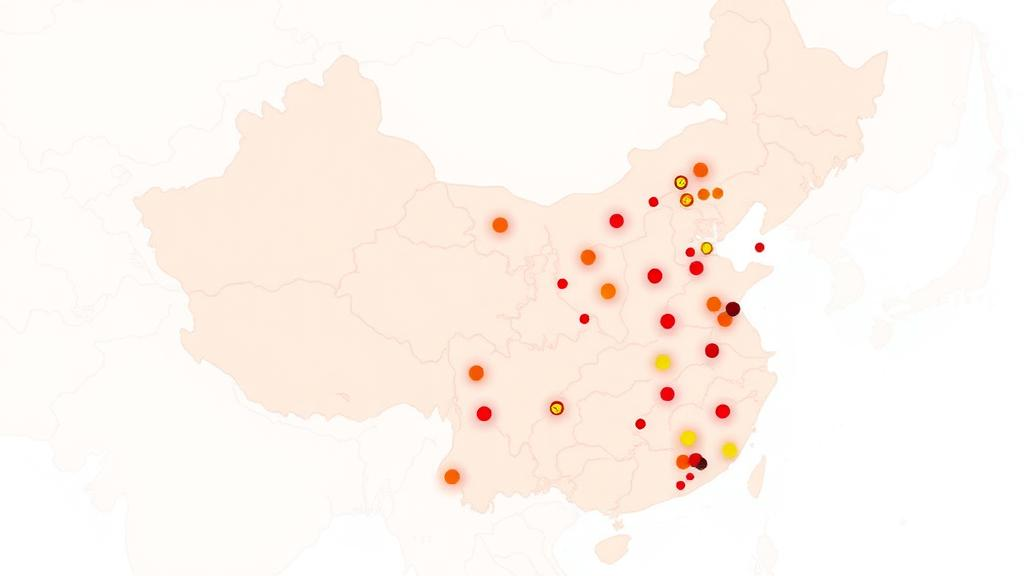
The headline finding is one of steady growth with stubborn geography. Overall, the utilization rate of traditional Chinese medicine among middle-aged and elderly chronic disease patients trended upward across the four survey waves, consistent with the strong policy backing the sector has received from the central government. But the map is far from uniform. The cold spots, the areas where utilization lagged most persistently, were located primarily in the southeastern coastal provinces, the very regions with the most developed economies and, in many respects, the most advanced healthcare infrastructure. Hot spots of traditional medicine use clustered elsewhere, suggesting that regional culture, health system structure and patient preference shape demand in ways that raw economic development does not capture.
The regression results were equally counterintuitive. Provincial GDP was negatively associated with traditional medicine utilization, meaning that wealthier provinces, controlling for other factors, showed lower rates of use among their chronically ill middle-aged and elderly residents. The prevalence of chronic disease itself was also negatively associated with utilization, an unexpected result that hints at how patients with heavy disease burdens may channel their care toward other parts of the health system. On the other side of the ledger, the prevalence of multiple chronic diseases, so-called multimorbidity, was positively associated with traditional medicine use, as was per capita financial allocation to traditional Chinese medicine institutions. Patients juggling several conditions at once, it appears, are more likely to incorporate traditional medicine into their care, particularly when public funding actively supports the institutions that provide it.
Perhaps the most consequential finding concerns the hospitals themselves. The study focused explicitly on the development of traditional Chinese medicine hospitals, examining whether their health resources, including beds and practitioners per capita, drove higher utilization rates. The answer, in most cases, was no: most of the relevant health resources of these hospitals were not significantly positively associated with utilization. In other words, supply-side expansion, the beds, the staff, the physical infrastructure that has absorbed so much investment, does not by itself pull patients through the door. The authors’ conclusion is blunt: policy strategies should prioritize demand enhancement rather than solely focusing on supply expansion, and traditional medicine hospitals need to return their focus to traditional medicine related projects.
Why might more resources fail to produce more patients? The study does not test mechanisms directly, but several explanations are consistent with its design. GTWR coefficients varied across provinces and years, which means the local relationship between resources and utilization differed from place to place; a bed built in a province with weak patient trust in traditional medicine may simply sit unused by the chronic disease population. The negative GDP association suggests a cultural or preference gradient, in which affluent, urbanized coastal populations with abundant biomedical alternatives lean less on traditional therapies. Meanwhile, the positive effect of per capita funding for traditional medicine institutions indicates that money directed specifically at the traditional medicine sector, rather than general economic growth, is what moves utilization. Demand, in short, is not a passive consequence of supply.
The demographic stakes are enormous. China’s population is aging rapidly, and chronic diseases such as hypertension, diabetes and cardiovascular conditions now dominate the disease burden among people aged 45 and older, precisely the CHARLS study population. Traditional Chinese medicine occupies an officially favored position in the national response, promoted both as a means of enhancing health service capacity and as a vehicle for cultural influence. If utilization among the people who most need long-term disease management is shaped more by trust, regional culture and targeted funding than by hospital construction, then the return on infrastructure-heavy investment may be diminishing. The authors argue that relevant departments should adopt appropriate measures to scientifically promote traditional medicine services in order to enhance public trust, a formulation that implicitly acknowledges skepticism in some regions, particularly the coastal cold spots.
Methodologically, the study demonstrates the value of treating health services data as spatial data. A conventional national regression would have averaged away the very patterns that matter most: the clustering of low utilization along the southeastern seaboard, the year-to-year drift in coefficients, the provincial heterogeneity in how beds and practitioners relate to patient behavior. By modeling space and time simultaneously, the researchers could show that the drivers of traditional medicine use are themselves geographically mobile, strengthening and weakening in different regions across the 2011 to 2018 window. The CHARLS data were collected under ethics approval from Peking University with written informed consent from all participants, and the new analysis used de-identified, publicly available data. The work was supported by the National Social Science Foundation of China.
The study, published open access on 30 September 2026, arrives at a moment when governments worldwide are debating how to integrate traditional and complementary medicine into formal health systems. Its central lesson travels beyond China: building capacity is not the same as building demand. For traditional Chinese medicine hospitals, the prescription offered by the data is to refocus on the services that define the tradition, and for policymakers, to invest in the public trust and patient engagement that turn infrastructure into care. For the millions of middle-aged and elderly Chinese living with chronic disease, the geography of that shift will determine whether the next decade of growth in traditional medicine reaches the coastal provinces where, so far, it has been slowest to arrive.
Subject of Research: Spatial and temporal patterns of traditional Chinese medicine utilization among middle-aged and elderly chronic disease patients in China
Article Title: Spatial-temporal distribution and associated factors of traditional Chinese medicine utilization among middle-aged and elderly patients with chronic diseases in China: focusing on the development of traditional Chinese medicine hospitals
Article References: Fan, P., Lei, T., Zhou, L., Li, H., & Rong, C. (2026). Spatial-temporal distribution and associated factors of traditional Chinese medicine utilization among middle-aged and elderly patients with chronic diseases in China: focusing on the development of traditional Chinese medicine hospitals. BMC Health Services Research. https://doi.org/10.1186/s12913-026-15720-7
Image Credits: AI Generated
DOI: 10.1186/s12913-026-15720-7
Keywords: traditional Chinese medicine, chronic disease, CHARLS, spatial analysis, health services research, aging population, GTWR regression, China, TCM hospitals, health policy, multimorbidity, healthcare utilization
Cite Scienmag News
Beatrice Stafford. (September 30, 2026). China’s Traditional Medicine Boom Maps Unevenly Across Its Aging Population. Scienmag. https://scienmag.com/chinas-traditional-medicine-boom-maps-unevenly-across-its-aging-population/
Beatrice Stafford. "China’s Traditional Medicine Boom Maps Unevenly Across Its Aging Population." Scienmag, 30 September 2026, https://scienmag.com/chinas-traditional-medicine-boom-maps-unevenly-across-its-aging-population/. Accessed 4 October 2026.
Beatrice Stafford. "China’s Traditional Medicine Boom Maps Unevenly Across Its Aging Population." Scienmag. September 30, 2026. https://scienmag.com/chinas-traditional-medicine-boom-maps-unevenly-across-its-aging-population/


