


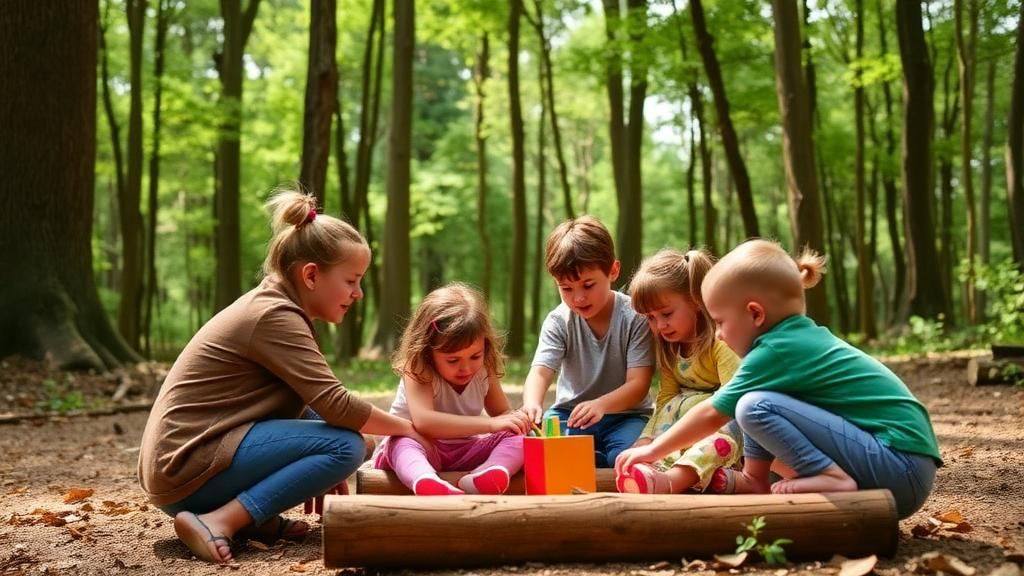
Deep in a forested nature reserve on Australia’s south-eastern coast, toddlers wade through mud kitchens, drag fallen branches into makeshift dens, and peer at insects through magnifying glasses while their parents look on. It might look like simple outdoor fun, but new research suggests these weekly gatherings are doing something far more profound: rebuilding the social fabric of modern parenthood. A study published in the Early Childhood Education Journal by Christopher Speldewinde and Suzanne Infantino of Southern Cross University provides some of the most detailed evidence yet that facilitated nature playgroups, a rapidly growing phenomenon in Australia, deliver benefits that flow just as strongly to the adults as to the children.
The research comes at a moment when nature-based early childhood education is expanding quickly across the country. Bush kinders, modelled on approaches long established in Nordic countries, the United Kingdom and New Zealand, have become a familiar part of the preschool landscape since Australia’s Early Years Learning Framework, introduced in 2009 and revised in 2022, explicitly encouraged educators to take children outdoors as a place of learning. Nature playgroups extend that philosophy to an even younger age group, serving children from birth to around four years old, many of whom are too young to attend a bush kinder. Sessions typically run in forests, parklands or on beaches, and are led by trained facilitators employed largely by private organisations, with each session built around a theme linked to the national early years curriculum.
To understand what actually happens inside these sessions, the researchers spent five weeks in August and September 2024 embedded with one weekly playgroup operating on a privately owned nature reserve adjacent to a national park. Each 90-minute session was run by two degree-trained facilitators and attended by between 13 and 16 children, mostly aged two to three, accompanied by 16 to 20 adult family members. The researchers adopted ethnographic methods, oscillating between observing from a distance and joining in the play, recording their fieldwork in an electronic journal because paper notebooks proved impractical in cold, wet forest conditions. They also conducted eight interviews with parents and five with facilitators, and asked the children themselves for assent before watching or joining their activities, asking questions such as whether it was okay to watch what they were doing.
Theoretically, the study leaned on two complementary frameworks. The first was Bronfenbrenner’s ecological systems model, which previous playgroup research had used to map the layered sources of support surrounding families, from facilitators to fellow parents to services beyond the playgroup itself. The second drew on Gibson’s affordance theory, the idea that learning emerges from the relationship between a person and their environment, and that a child’s body size, motor skills, experience and motivation determine what a forest or beach affords them. A stick is not just a stick; for one child it is a digging tool, for another a magic wand, and for a parent watching closely, a window into how their child interprets the world.
When the researchers analysed their data using an abductive thematic approach, testing their expectations against what families actually said and did, three themes emerged. The first, acceptance and belonging, echoed findings from earlier playgroup research: families felt welcomed by facilitators and other parents, and that sense of community deepened over the course of a term. One facilitator described the transformation plainly, noting that new families arrive anxious, quiet and reserved, but by the end of the term everyone is super connected and arranging to see each other outside of playgroup sessions. Parents reported that the group introduced them to a more diverse circle of people than they met through city daycare centres, and several described friendships that had persisted long after their first session.
The second theme concerned parents observing and building understandings of their children’s play and learning in nature. Because facilitators do not take direct responsibility for the children, adults must supervise and engage throughout, which means they witness every small discovery. One mother described watching children at the mud kitchen work out that water dripping through a bucket would refill a puddle below, calling it a genuinely positive experience to see nature through their children’s eyes. Another recounted her surprise when her young son showed her how to squeeze native plant seedlings out of their tubes during a planting activity, revealing knowledge she had not realised he possessed. A recurring observation was that children who struggled to engage at indoor daycare became deeply absorbed outdoors, something one mother attributed to the way play in nature connects directly to the stories and activities of the session.
The third theme, which the researchers labelled gaining parenting efficacy and validation of parenting practices, may be the most striking. Parents described how the playgroup changed or reinforced their approach to raising children. One mother who described herself as free range, allowing her children to take risks, said the group gave her confidence to keep going in the direction she was heading. Another explained that she had learned to step back and let her children choose their own activities, intervening only when asked. Facilitators deliberately modelled creative uses of natural materials, such as showing multiple ways to play with ropes, so parents could take ideas home. They also observed that parents, left on the mat weaving or unravelling wool while their children played, would chat comfortably with one another, describing the atmosphere as relaxing in a way that countered the isolation and stress of parenting.
The researchers illustrated these dynamics with vignettes drawn from 35 documented observations. In one, families arranged to meet at a nearby coffee shop after the session, with one mother agreeing to mind another’s child so the second could run errands, a small transaction that revealed how quickly the playgroup had generated practical mutual support networks. In another, a facilitator read a picture storybook to close the session, and a child peppered the reading with questions about birds and trees, prompting his mother to remark that he would never respond that way at daycare, and that something about being in nature, connecting the play to the story, made it real for him. In a third, two mothers who had met only that year through the playgroup discussed sleep routines on a mat, one sharing an app and professional resources with the other, who called her friend a wonderful help with parenting.
The study’s authors are careful about its limits. The sample consisted predominantly of Caucasian mothers who were either stay-at-home parents or had highly flexible work schedules from middle-class and upper-middle-class families, and the researchers acknowledge the findings may not translate to fathers, low-income families or other communities. The fieldwork, while ethnographic in method, was not a full long-term immersion in the field site, and the researchers note that families sometimes avoid natural settings as playgroup venues because of safety concerns, a challenge earlier studies of mobile nature playgroups also documented, including the lack of water and bathroom facilities and exposure to inclement weather. They call for broader-scale examination of nature playgroups across Australia and beyond, and for research into how the knowledge families gain outdoors is carried into the home.
Nevertheless, the central conclusion is difficult to ignore: at a time when more than a third of Australian preschool-aged children have attended informal playgroups and rates of developmental vulnerability are rising, the humble playgroup, relocated to the forest floor, appears to be solving two problems at once. It gives very young children self-directed, sensory-rich play in environments that educators and psychologists have long argued are essential to healthy development, and it gives their parents something they often did not expect when they signed up, a community, a sounding board and a growing confidence in their own parenting. As one facilitator put it, adults are not really taught how to free play, and the forest, it turns out, is teaching them too.
Subject of Research: Nature playgroups and parental support in early childhood education
Article Title: ‘It’s my Absolute Favourite thing to do’: Nature Playgroups Building Families' Connections with Nature and Each Other
Article References: Speldewinde, C., & Infantino, S. (2026). ‘It’s my Absolute Favourite thing to do’: Nature Playgroups Building Families' Connections with Nature and Each Other. Early Childhood Education Journal. https://doi.org/10.1007/s10643-026-02363-w
Image Credits: AI Generated
DOI: 10.1007/s10643-026-02363-w
Keywords: nature playgroups, early childhood education, parental support, bush kinder, outdoor learning, affordance theory, ethnography, play-based learning, parent networks, Australia, child development, social support
Cite Scienmag News
Courtney Benton. (September 30, 2026). Forest Playgroups Boost Parents as Much as Children, Australian Study Finds. Scienmag. https://scienmag.com/forest-playgroups-boost-parents-as-much-as-children-australian-study-finds/
Courtney Benton. "Forest Playgroups Boost Parents as Much as Children, Australian Study Finds." Scienmag, 30 September 2026, https://scienmag.com/forest-playgroups-boost-parents-as-much-as-children-australian-study-finds/. Accessed 4 October 2026.
Courtney Benton. "Forest Playgroups Boost Parents as Much as Children, Australian Study Finds." Scienmag. September 30, 2026. https://scienmag.com/forest-playgroups-boost-parents-as-much-as-children-australian-study-finds/


