


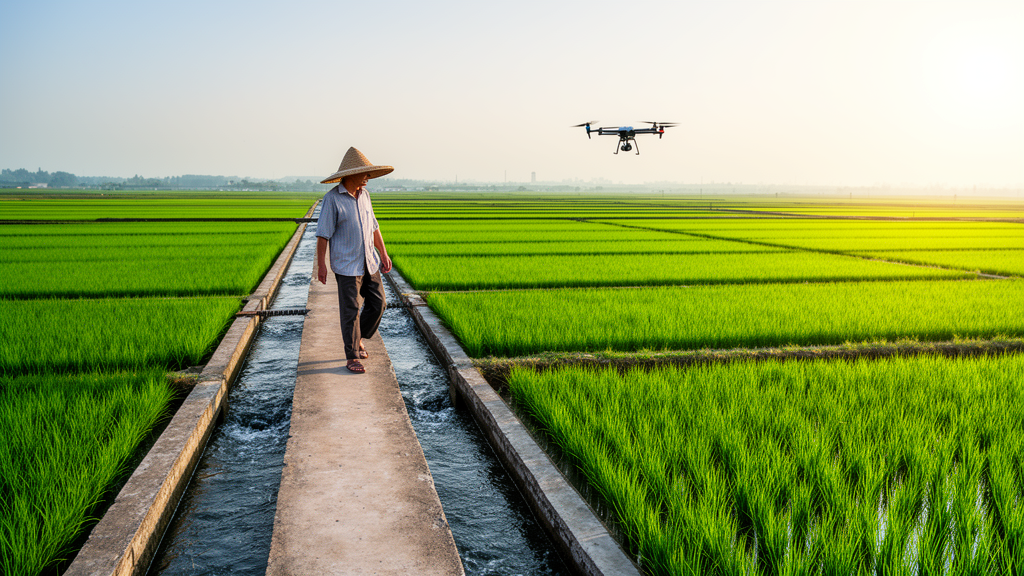
A sweeping survey of 1,400 rice farmers in Jiangxi Province, China, has found that high-standard farmland construction (HSFC), the country’s massive land consolidation program, significantly increases farmers’ adoption of green production behaviors. The study, published in Frontiers in Sustainable Food Systems, used an instrumental variables approach to establish a causal link between upgraded farmland and practices such as soil testing and formula fertilization, green pest control, and organic fertilizer use, offering some of the strongest micro-level evidence yet that reshaping the physical landscape can shift farmer behavior toward sustainability.
China’s agricultural sector has long relied on intensive chemical inputs to sustain output, with grain production stable above 650 million tons for a decade. But that model carries mounting costs: resource depletion, environmental pollution, and food safety concerns. National coverage of green agricultural technologies remains below 20 percent of total sown area, and farmer willingness to adopt them has been persistently low. The new research suggests that the bottleneck may lie not in farmer attitudes but in the structure of the land itself, fragmented into tiny plots that make green techniques impractical.
HSFC is China’s top-down answer to that fragmentation. The program consolidates scattered plots into larger contiguous fields, builds field roads, and upgrades irrigation and drainage infrastructure. The National Plan for HSFC set a target of 1.2 billion mu of high-standard farmland by 2030, embedding an ecology-first principle that mandates accelerated adoption of green production technologies. In Jiangxi, roughly 2.063 million hectares, about 75.8 percent of the province’s arable land, had already been converted by the time of the survey.
The research team, led by Yun Xiong of Nanchang Normal University and colleagues at Jiangxi Agricultural University, measured green production behavior as a composite score from zero to six, counting six practices across the rice production cycle. Farmers operating high-standard farmland adopted 0.763 more green behaviors on average than those who did not, a statistically significant difference that held across three estimation models: two-stage least squares, a recursive mixed-process ordered probit, and an instrumental variable Poisson model.
Because counties that adopt HSFC may differ systematically from those that do not, the researchers used the share of high-standard farmland held by other households in the same county as an instrument, isolating variation in program exposure that is unrelated to any individual farmer’s own choices. The instrument passed standard relevance tests, and the team ran a battery of exclusion restriction checks, controlling for county fiscal support, extension services, service market development, and peer effects, and applying a plausibly exogenous estimation framework that relaxes strict exogeneity. The positive effect of HSFC survived all of them.
The mechanism analysis reveals what the authors call a triple-scale operation effect. First, HSFC physically merges small plots into larger ones, reducing the coordination costs and machinery wear that make green techniques inefficient on fragmented land. Second, improved land quality and clearer property boundaries lower transaction costs in the farmland transfer market, allowing capable farmers to expand their operational scale and spread green inputs over more area. Third, better infrastructure attracts agricultural socialized service providers, whose mechanized and specialized services lower the barriers to adopting green technologies for smallholders who could not manage them alone.
Perhaps the study’s most distinctive finding concerns land tenure stability. Green behaviors pay off over years, not seasons, so farmers who fear their land will be readjusted have little incentive to invest in them. The researchers split their sample by whether farmers held a Land Contracting and Management Rights Certificate and by whether they expected future land readjustment. The green-promoting effect of HSFC was significant only among farmers with formal land-rights confirmation and those who did not expect readjustment, suggesting that stable tenure acts as an institutional safeguard without which the physical upgrades fail to translate into green investment.
Robustness checks reinforced the core result. Propensity score matching across three matching methods produced positive and significant treatment effects, an endogenous switching regression that accounts for unobserved selection found an average treatment effect of 0.468, and an entropy-weighted alternative measure of green behavior yielded consistent results. Heterogeneity analysis found the effect to be broad-based: it appeared among cooperative members and non-members alike, across plain and non-plain terrain, and in villages at both high and low levels of economic development, with no statistically significant differences between groups.
The policy implications are pointed. The authors argue that farmland construction must be paired with institutional support, particularly as China extends its second round of rural land contracting for another 30 years. They recommend strengthening land-rights confirmation, improving rural land transfer systems, and building out the socialized service sector in machinery operations, unified pest control, and formula fertilization. Without stable tenure, they warn, farmers may conclude that long-term green investments would amount to working for others’ benefit, squandering the infrastructure dividend.
For a country feeding nearly 20 percent of the world’s population on less than 10 percent of its arable land, the findings suggest that the path to sustainable agriculture may run through the bulldozer and the land registry as much as through the laboratory. By treating plot geometry, operational scale, service markets, and property rights as a single integrated system, the study offers a template for how land policy can quietly reshape the environmental footprint of hundreds of millions of small farms.
Subject of Research: The effect of high-standard farmland construction on farmers' green production behaviors in China
Article Title: How does high-standard farmland construction influence farmers’ green production behaviors? With a discussion on the synergistic effect of land tenure stability
Article References: Xiong, Y., Chen, J., Zhong, T., & Li, D. (2026). How does high-standard farmland construction influence farmers’ green production behaviors? With a discussion on the synergistic effect of land tenure stability. Frontiers in Sustainable Food Systems, 10, Article 1910342. https://doi.org/10.3389/fsufs.2026.1910342
Image Credits: AI Generated
DOI: 10.3389/fsufs.2026.1910342
Keywords: high-standard farmland construction, green production behaviors, land consolidation, land tenure stability, agricultural socialized services, plot size, operational scale, instrumental variables, Jiangxi Province, sustainable agriculture, China, rice farming
Cite Scienmag News
Alan Morgan. (October 19, 2026). China’s High-Standard Farmland Push Makes Rice Farmers Go Green, Study Finds. Scienmag. https://scienmag.com/chinas-high-standard-farmland-push-makes-rice-farmers-go-green-study-finds/
Alan Morgan. "China’s High-Standard Farmland Push Makes Rice Farmers Go Green, Study Finds." Scienmag, 19 October 2026, https://scienmag.com/chinas-high-standard-farmland-push-makes-rice-farmers-go-green-study-finds/. Accessed 19 October 2026.
Alan Morgan. "China’s High-Standard Farmland Push Makes Rice Farmers Go Green, Study Finds." Scienmag. October 19, 2026. https://scienmag.com/chinas-high-standard-farmland-push-makes-rice-farmers-go-green-study-finds/


