


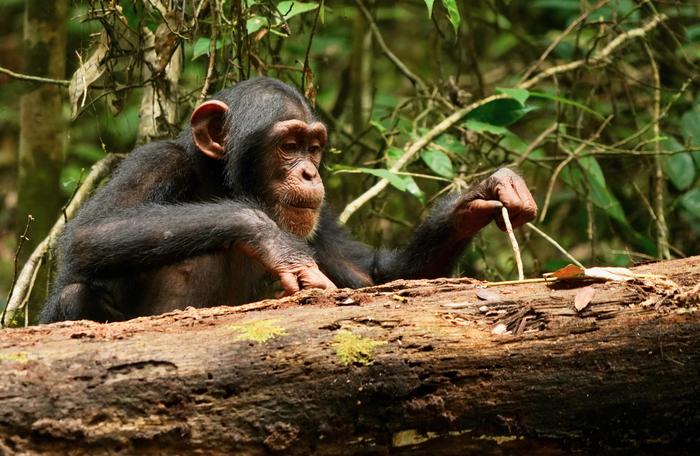
Chimpanzees continue to learn and hone their skills well into adulthood, a capacity that might be essential for the evolution of complex and varied tool use, according to a study publishing May 7th in the open-access journal PLOS Biology by Mathieu Malherbe of the Institute of Cognitive Sciences, France and colleagues.

Credit: Liran Samuni, Taï Chimpanzee Project (CC BY 4.0,
Chimpanzees continue to learn and hone their skills well into adulthood, a capacity that might be essential for the evolution of complex and varied tool use, according to a study publishing May 7th in the open-access journal PLOS Biology by Mathieu Malherbe of the Institute of Cognitive Sciences, France and colleagues.
Humans have the capacity to continue learning throughout our entire lifespan. It has been hypothesized that this ability is responsible for the extraordinary flexibility with which humans use tools, a key factor in the evolution of human cognition and culture. In this study, Malherbe and colleagues investigated whether chimpanzees share this feature by examining how chimps develop tool techniques as they age. The authors observed 70 wild chimps of various ages using sticks to retrieve food via video recordings collected over several years at Taï National Park, Côte d’Ivoire. As they aged, the chimps became more skilled at employing suitable finger grips to handle the sticks. These motor skills became fully functional by the age of six, but the chimps continued to hone their techniques well into adulthood. Certain advanced skills, such as using sticks to extract insects from hard-to-reach places or adjusting grip to suit different tasks, weren’t fully developed until age 15. This suggests that these skills aren’t just a matter of physical development, but also of learning capacities for new technological skills continuing into adulthood.
Retention of learning capacity into adulthood thus seems to be a beneficial attribute for tool-using species, a key insight into the evolution of chimpanzees as well as humans. The authors note that further study will be needed to understand the details of the chimps’ learning process, such as the role of reasoning and memory or the relative importance of experience compared to instruction from peers.
The authors add, “In wild chimpanzees, the intricacies of tool use learning continue into adulthood. This pattern supports ideas that large brains across hominids allow continued learning through the first two decades of life.”
#####
In your coverage, please use this URL to provide access to the freely available paper in PLOS Biology:
Citation: Malherbe M, Samuni L, Ebel SJ, Kopp KS, Crockford C, Wittig RM (2024) Protracted development of stick tool use skills extends into adulthood in wild western chimpanzees. PLoS Biol 22(5): e3002609.
Author Countries: France, Côte d’Ivoire, United States, Germany
Funding: This study was funded by the Max Planck Society (M.IF.EVAN8103 – to CC and RMW through the Evolution of Brain Connectivity Project). LS was supported by the German Research Foundation (DFG, Emmy Noether Fellowship 513871869). The funders had no role in the study design, data collection and analysis, decision to publish, or preparation of the manuscript.
Journal
PLoS Biology
Method of Research
Observational study
Subject of Research
Animals
COI Statement
Competing interests: The authors have declared that no competing interests exist.
Cite Scienmag News
Drew Townsend. (May 7, 2024). Chimps learn and improve tool-using skills even as adults. Scienmag. https://scienmag.com/chimps-learn-and-improve-tool-using-skills-even-as-adults/
Drew Townsend. "Chimps learn and improve tool-using skills even as adults." Scienmag, 7 May 2024, https://scienmag.com/chimps-learn-and-improve-tool-using-skills-even-as-adults/. Accessed 4 September 2026.
Drew Townsend. "Chimps learn and improve tool-using skills even as adults." Scienmag. May 7, 2024. https://scienmag.com/chimps-learn-and-improve-tool-using-skills-even-as-adults/

