


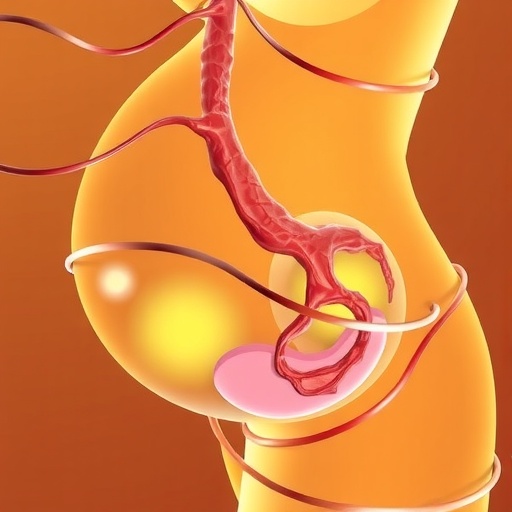
A groundbreaking study from the Barcelona Institute for Global Health (ISGlobal) offers compelling evidence that commonplace environmental chemicals—ubiquitous in food, water, personal care products, and household items—have tangible effects on fetal development and placental function. Published in the prestigious journal Environmental Science & Technology, this research harnesses the power of real-world exposure assessment methodologies to unravel how complex mixtures of endocrine disrupting chemicals (EDCs) influence birthweight and the biological pathways underlying pregnancy outcomes.
Endocrine disrupting chemicals, often abbreviated as EDCs, are a pervasive class of compounds capable of interfering with hormonal regulation in the human body. These include classes such as phthalates, phenols, parabens, pesticides, and the emergent bisphenol S (BPS), often used as a substitute for bisphenol A. Individuals encounter EDCs daily through ingestion, inhalation, and dermal absorption, setting the stage for cumulative exposure that can be particularly consequential during sensitive physiological windows like pregnancy.
Pregnancy represents a uniquely vulnerable window due to the critical role of tightly regulated hormonal and vascular processes necessary for proper placental development and fetal growth. The placenta itself functions as a multifaceted endocrine organ. Central to its role is angiogenesis—the development of new blood vessels. This process is mediated by a finely tuned balance of biomarkers, principally placental growth factor (PlGF) and soluble fms-like tyrosine kinase-1 (sFlt-1). Disruptions in this equilibrium may have far-reaching consequences on nutrient delivery and fetal development trajectories.
This new investigation stands apart by focusing not on isolated chemical exposures but rather on mixtures reflecting the complex reality faced by pregnant individuals. As lead author Bethany Knox of ISGlobal explains, “Pregnant women are exposed to complex mixtures of chemicals rather than single compounds.” To capture this complexity, the research team conducted repeated sampling of pooled urine over one-week periods at two gestational milestones—18 and 34 weeks. This longitudinal and composite biomonitoring strategy accounts for the inherent volatility and short half-lives of many non-persistent EDCs, substantially improving exposure quantification over traditional spot sampling.
Involving a robust cohort of 734 pregnant participants enrolled between 2018 and 2021 in Barcelona’s BiSC (Barcelona Life Study Cohort), the study measured urinary metabolites of over 40 chemicals. Advanced statistical models identified unique exposure patterns and their associations with fetal outcomes, revealing nuanced effects linked to specific chemical mixtures rather than single agents. Particularly notable were the findings concerning low molecular weight phthalates.
The data demonstrated that exposure to mixtures rich in low molecular weight phthalates showed a consistent association with reduced birthweight. This negative correlation underscores potential fetal growth restriction mediated by these compounds, which are commonly found in plastics, personal care products, and other consumer goods. The biological plausibility of this relationship is strengthened by parallel findings demonstrating altered placental angiogenic biomarker ratios (sFlt-1/PlGF), suggesting that phthalates may disrupt placental vascular development and function, thereby impairing fetal nutrient and oxygen supply.
Conversely, mixtures dominated by organophosphate compounds—including certain pesticides and flame retardants—were linked to increased estimated fetal weight and birthweight, but interestingly, only during the late stages of pregnancy. This counterintuitive association likely reflects confounding dietary factors as organophosphate exposure can rise with higher consumption of fruits and vegetables, foods inherently beneficial for fetal growth. Such findings highlight the intricate interplay between chemical exposures and lifestyle factors, cautioning against simplistic causal attributions.
Beyond growth metrics, the study suggests that the placenta is a critical mediator transforming environmental chemical exposures into developmental outcomes. The correlation between chemical mixtures and fetoplacental blood flow alterations, evaluated via angiogenic biomarkers, presents a plausible mechanistic pathway. These biomarkers, particularly the sFlt-1/PlGF ratio, are well-established indicators of placental health and have been implicated in pregnancy complications such as preeclampsia.
The broader implications of these findings resonate deeply within the fields of environmental health and public policy. By focusing on a comprehensive panel of chemicals prioritized by European regulatory agencies, the study addresses urgently needed knowledge gaps regarding population-level exposure risks, especially to substances still undergoing safety evaluation. It underscores that assessing chemicals in isolation falls short of capturing the true exposure landscape and biological interactions relevant to human health.
While deviations from normative fetal growth patterns were observed, the researchers caution against extrapolating these findings to individual prognoses, emphasizing that the study cohort may not perfectly represent wider populations in terms of demographics or exposure profiles. Nonetheless, at the population level, the evidence suggests widespread environmental chemical mixtures could subtly yet significantly influence pregnancy outcomes through placental disruption.
This research advances the emerging paradigm that the placenta is not only a physical interface between mother and fetus but also a biochemical sentinel responsive to environmental influences. Understanding how EDC mixtures perturb placental angiogenesis could unlock new preventative strategies or biomarkers for early detection of at-risk pregnancies. It also calls for integrated public health approaches that consider combined exposures instead of one-chemical-at-a-time models.
Future investigations are warranted to expand upon these findings, potentially integrating multi-omics approaches and longer-term follow-up into childhood development outcomes. Furthermore, expanding cohorts to diverse geographies and socio-economic backgrounds could help elucidate environmental justice dimensions of chemical exposure in pregnancy.
In sum, this pioneering research by ISGlobal and collaborators spotlights a complex yet critical facet of reproductive health: the interplay between everyday chemical mixtures, placental vascular biology, and fetal growth. As environmental exposures continue to evolve alongside chemical usage patterns, integrating insights from such integrative studies will be vital for safeguarding maternal and child health globally.
References: Knox, B., Güil-Oumrait, N., Midya, V., et al. (2026). Prenatal exposure to mixtures of nonpersistent endocrine-disrupting chemicals and angiogenic biomarkers, placental function, and fetal growth. Environmental Science & Technology, 60(11), 8339–8352.
Web References:
- Barcelona Life Study Cohort (BiSC): https://www.isglobal.org/en/-/bisc-barcelona-life-study-cohort–
- Endocrine Disruptors Definition: https://diccionario.isglobal.org/en/disruptores-endocrinos/
Cite Scienmag News
Harold Sullivan. (May 14, 2026). Chemical Mixtures During Pregnancy Could Impact Fetal Growth via the Placenta. Scienmag. https://scienmag.com/chemical-mixtures-during-pregnancy-could-impact-fetal-growth-via-the-placenta/
Harold Sullivan. "Chemical Mixtures During Pregnancy Could Impact Fetal Growth via the Placenta." Scienmag, 14 May 2026, https://scienmag.com/chemical-mixtures-during-pregnancy-could-impact-fetal-growth-via-the-placenta/. Accessed 4 September 2026.
Harold Sullivan. "Chemical Mixtures During Pregnancy Could Impact Fetal Growth via the Placenta." Scienmag. May 14, 2026. https://scienmag.com/chemical-mixtures-during-pregnancy-could-impact-fetal-growth-via-the-placenta/


