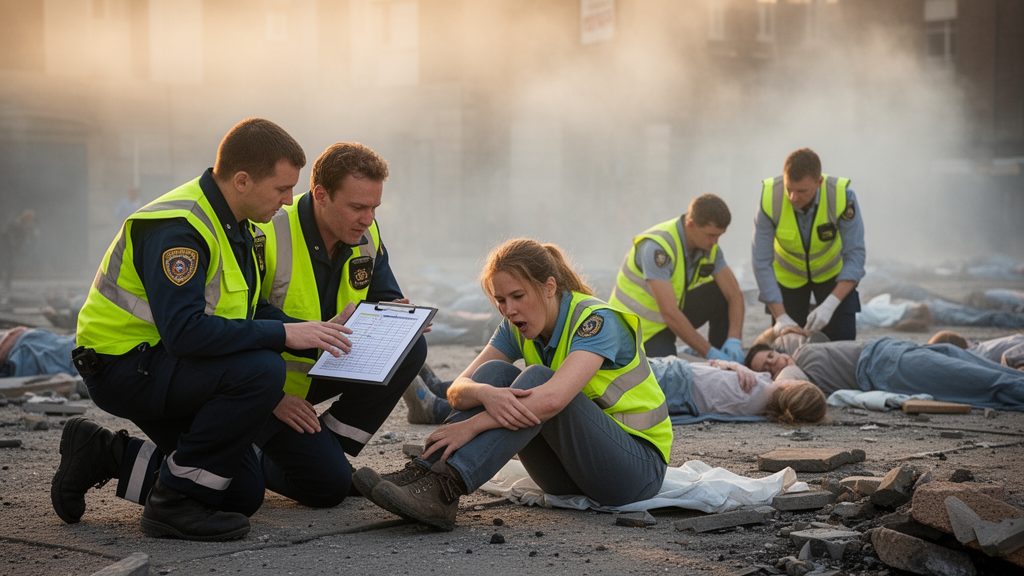
When a large-scale emergency strikes, responders must not only treat the physically injured but also identify relatives and close contacts of victims who are in acute psychological distress. A new study published in BMC Psychology suggests that a simple structured checklist can help emergency responders make those psychological triage decisions more consistently, at least in simulated scenarios.
The research, led by Fernando Amador Muñoz and colleagues, used a quasi-experimental two-group design. One group of emergency responders carried out psychological triage with a structured Checklist, while a comparison group performed the same task without any support material. Both groups assessed an identical set of simulated cases presented through standardised video-based scenarios. The triage system itself was based on a three-level, color-coded scheme—red, yellow and green—reflecting increasing levels of psychological risk, with red indicating the highest priority.
To judge performance, the researchers defined prioritisation accuracy relative to a reference standard established by an independent expert panel. They then analysed triage performance and assessor-related variables using a multilevel logistic regression model alongside complementary statistical tests.
The results showed that the Checklist improved overall prioritisation accuracy and reduced systematic misclassification in mild and ambiguous cases—precisely the situations where triage decisions are hardest and where inconsistency is most likely. Its contribution was less pronounced in high-priority scenarios.
Perhaps more striking was what the study did not find. Assessor-related variables including emotional intelligence, psychology training, sex and age did not predict triage performance, suggesting that individual background characteristics alone did not determine who triaged well in these simulations. The one exception was resilience, which showed a small inverse association with accuracy.
The study’s authors frame the work as an evaluation of a tool whose empirical testing has been scarce. Psychological triage in large-scale emergencies involving relatives and close contacts of victims remains insufficiently standardised, despite growing recognition of their acute distress and anticipatory anxiety.
Importantly, the team is explicit about the limits of the evidence. The Checklist is preliminary, and the design carries limitations that the authors acknowledge directly. In their conclusions, they state that the results should be considered initial evidence rather than definitive validation of the instrument.
Even so, the findings point toward a practical direction: simple, evidence-informed tools may support rapid prioritisation in large-scale emergencies, where responders must make fast judgments about people who are not physically injured but are psychologically at risk. The authors emphasise the need for continued refinement and validation of triage instruments before any firm conclusions can be drawn about their value in real-world disaster response.
Subject of Research: A structured checklist for psychological triage of distressed relatives in multi-affected emergencies, tested with emergency responders in simulated video scenarios.
Article Title: Psychological triage in multi-affected incidents: a simulated video-based assessment study with emergency responders in Spanish-speaking countries
Article References: Muñoz, F. A., Barón, F. J., Trillo, J., & Miranda, J. (2026). Psychological triage in multi-affected incidents: a simulated video-based assessment study with emergency responders in Spanish-speaking countries. BMC Psychology. https://doi.org/10.1186/s40359-026-05554-7
Image Credits: AI Generated
DOI: 10.1186/s40359-026-05554-7
Keywords: psychological triage, emergency responders, disaster response, checklist, simulation study, mental health, BMC Psychology, prioritisation accuracy, multilevel logistic regression, quasi-experimental design, Psychological, triage
Cite Scienmag News
Glenn Wilkins. (October 28, 2026). Checklist Helps Emergency Responders Triage Psychological Distress in Simulated Disasters. Scienmag. https://scienmag.com/checklist-helps-emergency-responders-triage-psychological-distress-in-simulated-disasters/
Glenn Wilkins. "Checklist Helps Emergency Responders Triage Psychological Distress in Simulated Disasters." Scienmag, 28 October 2026, https://scienmag.com/checklist-helps-emergency-responders-triage-psychological-distress-in-simulated-disasters/. Accessed 28 October 2026.
Glenn Wilkins. "Checklist Helps Emergency Responders Triage Psychological Distress in Simulated Disasters." Scienmag. October 28, 2026. https://scienmag.com/checklist-helps-emergency-responders-triage-psychological-distress-in-simulated-disasters/