


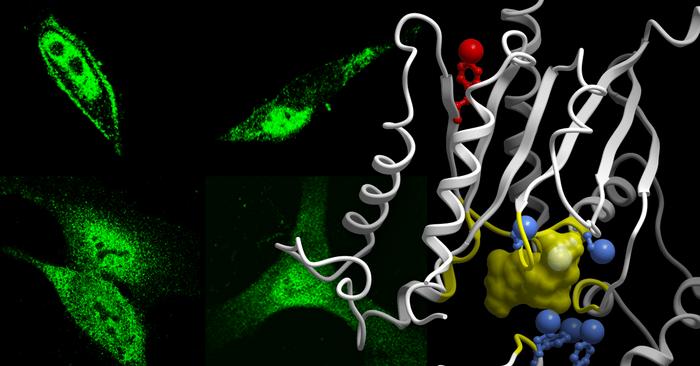
A group of researchers at University of California San Diego has identified the cause of a “short-circuit” in cellular pathways, a discovery that sheds new light on the genesis of a number of human diseases.

Credit: UC San Diego Health Sciences
A group of researchers at University of California San Diego has identified the cause of a “short-circuit” in cellular pathways, a discovery that sheds new light on the genesis of a number of human diseases.
The recent study, published in the journal Science Signaling, explores the biochemical mechanism that can interrupt the cellular communication chain — a disruptive interaction that Pradipta Ghosh, M.D., likens to a game-ending “buzzer.” Ghosh, a professor in the Departments of Medicine and Cellular and Molecular Medicine at University of California San Diego School of Medicine, and Irina Kufareva, Ph.D., an associate professor in the Skaggs School of Pharmacy and Pharmaceutical Sciences at University of California San Diego, are the corresponding authors on the paper.
The paper explains the mechanism of “cross talk” between two cellular pathways, one initiated by proteins known as growth factors and by their cellular receptors. The second pathway is mediated by a completely different G protein-coupled set of cellular receptors (GPCRs). Both classes of receptors deliver molecular messages from outside to inside the cell and signal cells to change in some way. Kufareva says that members of the GPCR family are targets of around 34 percent of all the drugs approved by the U.S. Food and Drug Administration.
“GPCRs are important drug targets mainly due to their involvement in signaling pathways related to many diseases,” she explained, citing mental and endocrinological disorders, viral infections, cardiovascular and inflammatory conditions, and even cancer.
Growth factors enable a second, equally important communication pathway inside the cell that makes the cells grow and divide. Whereas GPCRs act through intracellular molecular switches (G proteins), growth factor receptors are conventionally thought to bypass the switches. However, Ghosh and Kufareva note that researchers had been suspicious about some kind of a potential conflict between the two pathways, and careful research allowed the UC San Diego team to identify it.
Ghosh said the conflict stems from problematic phosphorylation, the attachment of a phosphate group to the G protein molecule. She explained that the team used advanced mass spectrometry techniques to map all occurrences of phosphoevents, the sites on G proteins that were phosphorylated when cells were stimulated by growth factors. Then they checked how this changed the ability of G proteins to perform their normal job downstream of GPCRs.
“Whatever aspect of GPCR signaling we looked at, it was negatively impacted by almost all phosphoevents on the ‘switch’ protein — the G protein — that would be introduced by growth factors,” Kufareva said. “That was understandable when we looked at how these phosphoevents distorted the G protein structure. Growth factors effectively ‘steal’ G proteins from GPCRs and in this way paralyze their signaling.”
Further testing of the phosphoevents showed that one single amino acid was responsible for the G protein theft. Ghosh said the amino acid known as tyrosine is located at position 320 within the G protein, which happens to be on the side of the G protein that makes contact with G protein-coupled receptors.
“This specific tyrosine was identified almost a decade ago as a special ‘trigger point’ for G protein-coupled receptors to relay their signals. We began to think about the importance of such a coincidence,” Ghosh explained. “That’s when a light bulb went off in our heads: If cell communication were a game, the tyrosine at position 320 on the G protein would be the buzzer. If the growth factors got to it first and phosphorylated that site, the G protein-coupled receptors simply had no shot!”
Kufareva and Ghosh say that the group’s discovery has implications for the development of new therapies for a number of conditions, including cancer. Ghosh said that many pharmaceuticals on the market are effective in treating a wide range of diseases because the drugs target G protein-coupled receptors. But there remain a number of conditions without good drug therapies — fibrosis, chronic inflammation and cancers — because until now the interaction of these two pathways has not been understood.
“We believe our findings are likely to be both important and timely, and will contribute to other emerging studies mapping the landscape of these two major signaling pathways that control practically every process in our cells,” Ghosh said.
“Our work is especially relevant in that growth factors, their receptors, and G-protein-coupled receptors appear to be highly co-expressed in many cancers,” added Kufareva.
All authors on the paper are associated with UC San Diego. Suchismita Roy, Saptarshi Sinha and Ananta James Silas are members of the School of Medicine’s Department of Cellular and Molecular Medicine, while Majid Ghassemian is a member of the Department of Chemistry and Biochemistry, Biomolecular and Proteomics Mass Spectrometry Facility.
This paper was supported by the National Institutes of Health (CA238042, AI141630, CA100768 and CA160911 to Pradipta Ghosh; R21 AI149369, R01 GM136202, R21 AI156662, and R01 AI161880 to Irina Kufareva). Saptarshi Sinha was supported through the American Association of Immunologists Intersect Fellowship Program for Computational Scientist and Immunobiologists.
# # #
Journal
Science Signaling
COI Statement
The authors declare no competing interests.
Cite Scienmag News
Nathaniel Bowman. (June 4, 2024). Chasing down a cellular ‘short circuit’. Scienmag. https://scienmag.com/chasing-down-a-cellular-short-circuit/
Nathaniel Bowman. "Chasing down a cellular ‘short circuit’." Scienmag, 4 June 2024, https://scienmag.com/chasing-down-a-cellular-short-circuit/. Accessed 4 September 2026.
Nathaniel Bowman. "Chasing down a cellular ‘short circuit’." Scienmag. June 4, 2024. https://scienmag.com/chasing-down-a-cellular-short-circuit/

