


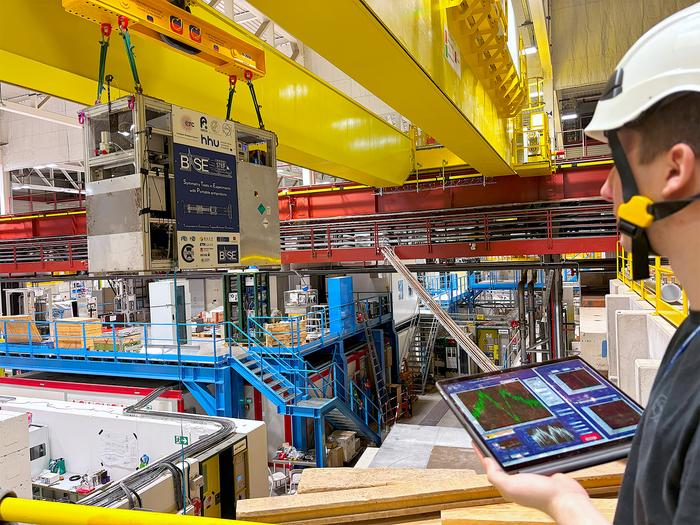
In a landmark breakthrough, the BASE collaboration, with significant contributions from Heinrich Heine University Düsseldorf (HHU), has achieved a pioneering feat in antimatter research by successfully relocating protons outside the confines of an antimatter laboratory using an innovative autonomous Penning-trap system. This development not only revolutionizes the logistics of handling antimatter particles but also paves the way for transporting precious antiprotons produced at CERN to high-precision facilities worldwide, marking a new era in experimental particle physics.
At the heart of this achievement lies the BASE-STEP system—an open, superconducting, transportable Penning trap designed to autonomously confine charged particles, such as protons and, in the future, antiprotons. Penning traps utilize a combination of strong magnetic and electric fields to confine charged particles in a defined region of space, enabling ultra-precise measurements of their fundamental properties. Traditionally, these systems require stringent laboratory settings with stable electromagnetic environments, but BASE-STEP’s novel design allows it to operate independently during transportation in conventional vehicles amid everyday environmental noise.
The significance of relocating these particles cannot be overstated. CERN’s Antimatter Factory produces low-energy antiprotons, essential for probing fundamental symmetries in physics with extraordinary precision. However, performing these delicate experiments near accelerators is fraught with challenges; magnetic field fluctuations from accelerator operations severely limit measurement accuracy. Thus, transporting antiprotons to specialized laboratories equipped for ultra-sensitive measurements—such as the new BASE-HHU facility in Düsseldorf—is crucial for advancing the understanding of matter-antimatter asymmetries.
Protons, the basic constituents of ordinary matter, share an almost perfect mirrored counterpart in antiprotons, which bear identical mass but opposite electric charge and magnetic moment. According to the Standard Model of particle physics, both should exhibit symmetrical properties; however, slight differences must exist to explain the observed excess of matter over antimatter in the universe. BASE seeks to identify these subtle deviations by exploiting the precision capabilities of Penning traps and advanced spectroscopic techniques.
Professor Dr. Stefan Ulmer, a leading physicist at HHU and founder of the BASE collaboration, emphasizes the challenge posed by the noisy electromagnetic environment near accelerator centers: “Achieving the sensitivity required to detect minute anomalies in the magnetic moment or charge-to-mass ratio demands an environment largely free of magnetic disturbances.” This necessity spurred the development of a mobile solution, enabling trapped particles to be relocated without loss or perturbation.
In the autumn of 2024, the team demonstrated the first-ever lossless transport of a cloud of protons from CERN’s Antimatter Factory using BASE-STEP. Operated autonomously and without external power for over four hours, the system maintained confinement integrity throughout typical road transit conditions. This milestone operation confirms that the intricate electromagnetic confinement of charged particles can survive transportation outside shielded laboratory environments—a feat previously deemed nearly unattainable.
Marcel Leonhardt, a master’s student at HHU and lead author of the pioneering study detailing these results, notes the broader implications: “The ability to safely and reliably transport particles in everyday traffic scenarios opens unprecedented opportunities for collaborative experiments across the continent. We could envision a network of laboratories sharing antimatter and exotic ions for detailed study without geographical limitations.”
The BASE-STEP system’s modular design also includes adaptability for extended journeys. Mobile power units can supply continuous operation beyond the initial autonomous four-hour window, theoretically enabling intercity or even intercontinental transport. Dr. Christian Smorra, project leader, envisions a future where laboratories across Europe, and eventually the world, can exchange rare particle samples, catalyzing an era of distributed precision science.
As promising as the proton transport results are, the ultimate goal remains the lossless relocation of antiprotons. These particles, essential for mass, charge, and magnetic moment comparison experiments, are produced only at CERN’s unique Antiproton Decelerator facility. Success in transporting these delicate antiparticles will alleviate the need for duplicative antimatter facilities and facilitate unprecedented measurement accuracies by leveraging optimal experimental environments.
Beyond antiprotons, the technology’s versatility offers a gateway to studying a plethora of exotic species including highly charged ions, molecular ions, and charged antimatter ions. Transporting these species independently of accelerator labs can fundamentally change the landscape of precision spectroscopy, quantum state preparation, and fundamental symmetry testing across physics and chemistry disciplines.
Continued refinement of autonomous, superconducting trapping and transport technologies stands to transform antimatter research into a more collaborative and globally accessible enterprise. Enabling high-precision measurements in optimized conditions far from high-energy particle accelerators circumvents magnetic interference, potentially pushing the frontier of our understanding of CPT (charge-parity-time) invariance and the underpinnings of the Standard Model itself.
The BASE collaboration has already delivered the most exacting tests of CPT symmetry with baryons, achieving relative uncertainties in the charge-to-mass ratio measurements at the astonishingly small scale of parts per trillion. This new capability to relocate particles without loss complements these achievements by expanding where such tests can be conducted, likely accelerating discovery and validation phases for fundamental physics inquiries.
In essence, the autonomous Penning-trap transport system not only solves a long-standing logistical issue in antimatter science but also unlocks a new paradigm in experimental flexibility. As the team moves toward successfully transporting antiprotons, the physics community stands on the cusp of enhanced precision measurements that may unveil the anomalies revealing the universe’s primordial matter-antimatter imbalance.
This groundbreaking work, published in the prestigious journal Nature, was primarily supported by the European Research Council and represents a milestone achievement for the BASE international collaboration—a consortium including institutes from Germany, Switzerland, the United Kingdom, and Japan. It highlights the synergetic blend of cutting-edge physics, engineering ingenuity, and collaborative scientific vision now driving antimatter research into the future.
News Publication Date: 14-May-2025
Web References:
https://www.nature.com/articles/s41586-025-08926-y
https://home.cern/science/experiments/base
References:
M. Leonhardt, D. Schweitzer, F. Abbass, K. K. Anjum, B. Arndt, S. Erlewein, S. Endo, P. Geissler, T. Imamura, J. I. Jäger, B. M. Latacz, P. Micke, F. Voelksen, H. Yildiz, K. Blaum, J. A. Devlin, Y. Matsuda, C. Ospelkaus, W. Quint, A. Soter, J. Walz, Y. Yamazaki, S. Ulmer, and C. Smorra. Proton Transport from the Antimatter Factory of CERN. Nature (2025). DOI: 10.1038/s41586-025-08926-y
Keywords
Protons, Antimatter, Penning trap, Particle transport, CPT invariance, Antiproton Decelerator, High-precision spectroscopy, BASE collaboration, Superconducting trap, Fundamental symmetries
Cite Scienmag News
Katie Riggs. (May 14, 2025). Charged Particles in Motion: The Journey of Protons. Scienmag. https://scienmag.com/charged-particles-in-motion-the-journey-of-protons/
Katie Riggs. "Charged Particles in Motion: The Journey of Protons." Scienmag, 14 May 2025, https://scienmag.com/charged-particles-in-motion-the-journey-of-protons/. Accessed 4 September 2026.
Katie Riggs. "Charged Particles in Motion: The Journey of Protons." Scienmag. May 14, 2025. https://scienmag.com/charged-particles-in-motion-the-journey-of-protons/


