


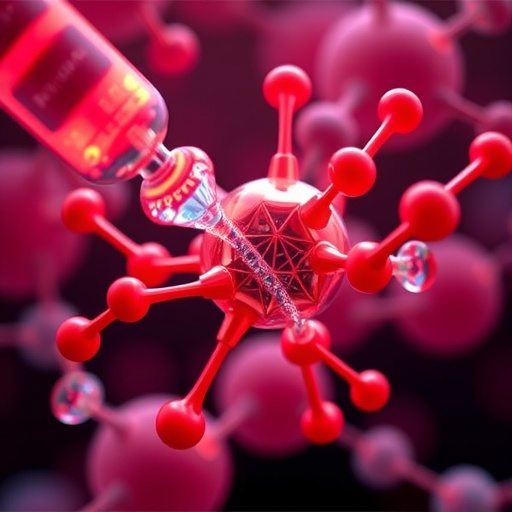
In the rapidly evolving landscape of targeted therapeutics, a groundbreaking study has unveiled a novel strategy that promises to revolutionize drug discovery and molecular biology: the identification of charged molecular glues enabled through targeted degron display. This remarkable advancement, detailed in a recent publication in Nature Chemical Biology, has far-reaching implications for the design of next-generation therapeutic agents that exploit the cell’s ubiquitin-proteasome system to selectively degrade disease-causing proteins.
At the heart of this breakthrough lies the concept of molecular glues—small molecules that facilitate the interaction between two proteins, often leading to the ubiquitination and subsequent degradation of a target protein. Unlike traditional inhibitors, which block protein function by binding active sites, molecular glues work by recruiting an E3 ubiquitin ligase to a target protein through induced proximity. However, despite their therapeutic promise, discovering molecular glues has been largely serendipitous due to the challenges in screening and identifying compounds capable of inducing such protein-protein interfaces.
The team led by Zhuang, Byun, Chrustowicz, and colleagues has introduced an innovative targeted degron display platform that systematically exposes degron motifs—short peptide sequences that signal proteins for degradation—and screens for charged molecular glues that can recruit E3 ligases in a highly selective manner. This strategic display of degrons allows for a precision-driven approach to uncovering molecular glues with unprecedented efficiency and specificity.
Mechanistically, this approach harnesses the intrinsic properties of charged amino acid residues within these degron sequences, which play critical roles in molecular recognition and binding affinity. By carefully tailoring and displaying these charged degron motifs, the researchers have created a screening environment that mimics the natural cellular context, enabling the identification of small molecules that bridge proteins via electrostatic interactions—a modality often overlooked in conventional screening paradigms.
The study details the design and construction of a high-throughput assay incorporating various charged degron sequences fused to a reporter system. This system quantitatively measures the recruitment efficacy of candidate molecular glues to E3 ligases, thereby enabling the rapid evaluation of molecular glue libraries. Through iterative screening and refinement, the platform yielded a new class of charged molecular glues capable of selectively degrading target proteins implicated in cancer and neurodegenerative diseases.
One of the compelling aspects of this technique is its ability to reveal nuanced insights into the physicochemical determinants of molecular glue activity. The researchers observed that electrostatic complementarity between the degron’s charged residues and ligand moieties on molecular glues significantly modulates binding kinetics and degradation potency. This finding not only enhances our understanding of molecular glue function but also provides a rational framework for the future design of charged ligands.
Moreover, the targeted degron display approach circumvents a critical bottleneck in drug discovery: the lack of structural information for many protein targets, especially those considered undruggable due to the absence of traditional binding pockets. By focusing on the degron-mediated recruitment processes instead of classical active sites, this method expands the druggable proteome landscape, offering hope for previously intractable diseases.
The broader implications of this research extend beyond therapeutic applications, touching upon fundamental biology and protein homeostasis regulation. By selectively modulating protein degradation pathways through charged molecular glues, scientists now have a powerful tool to dissect protein function dynamically and temporally within cells, enabling deeper exploration of cellular signaling networks and disease pathology.
From a translational perspective, the discovery also paves the way for precision medicine strategies tailored to individual degradation profiles. Personalized degron display libraries could be engineered based on patient-specific proteomic data, leading to bespoke molecular glues that effectively target aberrant proteins driving disease in a highly patient-specific manner.
Importantly, the versatility of the targeted degron display platform suggests potential for adaptation to diverse E3 ligase systems and protein classes, which is vital given the complex and heterogeneous nature of the ubiquitin-proteasome system. This modularity enhances the platform’s utility, making it a universal tool for molecular glue discovery across multiple therapeutic areas.
The study also underscores the increasing interplay between chemical biology, structural biology, and computational modeling. By integrating degron design, ligand chemistry, and biophysical analysis, the researchers achieved a synergistic methodology that accelerates not only discovery but also mechanistic elucidation—a critical axis in rational drug design.
In conclusion, the development of charged molecular glue discovery enabled by targeted degron display represents a hallmark advancement that transcends traditional drug discovery paradigms. By exploiting the dynamic interplay of charged degron motifs and small molecules, this innovative platform unlocks new frontiers in selective protein degradation with profound implications for therapeutic development, disease modeling, and chemical biology.
As the field continues to push the boundaries of what is feasible in manipulating the proteome, the insights and technologies presented in this study will undoubtedly serve as a beacon for future innovations, propelling molecular glue discovery into a new era defined by precision, efficiency, and therapeutic promise.
Cite Scienmag News
Ophelia Keating. (April 6, 2026). Charged Molecular Glue Discovery Via Targeted Degron. Scienmag. https://scienmag.com/charged-molecular-glue-discovery-via-targeted-degron/
Ophelia Keating. "Charged Molecular Glue Discovery Via Targeted Degron." Scienmag, 6 April 2026, https://scienmag.com/charged-molecular-glue-discovery-via-targeted-degron/. Accessed 3 September 2026.
Ophelia Keating. "Charged Molecular Glue Discovery Via Targeted Degron." Scienmag. April 6, 2026. https://scienmag.com/charged-molecular-glue-discovery-via-targeted-degron/


