


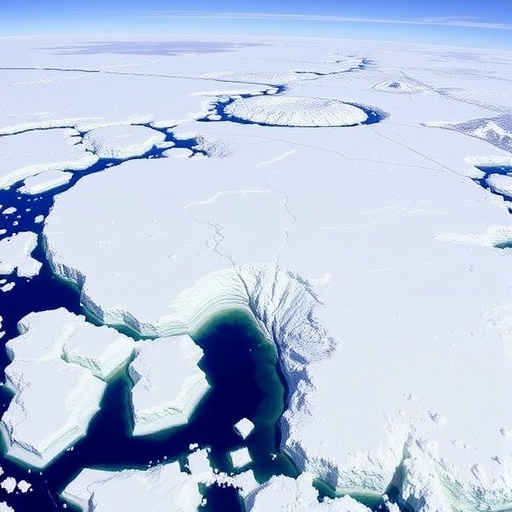
In the relentless expanse of Antarctica’s icy wilderness, a new study has unveiled a startling revelation about the vulnerability of its ice shelves to melting. Published in Nature Communications, this groundbreaking research reveals how beneath seemingly static ice surfaces lies a complex interplay of channelized topography that dramatically amplifies the sensitivity of cold Antarctic ice shelves to melting processes. This discovery not only alters our understanding of ice sheet dynamics but also signals urgent implications for global sea level rise projections.
Antarctica’s ice shelves, the floating extensions of the continental ice sheet, act as critical buffers slowing the flow of inland ice into the ocean. For years, scientists have recognized their significance in maintaining ice sheet stability and therefore their role in modulating global sea levels. However, the intricate mechanisms governing their response to climate-induced melting have remained elusive, especially in colder regions of Antarctica where melting is limited yet evidently impactful.
The research team, led by Qing Zhou and colleagues, focused on the influence of sub-ice shelf topography—specifically channelized or trough-like features carved into the Antarctic bedrock beneath ice shelves. Using a combination of high-resolution radar mapping and advanced ice flow modeling, the scientists demonstrated that these submerged channels act as focal points for ocean water to intrude under the ice, intensifying localized melting despite the overall cold conditions.
This phenomenon drastically modifies previous assumptions that cold ice shelves were less susceptible to ocean-driven melt due to their lower basal temperatures. Instead, the channelized landscape funnels warmer circumpolar deep water into confined spaces, accelerating melting in these zones. The study shows an amplification effect where modest ocean warming corresponds to significantly enhanced melt rates precisely where these channels exist.
Utilizing data collected from multiple Antarctic sectors, the study captures how this channelized topography varies spatially and impacts ice shelf melting heterogeneously. Some of the coldest ice shelves, once thought stable, are now understood to possess intricate troughs beneath them, acting as conduits for warmer water masses. The presence of these features fundamentally changes the thermal dynamics at the ice-ocean interface.
The authors applied sophisticated numerical models that simulate ocean circulation beneath ice shelves and the resulting melt patterns. By integrating the detailed bathymetric measurements with thermodynamic equations governing ice melt, the models quantified how channelization enhances the sensitivity of ice shelf basal melting to changes in ocean temperature. This coupling between topography and ocean physics enables prediction of future ice shelf responses under various climate scenarios with unprecedented accuracy.
Aside from its theoretical contributions, this insight holds profound practical value for climate science. Ice shelf thinning and disintegration are precursors to accelerated ice discharge from the Antarctic interior. Understanding which ice shelves are most vulnerable allows for better risk assessments concerning sea level rise, particularly over the coming decades when ocean warming is expected to continue.
Furthermore, the research underscores the heterogeneous nature of Antarctic ice shelf melting. Rather than uniform thinning, melting is concentrated along these channelized corridors, leading to potential weaknesses in ice shelf structure such as crevasse formation and fracturing. This spatial variability complicates predictions but offers critical targets for future monitoring and intervention efforts.
Significantly, the study also suggests a feedback mechanism wherein melting deepens these channels over time, further enhancing ocean water access and accelerating melt rates in a self-reinforcing cycle. This positive feedback could explain some rapid ice shelf collapses observed in recent years and signals an urgent need to incorporate channelized topography into climate models.
The research brings attention to the limitations of current large-scale ice sheet models which often smooth over fine-scale topographic features beneath ice shelves. By ignoring these critical channels, such models may underestimate melt sensitivity and the speed of ice deterioration. Incorporating detailed sub-ice topography data promises to refine projections and better inform policy decisions.
In the broader context, these findings dovetail with growing evidence that Antarctic ice shelves are highly dynamic systems intimately coupled to ocean circulation changes. With ongoing shifts in global climate patterns driving alterations in ocean temperature and circulation, the fate of the continent’s vulnerable ice shelves appears increasingly uncertain.
For glaciologists and climate scientists, this study marks a milestone in unraveling the complexity of ice-ocean interactions. It calls for enhanced observational campaigns focusing on sub-ice shelf bathymetry and for increased collaboration between oceanographers and glaciologists aiming to develop integrated models capturing fine-scale processes critical to ice shelf stability.
As concern mounts worldwide regarding the trajectory of sea level rise, innovations like this research remind us that seemingly minor landscape features beneath the Antarctic ice can wield outsized influence over global climate outcomes. It stands as a clarion call for intensified scientific inquiry and policy vigilance to mitigate the cascading impacts of a warming world.
Ultimately, the discovery that channelized sub-ice topography magnifies melt sensitivity in cold Antarctic ice shelves shifts the paradigm of cryospheric science. It redefines vulnerability zones, challenges existing assumptions, and equips the scientific community with new tools to anticipate and perhaps temper future ice shelf loss.
While the full implications of these discoveries will unfold with ongoing research, one thing is clear: Antarctica’s frozen frontiers harbor hidden intricacies that are vital to our planet’s climate equilibrium. The key lies not just in observing the surface but in decoding the submerged landscapes that orchestrate the fragile balance of ice and ocean.
This pioneering work by Zhou, Hattermann, Zhao, and colleagues exemplifies the power of technological advancement combined with scientific collaboration. By illuminating the hidden corridors beneath Antarctic ice shelves that govern melt behavior, it provides a critical piece of the puzzle in understanding—and responding to—the rapidly changing cryosphere.
As climate change accelerates, refining our grasp of Antarctic ice shelf dynamics through the lens of channelized topography may prove indispensable. It may well determine how effectively humanity can anticipate sea level rise and implement adaptation strategies before irreversible tipping points are crossed in Earth’s southernmost reaches.
Cite Scienmag News
Violet Maxwell. (May 7, 2026). Channelized Topography Boosts Antarctic Ice Shelf Melt. Scienmag. https://scienmag.com/channelized-topography-boosts-antarctic-ice-shelf-melt/
Violet Maxwell. "Channelized Topography Boosts Antarctic Ice Shelf Melt." Scienmag, 7 May 2026, https://scienmag.com/channelized-topography-boosts-antarctic-ice-shelf-melt/. Accessed 5 September 2026.
Violet Maxwell. "Channelized Topography Boosts Antarctic Ice Shelf Melt." Scienmag. May 7, 2026. https://scienmag.com/channelized-topography-boosts-antarctic-ice-shelf-melt/


