


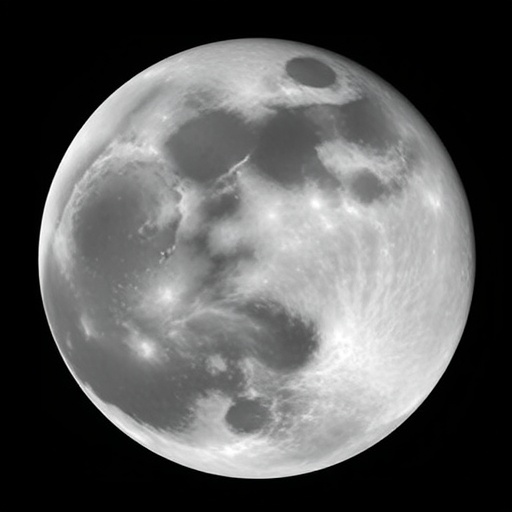
The recent publication by Wang, Chen, Chen, and colleagues marks a transformative leap in lunar geology, revealing compelling insights into the solidification processes of the Moon’s primitive magma oceans. This groundbreaking research, featured in Nature Communications (2026), provides substantial evidence that the anorthositic crust on the lunar farside formed through a solidification regime remarkably consistent with that of the nearside, upending previous notions of hemispherical asymmetry in lunar crust development and composition.
The Moon’s crust is predominantly anorthositic, primarily composed of plagioclase feldspar, and its formation is intricately tied to the crystallization and cooling of a hypothesized global magma ocean that existed shortly after the Moon’s formation. For decades, planetary scientists have debated whether the lunar farside’s anorthositic crust grew under conditions identical to, or fundamentally different from, its nearside counterpart. The study by Wang et al. leverages samples and data obtained from the Chang’e-6 mission, the most recent and sophisticated Chinese lunar probe that successfully retrieved farside lunar material, propelling our understanding of crustal genesis to unprecedented levels.
Utilizing state-of-the-art geochemical analysis and remote sensing data integrated with high-precision isotopic measurements, the researchers meticulously characterized the mineralogical, petrographic, and chemical compositions of anorthosites from the Chang’e-6 landing site. These comprehensive datasets were then subjected to thermodynamic modeling to simulate crystallization sequences and magma ocean viscosity parameters, revealing that the farside anorthosites emerged from a crystallizing magma ocean whose cooling rate, depth, and compositional stratification mirrored those on the nearside.
This hemispherical comparability challenges earlier theories suggesting that asymmetric heat flux variations and mantle convection patterns created distinct differentiation paths, resulting in heterogeneous crustal architecture. Instead, the findings imply that the lunar magma ocean’s solidification dynamics operated under a largely global homogenized environment. The implications of such a scenario extend far beyond lunar science, potentially informing models of early planetary crust formation throughout the inner solar system.
Moreover, the study’s geochemical fingerprints elucidate a more profound understanding of melt evolution and ferroan anorthosite formation processes. The researchers observed consistent plagioclase crystallization sequences and compositional zoning within mineral grains that point to steady-state magma ocean crystallization without spatial heterogeneity. This uniformity suggests that post-crystallization magmatic processes, rather than initial mantle heterogeneities, primarily influenced the observed crustal variations across hemispheres.
The Chang’e-6 samples also provide a rare opportunity to connect sample-based petrology with orbital geophysics. The close correspondence between subsurface density anomalies detected by lunar gravity mapping and the chemical signature of crustal anorthosites supports the hypothesis of a uniform crustal composition and thickness. These results are pivotal in refining crustal thickness models and assessing the Moon’s thermal evolution during its formative epochs.
By demonstrating that the lunar magma ocean’s solidification was hemispherically comparable, the research offers robust constraints on the timing, duration, and crystallization kinetics of early lunar crust formation. Such constraints resonate strongly with isotopic age dating, which indicates rapid early differentiation and solidification within a relatively narrow geochronological window. This synchronization underscores a dynamically uniform cooling regime that potentially mirrors conditions on other planetary bodies that experienced global magma oceans.
Technically, the integration of advanced mass spectrometry techniques, particularly Ti isotopic and trace element analyses, has been critical in determining source homogeneity and crustal mixing processes. These isotopic tracers lack significant variation between farside and nearside samples, providing compelling evidence against hemispheric compositional dichotomy in the primordial lunar crust. This finding recalibrates prevailing hypotheses about the Moon’s early internal dynamics and radioactive heat distribution.
The Chang’e-6 mission’s success in retrieving pristine lunar farside anorthosites was a technological and logistical triumph, opening new frontiers for in situ lunar geochemistry. The mission’s enhanced landing precision and sample return protocols allowed for high-fidelity material unaffected by terrestrial contamination, a perennial challenge in lunar studies. This pristine nature enabled the researchers to unravel subtle compositional nuances and confidently assert global uniformity in lunar crust formation mechanisms.
The global magma ocean model’s validation through these findings enhances the broader planetary science narrative, particularly regarding the early thermal and magmatic evolution of differentiated planetary bodies. The processes governing lunar crust crystallization provide analogs for examining the early histories of terrestrial planets, moons, and even differentiated asteroids. Understanding magma ocean solidification dynamics is thus essential for reconstructing planetary accretion and differentiation history across the inner solar system.
Furthermore, the work by Wang et al. underscores the synergistic value of integrating remote sensing with returned sample science. By mapping surface mineralogy and gravity anomalies and correlating these remote datasets with laboratory analyses, the study represents a holistic approach, setting a new standard for extraterrestrial geological investigations. This multidisciplinary strategy provides a template for future lunar missions and sample return endeavors aimed at unearthing the Moon’s most profound geological secrets.
From an academic perspective, the study invites re-examination of lunar models that invoke late-stage hemispherical variations driven by mantle overturn or asymmetric impact bombardment. If the lunar magma ocean solidification and early crust formation were more uniform than previously assumed, the genesis of nearside-farside compositional differences observed today may predominantly stem from localized post-solidification processes or mantle convection patterns emerging later in lunar history.
In conclusion, the Chang’e-6 derived data and analytical advancements have unlocked a paradigm shift in lunar science by unequivocally evidencing hemispherical equivalency in early lunar magma ocean solidification. This revelation not only enriches our understanding of the Moon’s geological evolution but also bolsters the broader planetary science framework concerning how primordial planetary crusts crystallize from magma oceans. The insights gleaned illuminate pathways for future explorations, including detailed investigations of planetary interiors, crust-mantle interactions, and the geochemical evolution of terrestrial bodies in our solar system.
Cite Scienmag News
Violet Maxwell. (May 15, 2026). Chang’e-6 Reveals Moon’s Hemispheric Magma Ocean Solidification. Scienmag. https://scienmag.com/change-6-reveals-moons-hemispheric-magma-ocean-solidification/
Violet Maxwell. "Chang’e-6 Reveals Moon’s Hemispheric Magma Ocean Solidification." Scienmag, 15 May 2026, https://scienmag.com/change-6-reveals-moons-hemispheric-magma-ocean-solidification/. Accessed 4 September 2026.
Violet Maxwell. "Chang’e-6 Reveals Moon’s Hemispheric Magma Ocean Solidification." Scienmag. May 15, 2026. https://scienmag.com/change-6-reveals-moons-hemispheric-magma-ocean-solidification/


