


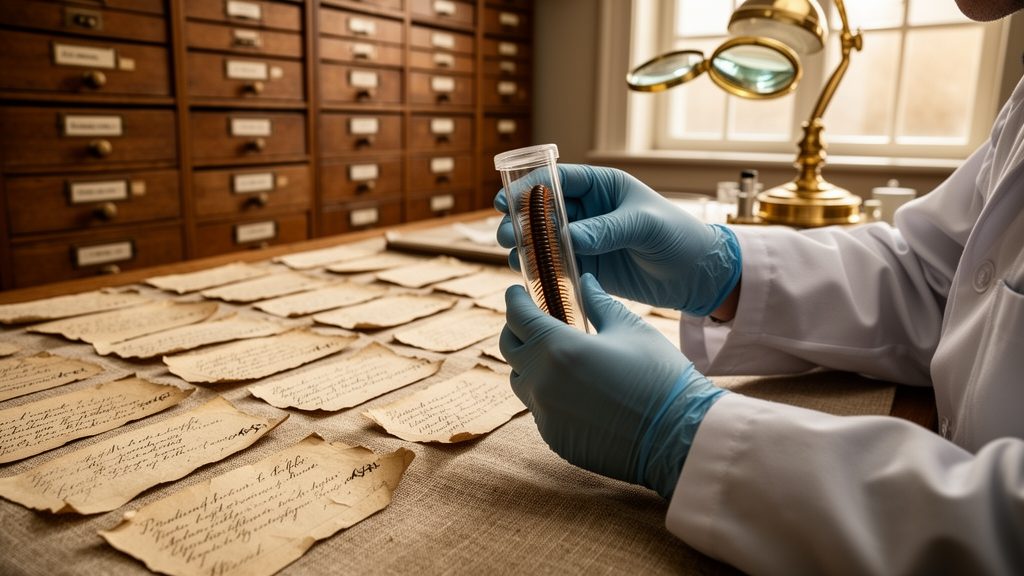
Deep in the stores of the Museum für Naturkunde Berlin sit tens of thousands of glass vials and boxes containing myriapods, the sprawling group of many-legged arthropods that includes millipedes, centipedes, and their little-known relatives the pauropods and symphylans. For more than a century, most of these specimens have carried handwritten labels recording little more than a place name, often in an archaic form of German that no longer appears on any modern map. A new study published in Zoosystematics and Evolution has now done the painstaking detective work of translating those labels into precise latitude and longitude coordinates, producing the first large-scale visualisation of where a single museum’s entire myriapod collection actually came from.
The scale of the undertaking was formidable. The researchers started with 15,648 individual catalogue entries, or lots, each based on the original specimen labels. Of these, 652 entries, roughly four percent, had no locality information at all, and five turned out to be woodlice, crustaceans that had been mistakenly registered as millipedes. After excluding records that could not be matched with confidence to a modern place name, along with those too vague to yield meaningful coordinates, the team extracted 2,366 localities for which geographical positions could be determined. Each coordinate was assigned an uncertainty estimate using the point-radius method, acknowledging that a label reading simply Riviera or Siebenbürgen can only ever be pinned down approximately.
The modernisation of place names was a central challenge. Many localities in Central Europe and the Baltic region were recorded under historical German names that were in common use when most of the material was collected in the late nineteenth and early twentieth centuries. The researchers used GeoNames as their primary reference for updating these to modern equivalents, supplemented by Wikipedia and specialist resources such as speleological websites for cave localities. Some sites proved genuinely elusive. The abandoned research station of Chinchoxo in West Africa appears only on old maps, while the Ralum station in Papua New Guinea had to be located using coordinates from an associated German colonial weather station.
The resulting maps reveal a collection dominated by Europe, which accounts for 1,799 localities, or 76 percent of the total. Within Europe, the focus falls squarely on Central Europe, with a broad band of collecting sites running through Germany, Switzerland, Austria, and northern Italy, and a particularly striking line of records along the Alps. Germany alone contributed 793 localities, spanning every federal state except Saarland. Africa ranks second with 216 localities, followed by Asia with 168, Oceania with 102, South America with 47, and North America with just 31, making it the least well-represented inhabited continent in the collection.
Much of the European pattern reflects the careers of two towering figures in German myriapodology. Karl Verhoeff, active from 1890 to 1945, was the single largest source of material, and his collecting trajectory can be read directly off the map: from the Bonn region where he studied, through Dresden and the Erzgebirge, to the Black Forest and Danube Valley, and finally to Bavaria where he settled. Otto Schubart, who worked in Germany from 1923 until emigrating to Brazil in 1934, left his own imprint, with dense clusters around his home in Potsdam and in his native Schleswig-Holstein. Verhoeff also left a methodological headache for future curators: he had a tendency to build type series from specimens gathered at multiple sites, then label the museum material only with the broad region of origin, making it impossible to determine exactly where individual objects were collected.
The Berlin dataset also preserves an unexpected snapshot of a vanished Germany. Because most of the collection was assembled before the Second World War, the mapped localities reflect the pre-1945 borders remarkably well, with records from East Prussia in what is now Poland and the Kaliningrad Oblast of Russia, from Silesia along the River Oder, and from Alsace in France. Notably, the collection shows no so-called GDR effect, the concentration of specimens that would be expected if collecting had been restricted to East Germany during the Cold War, since there were no major contributors after Verhoeff and Schubart. Surprisingly well-sampled corners of Europe include Estonia and Latvia, thanks to the Baltic German academic community, and even Scandinavia, via the Norwegian arachnologist Embrik Strand, who worked in Berlin for several years.
Beyond Europe, the maps trace the contours of German colonial history with uncomfortable clarity. The African holdings include localities from the former colonies of Togoland, Kamerun, Deutsch-Südwestafrika, and Deutsch-Ostafrika, corresponding to modern Togo, Cameroon, Namibia, and Tanzania, with collectors often being colonial officials, military officers, or scientists dispatched to the territories. Concentrations appear around Kilimanjaro, where Bror Yngve Sjöstedt collected in 1905 and 1906, and around Lake Victoria and the Lake Albert to Lake Kivu region, largely from the 1907 to 1908 Deutschen Zentralafrika-Expedition led by Hermann Schubotz. Yet the African record is not purely colonial: substantial material predates that era, including specimens gathered in Mozambique between 1842 and 1848 by Wilhelm Peters, later a director of the Berlin museum, and 27 localities in South Africa reaching back to Hinrich Lichtenstein, who became the museum’s first director in 1810.
Asia and Oceania tell similar stories of expeditions and empires. Indonesia is the largest single Asian source with 56 localities, collected by figures such as Eduard von Martens during the Prussian East Asia Expedition of the 1860s and Bernhard Rensch on the 1927 to 1928 Sunda Expedition. Japanese material includes specimens gathered by German academics recruited to help modernise the country during the Meiji period, while the short-lived German colony of Kiautschou explains records from Qingdao. In Oceania, 29 localities cluster in the former colony of Kaiser-Wilhelms-Land in northern Papua New Guinea, where Friedrich Dahl was based at the Ralum station from 1896 to 1897, and a remarkable 42 named localities concentrate around Perth in Western Australia, the legacy of a 1905 Hamburg research expedition. The Americas, by contrast, were only sporadically sampled, with many older records assigned to entities like the Viceroyalty of New Granada that cannot be translated into modern point data at all.
The authors are careful to stress what these maps are and what they are not. The point data document where specimens came from, not how many specimens each locality yielded, so a single centipede from Iceland and 166 lots from Dahme in northern Germany each appear as one dot. Nor do the maps constitute distributional or ecological data suitable for analysis without further work. Nevertheless, the study highlights a striking coincidence: many intensively sampled regions correspond to modern biodiversity hotspots, including the Mediterranean Basin, Tanzania, Madagascar, the Cape region of South Africa, Sri Lanka, the Sundaland complex, and south-western Australia. The researchers hope this will encourage regional specialists to work with the collections, verify identifications, and improve the overall quality of the data.
Perhaps the most valuable lesson of the project is methodological. Mapping old collection data, the authors note, is not a trivial undertaking and demands an appreciation of geography and history well beyond the usual biological training of museum curators. Genealogical websites proved unexpectedly useful for tracking down central and eastern European localities under their earlier German names, and some places remained frustratingly ambiguous, such as the several settlements called Lunow that could be in Brandenburg or in what is now West Pomerania in Poland. The raw data will eventually be exported into the museum’s collection database, and the authors present their work as a baseline for future studies of myriapod distributions worldwide, a reminder that the humblest specimen label, patiently decoded, can still yield scientific and historical insight more than a century after it was written.
Subject of Research: Georeferencing and mapping the historical locality data of the myriapod collection at the Museum für Naturkunde Berlin
Article Title: Mapping the collection: visualising locality data for myriapods in the Museum für Naturkunde Berlin
Article References: Dunlop, J. A., & Friederichs, A. (2026). Mapping the collection: visualising locality data for myriapods in the Museum für Naturkunde Berlin. Zoosystematics and Evolution, 102(1), 1-15. https://doi.org/10.3897/zse.102.167065
Image Credits: AI Generated
Keywords: myriapods, millipedes, centipedes, Museum für Naturkunde Berlin, georeferencing, natural history collections, biodiversity data, colonial history, Karl Verhoeff, Otto Schubart, distribution mapping, Zoosystematics and Evolution
Cite Scienmag News
Drew Townsend. (October 19, 2026). Century-old labels reveal where Berlin’s vast millipede collection really came from. Scienmag. https://scienmag.com/century-old-labels-reveal-where-berlins-vast-millipede-collection-really-came-from/
Drew Townsend. "Century-old labels reveal where Berlin’s vast millipede collection really came from." Scienmag, 19 October 2026, https://scienmag.com/century-old-labels-reveal-where-berlins-vast-millipede-collection-really-came-from/. Accessed 19 October 2026.
Drew Townsend. "Century-old labels reveal where Berlin’s vast millipede collection really came from." Scienmag. October 19, 2026. https://scienmag.com/century-old-labels-reveal-where-berlins-vast-millipede-collection-really-came-from/


