


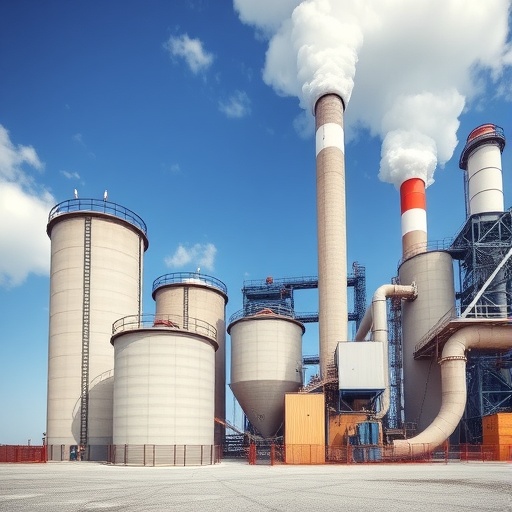
Cement could become more than a symbol of construction. In a new study, researchers at ETH Zurich report that cement manufacturing could be combined with direct air capture (DAC) to produce a material with a substantially lower, and potentially net-negative, climate impact. The approach uses the same calcium-based chemistry already central to cement production to remove carbon dioxide from the atmosphere, creating a possible link between one of the world’s largest industrial emission sources and a technology designed to reverse atmospheric pollution.
Cement is produced at an extraordinary scale, with roughly four billion tonnes manufactured globally each year. The industry currently contributes an estimated 5 to 8 percent of worldwide carbon dioxide emissions. A major share of those emissions does not come from burning fuel, but from the chemistry of making cement itself. During calcination, limestone—or calcium carbonate—is heated to high temperatures and breaks down into quicklime, or calcium oxide, and carbon dioxide. This unavoidable chemical reaction releases CO₂ even when the kiln is powered by clean energy.
The ETH Zurich team, led by André Bardow, examined whether this process could be redesigned to capture those emissions while also extracting additional carbon dioxide from the air. The study was conducted with Heirloom Carbon Technologies, a US company developing calcium-looping DAC systems. In this process, limestone and related calcium compounds circulate through a chemical cycle. The researchers’ analysis suggests that integrating DAC with cement production could reduce the climate impact of cement manufacturing by as much as 78 percent by 2050 through kiln electrification and direct capture of process emissions alone.
The proposed system relies on a kiln powered by electricity instead of coal, gas or other fossil fuels. Electrifying the kiln eliminates emissions from combustion, while the CO₂ released when limestone decomposes can be captured before it enters the atmosphere. Because this stream is not mixed with combustion exhaust gases, it is comparatively concentrated and easier to separate. The captured carbon dioxide can then be compressed and transported to underground storage, preventing it from returning to the atmosphere.
The system can also be designed to remove additional carbon dioxide from ambient air. Once water is added to quicklime, it becomes slaked lime, a calcium compound that can react with CO₂ in the atmosphere and convert back into limestone. Air contactors—large structures that move atmospheric air across reactive material—promote this absorption. The regenerated limestone can subsequently be processed again for cement production, while the carbon dioxide captured directly from the air is separated and permanently stored. Repeating the calcium cycle increases the amount of atmospheric CO₂ removed before the material is used in cement.
This combination offers an unusual industrial advantage: DAC based on calcium looping and cement manufacturing already depend on closely related materials and high-temperature processing. Instead of constructing an entirely separate chemical industry, the technology could potentially be attached to established cement supply chains. The changes would still require additional air-contacting equipment and low-carbon electric kilns, but the underlying chemistry is familiar to the cement sector. That compatibility could make the approach easier to scale than systems requiring entirely new industrial infrastructure.
The study is the first prospective life-cycle assessment of industrial-scale calcium-looping DAC, according to the researchers. Rather than examining only the operation of a capture plant, the analysis considered environmental impacts across the full chain, including raw-material extraction, equipment construction, energy consumption, plant operation and the underground storage of captured CO₂. The researchers also evaluated whether removing carbon would shift environmental pressure toward other areas, such as water consumption or land use.
Energy emerged as the dominant factor determining the system’s environmental performance. Capturing carbon dioxide from air is inherently energy-intensive because the gas makes up only a small fraction of the atmosphere. The team therefore tested several electricity scenarios, including the current US power mix, a heavily decarbonized grid supplied largely by wind and solar power, and an autonomous system using photovoltaic generation paired with battery storage. The cleaner the electricity, the greater the net climate benefit of the DAC-cement system.
Across the scenarios projected for 2050, the commercial calcium-looping plants analyzed by the researchers removed more CO₂ than they generated over their entire life cycle. Their estimated carbon-removal efficiency ranged from 85 to 96 percent. For every tonne of CO₂ captured and stored, between approximately 40 and 150 kilograms were emitted elsewhere in the process chain, depending largely on the energy source. Renewable electricity delivered the strongest performance, while more carbon-intensive power reduced the amount of net removal.
The concept is already being tested against real industrial data. Heirloom has operated a calcium-looping DAC facility in California since 2023, with a nominal annual capacity of 1,000 tonnes of CO₂, and plans a substantially larger plant in Louisiana. However, important uncertainties remain. Indirectly heated electric calcination kilns are not yet widely deployed at industrial scale, and the economics of integrating DAC into cement plants were outside the scope of the study. The researchers say future field trials must determine whether the technology can operate reliably and affordably while delivering the deep emissions cuts predicted by the life-cycle models.
News Publication Date: 4 June 2026
Web References: https://doi.org/10.1016/j.checir.2026.100041
References: Bolongaro V, Shu DY, McQueen N, Bardow A. “Life cycle assessment of solid calcium-looping direct air capture and its synergistic dual use for net-negative cement.” Chem Circularity, 4 June 2026. DOI: 10.1016/j.checir.2026.100041
Keywords
Direct air capture, carbon dioxide removal, cement production, calcium looping, carbon capture and storage, climate technology, industrial decarbonization, net-negative emissions, electrified kilns, renewable energy
Cite Scienmag News
Russell Cooper. (August 12, 2026). Cement Plants Could Help Remove CO₂ From the Atmosphere. Scienmag. https://scienmag.com/cement-plants-could-help-remove-co%e2%82%82-from-the-atmosphere/
Russell Cooper. "Cement Plants Could Help Remove CO₂ From the Atmosphere." Scienmag, 12 August 2026, https://scienmag.com/cement-plants-could-help-remove-co%e2%82%82-from-the-atmosphere/. Accessed 3 September 2026.
Russell Cooper. "Cement Plants Could Help Remove CO₂ From the Atmosphere." Scienmag. August 12, 2026. https://scienmag.com/cement-plants-could-help-remove-co%e2%82%82-from-the-atmosphere/


