

Sunday, May 3, 2026
Science
No Result
View All Result
  • Login
  • HOME
  • SCIENCE NEWS
  • CONTACT US
  • HOME
  • SCIENCE NEWS
  • CONTACT US
No Result
View All Result
Scienmag
No Result
View All Result
Home Science News Technology and Engineering

Cell contraction drive the initial shaping of human embryos

May 1, 2024
in Technology and Engineering
Reading Time: 2 mins read
0
Cell contraction drive the initial shaping of human embryos
66
SHARES
604
VIEWS
Share on FacebookShare on Twitter
ADVERTISEMENT

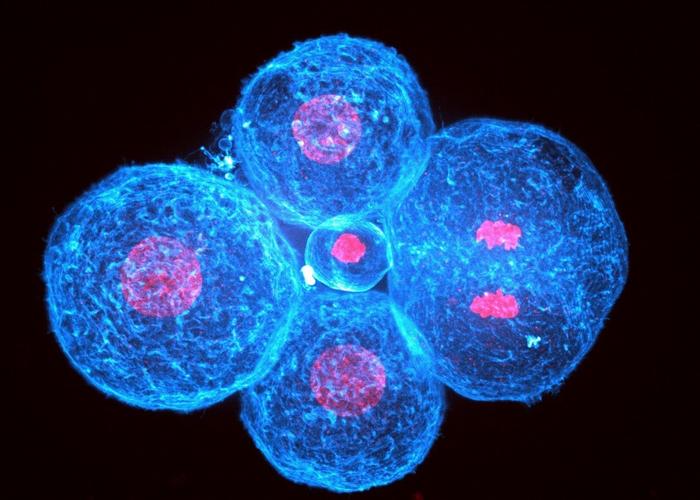
In humans, embryonic cell compaction is a crucial step in the normal development of an embryo. Four days after fertilisation, cells move closer together to give the embryo its initial shape. Defective compaction prevents the formation of the structure that ensures the embryo can implant in the uterus. In assisted reproductive technology (ART), this stage is carefully monitored before an embryo is implanted.

Cell contraction drive the initial shaping of human embryos

Credit: © Julie Firmin et Jean-Léon Maître

In humans, embryonic cell compaction is a crucial step in the normal development of an embryo. Four days after fertilisation, cells move closer together to give the embryo its initial shape. Defective compaction prevents the formation of the structure that ensures the embryo can implant in the uterus. In assisted reproductive technology (ART), this stage is carefully monitored before an embryo is implanted.

An interdisciplinary research team1 led by scientists at the Genetics and Developmental Biology Unit at the Institut Curie (CNRS/Inserm/Institut Curie) studying the mechanisms at play in this still little-known phenomenon has made a surprising discovery: human embryo compaction is driven by the contraction of embryonic cells. Compaction problems are therefore due to faulty contractility in these cells, and not a lack of adhesion between them, as was previously assumed. This mechanism had already been identified in flies, zebrafish and mice, but is a first in humans.

By improving our understanding of the early stages of human embryonic development, the research team hopes to contribute to the refinement of ART as nearly one third of inseminations are unsuccessful today.2

The results were obtained by mapping cell surface tensions in human embryonic cells. The scientists also tested the effects of inhibiting contractility and cell adhesion and analysed the mechanical signature of embryonic cells with defective contractility.

Notes :
1 – Scientists from the following entities also took part in the study: the Centre interdisciplinaire de recherche en biologie (CNRS/Collège de France/Inserm), the Reproductive Biology Department – CECOS (AP-HP) and the Institut Cochin (CNRS/Inserm/Université Paris Cité).

2 – Source: Agence de la biomédecine


Journal

Nature

DOI

10.1038/s41586-019-0000-0

Article Title

Mechanics of human embryo compaction

Article Publication Date

1-May-2024

Share26Tweet17
Previous Post

Why you can taste more ethanol in a cold pint of beer or warm glass of baijiu

Next Post

The women’s health initiative randomized trials and clinical practice

Related Posts

CD44+ Monocytes Drive Inflammation in Preemie Lung Disease — Technology and Engineering
Technology and Engineering

CD44+ Monocytes Drive Inflammation in Preemie Lung Disease

May 3, 2026
Brain Complexity Enhances Premature Newborns’ Maturity Evaluation — Technology and Engineering
Technology and Engineering

Brain Complexity Enhances Premature Newborns’ Maturity Evaluation

May 3, 2026
Simulating Neurodevelopment Care for Children with Heart Disease — Technology and Engineering
Technology and Engineering

Simulating Neurodevelopment Care for Children with Heart Disease

May 3, 2026
Synchrotron Micro-CT Reveals CNS Fluid Spaces In Vivo — Technology and Engineering
Technology and Engineering

Synchrotron Micro-CT Reveals CNS Fluid Spaces In Vivo

May 3, 2026
12-Month Study Tracks Post-COVID Symptoms in Children — Technology and Engineering
Technology and Engineering

12-Month Study Tracks Post-COVID Symptoms in Children

May 3, 2026
Micro-Wrinkled Fiber Enables Smart Health and Interaction — Technology and Engineering
Technology and Engineering

Micro-Wrinkled Fiber Enables Smart Health and Interaction

May 3, 2026
Next Post
The women’s health initiative randomized trials and clinical practice

The women’s health initiative randomized trials and clinical practice

  • Mothers who receive childcare support from maternal grandparents show more parental warmth, finds NTU Singapore study

    Mothers who receive childcare support from maternal grandparents show more parental warmth, finds NTU Singapore study

    27639 shares
    Share 11052 Tweet 6908
  • University of Seville Breaks 120-Year-Old Mystery, Revises a Key Einstein Concept

    1042 shares
    Share 417 Tweet 261
  • Bee body mass, pathogens and local climate influence heat tolerance

    677 shares
    Share 271 Tweet 169
  • Researchers record first-ever images and data of a shark experiencing a boat strike

    540 shares
    Share 216 Tweet 135
  • Groundbreaking Clinical Trial Reveals Lubiprostone Enhances Kidney Function

    527 shares
    Share 211 Tweet 132
Science

Embark on a thrilling journey of discovery with Scienmag.com—your ultimate source for cutting-edge breakthroughs. Immerse yourself in a world where curiosity knows no limits and tomorrow’s possibilities become today’s reality!

RECENT NEWS

  • Genetic Roots of Adult Executive Function Uncovered
  • CD44+ Monocytes Drive Inflammation in Preemie Lung Disease
  • 3D Diffusion Modeling Reveals Magmatic Histories
  • Axon Pathways Connect Small Gestational Age to Lung Restrictions

Categories

  • Agriculture
  • Anthropology
  • Archaeology
  • Athmospheric
  • Biology
  • Biotechnology
  • Blog
  • Bussines
  • Cancer
  • Chemistry
  • Climate
  • Earth Science
  • Editorial Policy
  • Marine
  • Mathematics
  • Medicine
  • Pediatry
  • Policy
  • Psychology & Psychiatry
  • Science Education
  • Social Science
  • Space
  • Technology and Engineering

Subscribe to Blog via Email

Enter your email address to subscribe to this blog and receive notifications of new posts by email.

Join 5,146 other subscribers

© 2025 Scienmag - Science Magazine

Welcome Back!

Login to your account below

Forgotten Password?

Retrieve your password

Please enter your username or email address to reset your password.

Log In
No Result
View All Result
  • HOME
  • SCIENCE NEWS
  • CONTACT US

© 2025 Scienmag - Science Magazine

Discover more from Science

Subscribe now to keep reading and get access to the full archive.

Continue reading
