


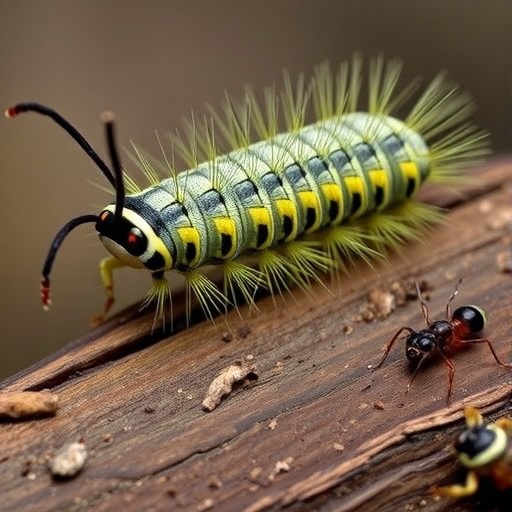
In the hidden realms beneath our feet, a remarkable form of communication unfolds between some of nature’s smallest yet most fascinating creatures: ants and butterfly caterpillars. Groundbreaking research from the University of Warwick, in collaboration with the University of Turin and the Forest Research Institute, has upended long-held assumptions about insect communication, revealing that butterfly caterpillars employ intricate rhythmic signals to interact with ants. These signals serve a vital purpose, enabling the caterpillars to secure protection, nourishment, and entry into ant colonies — a remarkable demonstration of cross-species collaboration mediated not by smell or sight, but by precisely timed vibrations.
Historically, scientists understood that many butterfly species, during their vulnerable caterpillar stages, rely heavily on ants for survival. The ants effectively adopt these caterpillars as part of their colony, offering shelter within their nests and defending them from predatory threats. In exchange, caterpillars reward their hosts with sweet secretions or mimic ant behavior to blend seamlessly into the social fabric of the colony. Until now, much of this cooperative relationship was attributed predominantly to chemical mimicry; caterpillars emit pheromones resembling those of ants, tricking the ants into acceptance. However, this new study adds a critical and unexpected dimension: vibrational communication carried through rhythms as sophisticated as those found in more cognitively complex animals.
The research team carried out a meticulous comparative analysis of vibroacoustic signals generated by two species of ants alongside nine butterfly caterpillar species exhibiting varying degrees of myrmecophily—the degree to which caterpillars associate intimately with ants. These signals are minute vibrations that propagate through substrates such as plants, soil, and the walls of ant nests, acting like invisible codes that can be interpreted by the sensitive antennae of ants. By assessing features such as pulse tempo, interval timing, and overall rhythmic pattern structure, the researchers uncovered that caterpillars deeply integrated with ants produce signals with a high degree of regularity and complexity mimicking ant rhythms. These rhythms possess qualities akin to musical compositions, with alternating strong and weak beats that create a structured, recognizable pattern.
Such rhythmic precision is astonishing when viewed through the lens of known animal communication systems. Until recently, scientists believed that complexity in rhythm was largely restricted to primates and other higher mammals, animals with significantly developed brains. However, this discovery of precise, rhythmic dialogue between ants and caterpillars challenges this paradigm. It suggests rhythm might be a fundamental and more universal mode of communication, extending into realms of small insects previously overlooked in neuroethological studies. The ability of caterpillars to “speak” ant rhythms not only secures their survival but exemplifies an exquisite evolutionary adaptation—biological “jamming” of communication channels between distinct species for mutual benefit.
Dr. Chiara De Gregorio of Warwick’s Department of Psychology eloquently describes this phenomenon: caterpillars are “speaking the ants’ language—not just chemically, but rhythmically.” This rhythmic mimicry enables caterpillars to be fully accepted as colony members. In the noisy, vibrationally saturated environment inside an ant nest, rhythmic signals stand out precisely because they are regular and predictable. This enables ants to quickly recognize the signals as belonging to an ally rather than an intruder. The importance of rhythmicity in social cohesion, typically highlighted in human contexts such as music and dance, is thus echoed unexpectedly in insect societies.
Particularly noteworthy is the caterpillars’ use of two rhythmic characteristics shared with ants: isochrony and double meter. Isochrony refers to evenly spaced pulses that generate a steady underlying beat—the kind of rhythm that forms the backbone of much human music. Double meter introduces complexity with alternating long and short intervals, generating a dynamic rhythm that further strengthens signal distinctiveness. These features were exclusively found in the most ant-dependent butterfly species, indicating a co-evolutionary trajectory. Close ecological interactions have sculpted these caterpillars’ communication methods to align seamlessly with their ant hosts’ vibrational language.
Such findings carry profound implications for our understanding of animal communication systems. They confront assumptions that complex temporal structuring in signaling requires large brains and suggest ecological pressures can drive the emergence of sophisticated rhythmic displays even in tiny insects. This rhythmic dialogue underpins the caterpillars’ survival, illustrating how evolution can craft communication systems optimized for particular environmental niches—in this case, the cramped, dark, and noisy ant nest where effective signaling is paramount and getting the timing wrong could mean rejection and death.
Methodologically, the study utilized cutting-edge vibrometry and signal analysis, allowing researchers to record and dissect the intricate vibrations emitted by ants and caterpillars in naturalistic settings. This approach permitted fine-scale comparisons, revealing not just the presence of signals but their temporal organization critical to understanding rhythmic complexity. The experimentation provides a powerful example of neuroethology — the interdisciplinary study of neural bases of natural behaviors — and highlights the value of integrating behavioral ecology with advanced bioacoustic technologies.
On a broader scale, this research enriches the narrative of mutualism within ecosystems, illustrating that cooperative relationships are mediated through elaborate sensory channels far beyond what we commonly imagine. It also opens new avenues for exploring how rhythms and timekeeping have evolved across the animal kingdom, informing disciplines ranging from evolutionary biology to neurobiology and even robotics, where biomimicry of such communication strategies might find novel applications.
In summary, the discovery that butterfly caterpillars engage in rhythmic signaling with ants to gain protection and sustenance fundamentally reshapes our understanding of insect communication and evolutionary adaptation. These tiny caterpillars are not merely passive recipients of ant care but active participants in a complex dialog, employing vibrational rhythms to ensure their safety and development. Nature’s ingenuity continues to amaze, showing that sophisticated communication transcends size and brain capacity and is deeply embedded in the social fabric of life’s interconnected web.
News Publication Date: (Not provided)
Web References:
https://doi.org/10.1111/nyas.70223
References:
De Gregorio, C., Barbero, F., et al. “Rhythmic signaling of ants and butterflies with varying degrees of myrmecophily.” Annals of the New York Academy of Sciences.
Cite Scienmag News
Gavin Prescott. (February 25, 2026). Caterpillars Use Intricate Rhythms to Communicate with Ants. Scienmag. https://scienmag.com/caterpillars-use-intricate-rhythms-to-communicate-with-ants/
Gavin Prescott. "Caterpillars Use Intricate Rhythms to Communicate with Ants." Scienmag, 25 February 2026, https://scienmag.com/caterpillars-use-intricate-rhythms-to-communicate-with-ants/. Accessed 4 September 2026.
Gavin Prescott. "Caterpillars Use Intricate Rhythms to Communicate with Ants." Scienmag. February 25, 2026. https://scienmag.com/caterpillars-use-intricate-rhythms-to-communicate-with-ants/


