


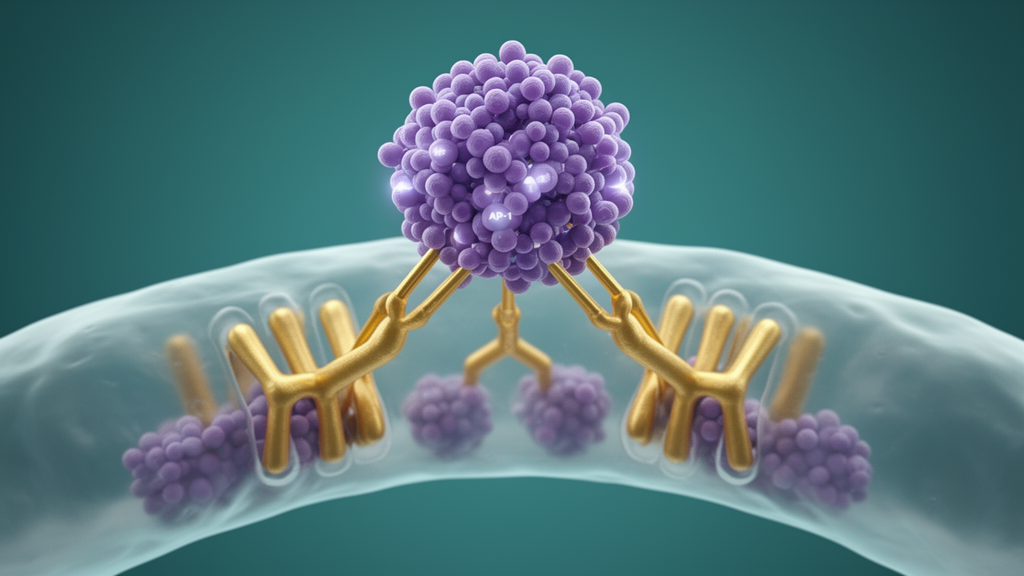
Inside every eukaryotic cell, an elaborate logistics network ferries proteins between compartments such as endosomes and the trans-Golgi network. A central player in this traffic is the adaptor protein complex AP-1, a heterotetrameric machine that selects cargo molecules and recruits the coat protein clathrin to shape transport vesicles. For decades, textbooks have portrayed cargo as a passive passenger in this process, merely stabilizing the adaptor once the small GTPase ARF1 has done the heavy lifting of membrane recruitment. A new study by Deng and colleagues, published in Cell and highlighted in Cell Research, upends that picture by showing that cargo itself is an active structural component of the assembling coat.
The AP-1 complex recognizes its cargo through two well-characterized sorting signals embedded in the cytoplasmic tails of membrane proteins. The first is a tyrosine-based motif, written Yxxφ, where φ stands for a bulky hydrophobic residue; this motif docks onto the µ1 subunit of AP-1. The second is a dileucine-based motif of the sequence [D/E]xxxL[L/I], which binds to the σ1 subunit. Because these two binding sites sit on different subunits of the same adaptor, researchers had generally assumed that a single cargo tail engages one AP-1 complex at a time, with oligomerization of adaptors driven by ARF1 and by clathrin’s self-association.
Deng and colleagues took a reductionist approach to test this assumption. They reconstituted coat assembly in a test tube using purified human AP-1, a GTP-locked version of ARF1 that lacked its N-terminal amphipathic helix, and a synthetic cargo peptide carrying both sorting motifs. When all three ingredients were combined, robust clathrin cages assembled spontaneously. Strikingly, when the cargo peptide was omitted, ARF1 and AP-1 failed to form any higher-order structures at all. This simple but powerful experiment demonstrated that cargo is not a passive client but a necessary ingredient for building the adaptor lattice.
To understand how the peptide achieves this, the team turned to cryoelectron microscopy. The structures revealed a previously unrecognized interface between AP-1 complexes, formed by the µ1 subunit of one tetramer and the σ1 subunit of a neighboring one. The cargo peptide acts as a physical bridge: its tyrosine-based motif is gripped by the µ1 subunit of one AP-1 complex while its dileucine-based motif, located downstream on the same tail, is simultaneously bound by the σ1 subunit of a second complex. A single cargo molecule can therefore tether two adaptors together, and multiple cargo molecules can stitch many adaptors into a two-dimensional lattice on the membrane surface.
The functional importance of this µ1–σ1 interface was tested by mutational analysis. Disrupting the interface reduced clathrin cage assembly in vitro to roughly the same extent as disrupting the ARF1-mediated contacts between AP-1 complexes. In other words, the cargo bridge contributes as much to lattice stability as the GTPase-driven scaffold that scientists have studied for years. This is a remarkable result, because it implies that the classical ARF1-centric model of coat assembly captures only half of the stabilizing interactions.
To confirm that the mechanism operates in living systems rather than only in purified protein mixtures, the researchers performed rescue experiments in HeLa cells and in zebrafish lacking either the µ1 or the σ1 subunit of AP-1. Re-expression of the wild-type subunits restored normal function and rescued the knockout phenotypes. In contrast, mutant versions of the subunits engineered to disrupt the µ1–σ1 interface failed to rescue the defects in both the cultured cells and the fish. The cargo-bridging interface is therefore not an artifact of in vitro reconstitution but a physiologically essential element of AP-1 function.
The implications reach well beyond AP-1 itself. The same tyrosine-based and dileucine-based sorting motifs are recognized by the related adaptor complexes AP-2, which mediates endocytosis at the plasma membrane, and AP-3, which sorts cargo to lysosome-related organelles. If cargo bridging drives AP-1 oligomerization, it is plausible that a similar mechanism operates across the adaptor protein family, making cargo-driven multimerization a general principle of protein transport. This would also help explain how AP-3 can concentrate cargo independently of clathrin, as previous work has suggested, since a cargo-bridged adaptor lattice could concentrate cargo even without an outer clathrin shell.
The study also reframes the architecture of coated vesicle formation. Clathrin multimerization has long been considered the driving force behind adaptor lattice formation, but the new work raises the question of whether clathrin is required for adaptor oligomerization at all, or whether cargo- and ARF1-mediated stabilization is sufficient to nucleate a lattice. It further suggests that coat assembly is driven not only by interactions among adaptors, coat proteins, and GTPases, but also by the cargo molecules that the coat is built to carry. Cargo concentration at the budding site, in this view, is a direct consequence of the assembly mechanism itself rather than a byproduct of it.
Several questions remain open. The cryo-EM structures were obtained in the absence of membranes, so it will be important to recapitulate the findings on cargo-loaded liposomes and ultimately in cells, where membrane curvature and lipid composition could modulate the bridging interaction. It is also unclear whether the µ1–σ1 interface observed between AP-1 tetramers can form between other adaptor complexes, given that different adaptors show distinct patterns of interaction with ARF1. Deng and colleagues note that their AP-1 assembly may represent an intermediate conformational state between previously described open and closed AP-1 trimers, implying that additional interactions beyond cargo binding are needed for AP-1 to reach the open conformation in which it can engage the membrane and bind cargo and clathrin simultaneously.
What is already clear is that the cargo bridge concept fundamentally changes how scientists view the construction of transport vesicles. Rather than being passive clients that stabilize a particular adaptor conformation, cargo proteins actively participate in the assembly of the molecular machine that carries them. This cargo-driven mechanism provides an elegant explanation for how adaptors achieve site-specific multimerization on membranes and how the right proteins are concentrated into the right vesicles. As researchers test these ideas across the adaptor family and in membrane-reconstituted systems, the humble cargo molecule may turn out to be one of the principal architects of its own journey through the cell.
Subject of Research: Cargo-bridged oligomerization of the AP-1 adaptor complex in clathrin-coated vesicle transport
Article Title: The cargo bridge — how cargo binding triggers AP-1 oligomerization
Article References: Stockhammer, A., & Ungermann, C. (2026). The cargo bridge — how cargo binding triggers AP-1 oligomerization. Cell Research. https://doi.org/10.1038/s41422-026-01316-7
Image Credits: AI Generated
DOI: 10.1038/s41422-026-01316-7
Keywords: AP-1 adaptor complex, clathrin-coated vesicles, cargo sorting motifs, ARF1 GTPase, cryo-EM, oligomerization, trans-Golgi network, endosomal transport, µ1–σ1 interface, vesicle trafficking, cell biology, adaptor protein complexes
Cite Scienmag News
Ophelia Keating. (October 16, 2026). Cargo proteins act as molecular bridges that drive AP-1 coat assembly. Scienmag. https://scienmag.com/cargo-proteins-act-as-molecular-bridges-that-drive-ap-1-coat-assembly/
Ophelia Keating. "Cargo proteins act as molecular bridges that drive AP-1 coat assembly." Scienmag, 16 October 2026, https://scienmag.com/cargo-proteins-act-as-molecular-bridges-that-drive-ap-1-coat-assembly/. Accessed 16 October 2026.
Ophelia Keating. "Cargo proteins act as molecular bridges that drive AP-1 coat assembly." Scienmag. October 16, 2026. https://scienmag.com/cargo-proteins-act-as-molecular-bridges-that-drive-ap-1-coat-assembly/


