


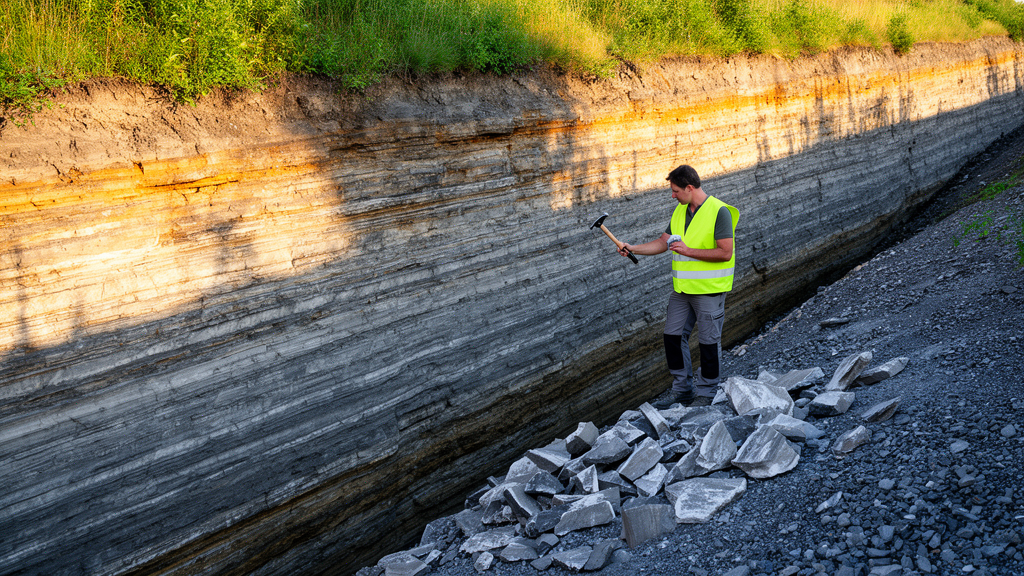
When a canal cutting near the Bavarian village of Dörlbach slumped and forced extensive repair work between 2010 and 2012, geologists saw something more than a construction nuisance. The Ludwigskanal, built in 1840 and 1841 southeast of Nürnberg, had already made history: it exposed the first large-scale temporary section of the Lower Jurassic Schwarzjura Group in southern Germany and yielded one of the world’s first large skulls of the marine reptile Temnodontosaurus, measuring 1.6 metres. Nearly two centuries later, the renewed exposure allowed a team to re-investigate a scientifically crucial reference section of the South German Toarcian, bed by bed, with modern methods. The results, published in the journal Zitteliana, provide the first complete sequence stratigraphic interpretation of the Toarcian in the Franconian Alb and a fresh framework for studying one of the most dramatic environmental crises of the Mesozoic.
The investigated section is remarkably thin: just 16 metres of rock, described from the upper part of the Amaltheenton Formation through the famous Posidonienschiefer and the Jurensismergel Formation to the base of the Opalinuston Formation. Despite this modest thickness, the succession covers a vast stretch of time. Ammonite biostratigraphy, based on roughly 425 determinable ammonites recovered in situ, indicates more than 9 metres of Upper Pliensbachian, only 1.15 to 1.20 metres for the entire Lower Toarcian, 5.04 metres for the Upper Toarcian, and more than 0.5 metres for the Lower Aalenian. All Toarcian ammonite zones and almost all subzones are present, even though major parts of the Tenuicostatum Zone and the Fallaciosum Subzone are missing. Such completeness in so little sediment is a hallmark of condensation, where slow sedimentation and erosion compress millions of years into centimetres of rock.
Geochemical analyses of the bulk rock revealed a striking pattern. Carbonate contents are low in the Amaltheenton, then jump suddenly to as much as 94 weight percent at the base of the Posidonienschiefer and remain consistently high in its lower part, before successively declining through the Jurensismergel into the basal Opalinuston. Organic carbon contents of the Posidonienschiefer at Dörlbach appear comparatively low, averaging 2.45 weight percent, far below the 6.77 weight percent measured at the classic Swabian Alb section of Dotternhausen. But when the authors normalized organic carbon to the carbonate-free silicate fraction, the values became almost identical: 11.18 weight percent at Ludwigskanal versus 12.22 weight percent at Dotternhausen. The apparent difference is therefore a dilution effect, caused by the unusually high carbonate contents at the Franconian section, not a genuine difference in organic matter production or preservation.
Normalized to the silicate fraction, the organic carbon record shows a clear first maximum in the Exaratum Subzone, with values reaching up to 17.6 weight percent in the basal Laibstein beds, and a second maximum in the interval from the Falciferum Shale to the Monotis Bed, up to 14.1 weight percent. This pattern matches the peak of the Toarcian Oceanic Anoxic Event, a global episode of widespread seafloor oxygen depletion around 183 million years ago that has been linked to massive volcanic carbon release, seawater warming, and biotic turnover. Intriguingly, the Ludwigskanal record differs from most central European sections in one respect: high organic carbon levels persist into the middle parts of the Upper Toarcian, suggesting that anoxic or oxygen-poor bottom waters lingered longer in this current-swept part of the NW European Epicontinental Seaway.
The ammonite assemblages recovered bed by bed allowed a high-resolution biostratigraphic subdivision. The Posidonienschiefer begins with an erosive discontinuity marked by reworked concretions of the underlying Amaltheenton, and the laminated limestone concretions of the Laibstein I bed yielded Tiltoniceras antiquum just a few centimetres above the base, representing the latest Semicelatum Subzone. The overlying Laibstein II bed contains an assemblage typical of the Elegans Subzone, including Harpoceras serpentinum and abundant holoplanktonic gastropods of the species Coelodiscus minutus. A single compressed specimen of Harpoceras falciferum, the index fossil of the Falciferum Zone, was recovered from the Falciferum Shale and is figured for the first time for the Franconian Alb. Higher beds with densely packed Meleagrinella shells, the Dactylioceras Bed and the Monotis Bed, belong to the Commune Subzone, while the Bifrons Shale contains Hildoceras semipolitum, defining the Semipolitum Horizon at the top of the Bifrons Zone, a horizon detected for the first time in the region.
The Upper Toarcian succession proved equally informative. The Variabilis Shale is characterized by abundant pyrite-preserved Catacoeloceras raquinianum, Pseudolioceras compactile, and Lytoceras sublineatum, with compressed Haugia variabilis concentrating in its topmost centimetres. A change in the ammonoid assemblage in the thin marl bed below the famous Belemnite Battlefield, with Pseudogrammoceras subregale and Haugia cf. phillipsi, marks the Illustris Subzone, another first for the area. The Belemnite Battlefield itself, a grey bituminous calcareous marl crowded with belemnite rostra and bored phosphorite nodules, is poor in ammonoids but consistent with the upper Variabilis Zone. The overlying Main Phosphorite Bed represents a condensation horizon spanning the transition from the Variabilis to the Thouarsense Zone, and the bituminous Toarcensis Shale above it contains a monospecific assemblage of Grammoceras thouarsense. No evidence of the Fallaciosum Subzone was found at Dörlbach, although it is known from the neighbouring section of Hausheim.
The uppermost Toarcian and the transition to the Aalenian complete the picture. A clear erosive discontinuity at the base of the Dispansum Zone, marked by a belemnite accumulation with corroded phosphorites, is followed by marls with Phlyseogrammoceras dispansum, Alocolytoceras rugiferum, and Hammatoceras insigne. First Dumortieria appear near the top of this bed, with Dumortieria insignisimilis marking the base of the Levesquei Subzone, the Dumortieri Horizon, again detected for the first time in the region. An ammonite accumulation in the topmost centimetres with Dumortieria pseudoradiosa, D. radiosa, and D. striatulocostata marks the onset of the Pseudoradiosa Subzone. A condensed bed with Cotteswoldia mactra defines the base of the Mactra Subzone of the Aalensis Zone, and the overlying marls with Cotteswoldia aalensis, Pleydellia subcompta, and Pleurolytoceras hircinum represent the Aalensis Subzone. The youngest ammonite subzone of the Lower Jurassic, the Torulosum Subzone, is documented by a condensed horizon with Pleydellia buckmani, P. lotharingica, and Pleurolytoceras torulosum. The Toarcian-Aalenian boundary is drawn in analogy to a neighbouring drill section that yielded Leioceras opalinum immediately above the equivalent of this bed.
On the basis of these discontinuities, condensed beds, and correlations with neighbouring sections across southern Germany, the authors propose a sequence stratigraphic interpretation built on transgressive-regressive cycles of third order. The Posidonienschiefer Formation corresponds to a single third-order transgressive-regressive sequence, from the top of the Hawskerense Subzone to a fucoid bed at the top of the Variabilis Subzone, with a maximum flooding surface at the top of the Falciferum Zone. The Jurensismergel Formation exhibits two such sequences: the first ranges from the base of the Illustris Subzone, marked by the Intra-Variabilis-Discontinuity, to the top of the Thouarsense Zone, with a maximum flooding surface within the Thouarsense Zone; the second extends from the erosive base of the Dispansum Zone to the top of the Aalensis Subzone, with a maximum flooding surface at the Pseudoradiosa-Aalensis Zone boundary. The Opalinuston begins with a new sequence at the base of the Torulosum Subzone.
One of the most consequential reinterpretations concerns the Belemnite Battlefield. Earlier workers had considered this belemnite accumulation a maximum regression surface at the base of the Jurensismergel, with its components reworked from the Posidonienschiefer below. The new study argues otherwise: the bored phosphorite nodules are not derived from the bituminous shales below, and correlations with Swabian Alb sections indicate an erosive discontinuity at the base of the marl bed beneath the battlefield. The Belemnite Battlefield therefore reflects a transgressive ravinement surface within the first Jurensismergel sequence, formed by winnowing along a coast-parallel seawater current, consistent with the formation model proposed by Urlichs in 1971. This reinterpretation also shifts the lithostratigraphic boundary between the Posidonienschiefer and Jurensismergel formations, placing the Fucoid Bed at the top of the Posidonienschiefer and the poorly bituminous marls below the battlefield at the base of a new stratigraphic sequence.
The study also reveals a consistent pattern in fossil preservation that tracks sea-level change. Transgressive system tracts of the third-order cycles are commonly phosphoritic, while some regressive system tracts show pyrite preservation of ammonites. The maximum regression surfaces at the base of the Toarcian and within the Variabilis Zone reflect significant submarine erosion and relief formation by seawater currents, an effect less pronounced at the base of the Dispansum Zone and at the Jurensismergel-Opalinuston boundary. In the Swabian Alb, submarine swells remaining after Variabilis Zone erosion show aphotic microbialites in the Toarcensis Zone, indicating highly reduced sedimentation during maximum flooding. The litho-, bio-, and sequence stratigraphic framework established at the Ludwigskanal now serves as a scaffold for future isotope and biogeochemical studies on the Toarcian Oceanic Anoxic Event and its recovery phase, in this seawater current-affected part of the epicontinental seaway, where seawater temperatures, current systems, and the persistence of oxygen depletion can be disentangled with unprecedented stratigraphic precision.
Subject of Research: Toarcian biostratigraphy and sequence stratigraphy of the Ludwigskanal section, Franconian Alb, southern Germany
Article Title: Biostratigraphy and sequence stratigraphy of the Toarcian Ludwigskanal section (Franconian Alb, Southern Germany)
Article References: Arp, G., Gropengießer, S., Schulbert, C., Jung, D., & Reimer, A. (2021). Biostratigraphy and sequence stratigraphy of the Toarcian Ludwigskanal section (Franconian Alb, Southern Germany). Zitteliana, 95, 57-94. https://doi.org/10.3897/zitteliana.95.56222
Image Credits: AI Generated
DOI: 10.3897/zitteliana.95.56222
Keywords: Biostratigraphy, sequence, stratigraphy, Toarcian, Ludwigskanal, section, Franconian, Southern, Germany, scientific research
Cite Scienmag News
Violet Maxwell. (October 17, 2026). Canal cutting rewrites the story of a Toarcian crisis in southern Germany. Scienmag. https://scienmag.com/canal-cutting-rewrites-the-story-of-a-toarcian-crisis-in-southern-germany/
Violet Maxwell. "Canal cutting rewrites the story of a Toarcian crisis in southern Germany." Scienmag, 17 October 2026, https://scienmag.com/canal-cutting-rewrites-the-story-of-a-toarcian-crisis-in-southern-germany/. Accessed 17 October 2026.
Violet Maxwell. "Canal cutting rewrites the story of a Toarcian crisis in southern Germany." Scienmag. October 17, 2026. https://scienmag.com/canal-cutting-rewrites-the-story-of-a-toarcian-crisis-in-southern-germany/


