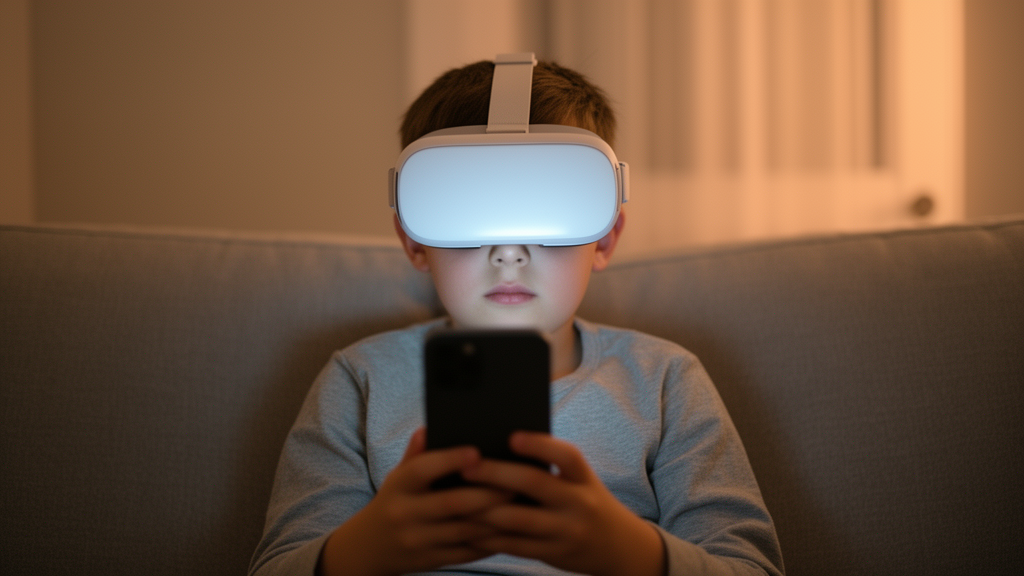
Myopia is quietly becoming one of the defining health challenges of the twenty-first century. By 2050, researchers project that nearly 4.76 billion people — almost half the global population — will be myopic, with 938 million affected by high myopia that carries serious risks of permanent vision loss. Against this backdrop, a team at Chengdu University of Traditional Chinese Medicine has published one of the most comprehensive assessments to date of whether the digital tools already in our pockets — smartphones, wearables, artificial intelligence, virtual reality — can be harnessed for myopia detection, treatment and management. Their systematic review, published in Frontiers in Public Health, sifted through more than 6,300 studies and landed on a strikingly nuanced verdict: real promise, but very weak proof.
The review, registered on PROSPERO and conducted under PRISMA guidelines, searched six databases including PubMed, Embase, Cochrane and three major Chinese repositories for studies published between January 2000 and December 2025. After removing 1,459 duplicates and screening 4,911 records, the authors ultimately included 33 studies covering 26,651 patients. The design mix tells its own story: 15 cross-sectional studies, 5 cohort studies, 5 randomized controlled trials, 5 self-controlled studies, 2 non-randomized trials and a single cross-over study. Twenty-one studies were rated Good in quality assessment, 12 Fair, and — crucially — the GRADE certainty of evidence was rated very low across every domain examined.
Geography matters enormously here. Twenty-six of the 33 studies — nearly 79 percent — were conducted in Asia, where myopia prevalence among East Asian schoolchildren can reach 52.5 percent at age 12 and 59.1 percent at age 17, compared with 8.6 and 17.7 percent among European Caucasian children in the same Australian cohort. In Weifang, China, a large-scale survey found the city’s total myopia rate among school-age students was 75.35 percent. This concentration of evidence from East Asia, the authors caution, limits generalizability to other regions — particularly low- and middle-income countries where healthcare infrastructure, digital literacy and device availability differ substantially.
On the detection front, the results are genuinely encouraging. Six studies assessed diagnostic performance of digital tools for myopia and related conditions, and all six were evaluated as beneficial. Sensitivity ranged from 0.76 to 0.97 and specificity from 0.76 to 1.00. The standout performer was a deep learning system for grading myopic maculopathy, achieving a sensitivity of 0.97, a specificity of 0.99 and an area under the curve of 0.998. Two studies used smartphone flashes and cameras to identify eye diseases; one assembled a lighting conversion unit onto a pocket-sized digital camera to calculate diopter and dark zone height; two built deep learning models for batch interpretation of refractive errors and fundus lesions. A tablet-based vision screener even reduced per-student workload by 42.86 percent and financial expenditure by 25.97 percent compared with manual monitoring.
But the picture darkens when it comes to visual and refractive monitoring. Across six studies, digital tools consistently produced marginally worse visual acuity than clinical measurements, with LogMAR biases ranging from 0.02 to 0.13. The Netra smartphone-based refractor, paired with a wearable device, showed particularly problematic overestimation of myopia — a median myopic overcorrection of 0.60 diopters unassisted, and around 1.25 diopters without cycloplegia in one study. After cycloplegia, the differences collapsed to 0.01 and 0.10 diopters, suggesting the overestimation was largely driven by accommodative factors rather than fundamental device error. The Easee web-based platform achieved favorable agreement for visual acuity within 95 percent confidence intervals but produced contradictory findings for refractive error, with one study reporting a bias of 0.13 LogMAR.
Treatment results were more uniformly positive. Seven studies applied digital health technologies to improve visual acuity or reduce refractive error, and all seven reported beneficial effects. Four used virtual reality-based visual training, with uncorrected visual acuity improving across all studies and follow-up durations ranging from 10 days to one year. Two studies adopted wearable VR devices for myopic anisometropic amblyopia, yielding improvements not only in best-corrected visual acuity — from 0.48 to 0.77 in one trial — but also in stereopsis, refractive error, P100 latency and P1 amplitude on visual evoked potentials. One study even combined Traditional Chinese Medicine with modern digital technology, using far-infrared hot moxibustion technology emitting radiation at approximately 10 micrometers to mimic beneficial components of natural sunlight while delivering moxibustion therapy to periocular acupoints, reporting refractive error improvements from 1.10 to 1.99 diopters.
Management — arguably the most strategically important domain for prevention — showed fascinating preliminary findings. Seven studies used wearables, smartwatches and smartphones to quantify environmental risk factors. The Clouclip wearable device revealed that myopic children spent significantly longer on daily total near-work time (237.06 minutes versus 140.62 minutes) and single-session near-work duration (79.28 minutes versus 36.06 minutes) than non-myopic children. A working distance of 40 centimeters was linked to adverse myopia-related effects, while outdoor exposure lasting at least 15 minutes showed a protective effect against myopic shift — but only when sunlight intensity exceeded 2,000 lux. Three behavioral intervention studies incorporated real-time alerts or screen dimming when unhealthy viewing behaviors were detected, with one AI-powered tablet promptly rectifying 65.49 percent of viewing distance errors and 86.48 percent of viewing posture errors.
The authors are refreshingly candid about the limitations. Sample sizes varied enormously, from 23 to 6,716 subjects. Heterogeneity was substantial across outcome measures, device types and study designs. Fifteen cross-sectional studies can only identify correlational associations rather than causal relationships. The predominance of non-randomized designs, methodological limitations in primary studies, inconsistency across studies and imprecision from small sample sizes all contributed to downgrading certainty. The authors also flag a paradox at the heart of pediatric myopia care: the therapeutic methods reviewed — particularly VR-based training and smartphone-based testing — necessarily involve sustained screen engagement in children, who are already facing increasing digital media exposure at an early age. The American Academy of Pediatrics advises that children under 18 to 24 months avoid screen media entirely, except for video chatting.
Despite these caveats, the review’s conclusion is cautiously optimistic. Digital health technologies show preliminary promise across all three domains of myopia care — detection, treatment and management. For detection, diagnostic accuracy is acceptable and agreement with clinical standards is reasonable, though systematic bias remains in visual and refractive measurements. For treatment, VR-led vision training has potential to modulate visual acuity and refractive error. For management, behavioral interventions with real-time feedback may modify unhealthy viewing behaviors, while environmental monitoring supports feasibility. What is urgently needed now, the authors argue, are well-designed, large-scale randomized controlled trials with standardized outcome measures, validation in diverse geographic settings beyond East Asia, and careful attention to user comfort and safety — including the virtual reality vertigo some children experienced during training. The digital toolkit for fighting the myopia epidemic exists; the rigorous evidence to justify deploying it at scale is still being built.
Subject of Research: Digital health technologies for myopia care: a systematic review
Article Title: Digital health technologies for myopia care: a systematic review
Article References: Xu, H., He, L., Pan, Z., & Lu, X. (2026). Digital health technologies for myopia care: a systematic review. Frontiers in Public Health, 14, Article 1939923. https://doi.org/10.3389/fpubh.2026.1939923
Image Credits: AI Generated
DOI: 10.3389/fpubh.2026.1939923
Keywords: myopia, digital health, artificial intelligence, virtual reality, wearable devices, systematic review, ophthalmology, public health, Digital, health, technologies, care
Cite Scienmag News
Kristina Jarvis. (October 17, 2026). Smartphones, AI and VR: Can Digital Tools Really Tame the Global Myopia Epidemic? Scienmag. https://scienmag.com/smartphones-ai-and-vr-can-digital-tools-really-tame-the-global-myopia-epidemic/
Kristina Jarvis. "Smartphones, AI and VR: Can Digital Tools Really Tame the Global Myopia Epidemic?" Scienmag, 17 October 2026, https://scienmag.com/smartphones-ai-and-vr-can-digital-tools-really-tame-the-global-myopia-epidemic/. Accessed 17 October 2026.
Kristina Jarvis. "Smartphones, AI and VR: Can Digital Tools Really Tame the Global Myopia Epidemic?" Scienmag. October 17, 2026. https://scienmag.com/smartphones-ai-and-vr-can-digital-tools-really-tame-the-global-myopia-epidemic/