


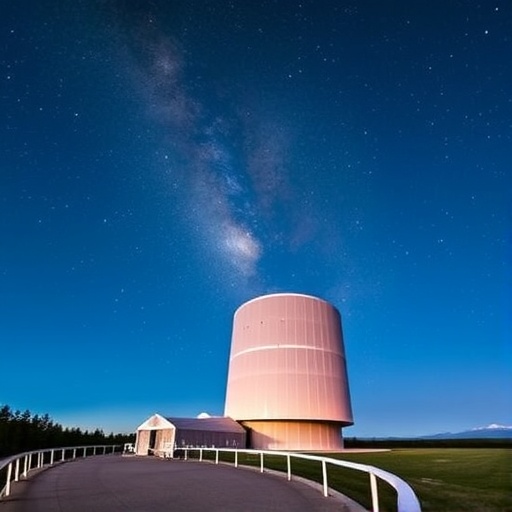
The European Extremely Large Telescope (ELT), currently under construction in Chile, is set to revolutionize the field of observational astronomy by becoming the most powerful optical and infrared telescope ever assembled. Boasting an enormous 39-meter primary mirror, this new class of “giant telescopes” will enable astronomers to observe the universe in dazzling detail, probing celestial objects from close exoplanets to the farthest reaches of distant galaxies. Scheduled for first light later this decade, the ELT promises to open unprecedented windows on cosmic phenomena, deepening our understanding of the cosmos at scales never before attainable.
Canada is poised to play a significant role in this ambitious international endeavor. Though not a formal member of the European Southern Observatory (ESO), the organization overseeing the ELT, Canadian researchers have secured a major foothold through federal funding. Led by scientists at the Université de Montréal, the Mont-Mégantic Observatory (OMM), and the Trottier Institute for Research on Exoplanets (IREx), in partnership with the University of British Columbia, Canada has been awarded close to $11.3 million from the Canada Foundation for Innovation (CFI). This investment specifically supports Canada’s contribution to the ANDES instrument, a high-dispersion echelle spectrograph integral to the ELT’s scientific arsenal.
The ANDES instrument—ArmazoNes high Dispersion Echelle Spectrograph—is designed to deliver extraordinary spectral resolution and sensitivity across both visible and infrared wavelengths. Utilizing advanced optical components and cutting-edge detector technologies, ANDES will tackle some of astrophysics’ most compelling questions. Its capabilities include probing the chemical composition of stars, investigating the earliest epochs of cosmic history, and examining the intricate processes that govern the formation and evolution of galaxies. The instrument’s spectral breadth and precision will offer unparalleled ability to dissect celestial light, unlocking the physics encoded in photons that have traveled billions of years to reach us.
One of ANDES’ most groundbreaking scientific objectives is the direct search for biosignatures in the atmospheres of Earth-like exoplanets orbiting Sun-like stars. By combining high-dispersion spectroscopy with sophisticated imaging techniques, ANDES will be the first instrument capable of detecting key molecular signatures such as water vapor, oxygen, methane, and carbon dioxide on planets beyond our Solar System. These molecules are critical indicators of potential biological activity or habitability, and their identification could provide transformative evidence about life’s distribution in the universe. This endeavor is often hailed as the “Holy Grail” of exoplanetary science, representing a monumental step toward answering whether humanity is alone.
Canadian scientists involved in the ANDES project emphasize the transformative impact this access will have on Canadian astronomy. René Doyon, physics professor at Université de Montréal and co-principal investigator for the Canadian contribution to ANDES, highlights that participation in the ELT positions Canada on the frontline of next-generation ground-based observational astronomy. This opportunity is particularly poignant given current delays plaguing other international observatory projects. Without this involvement, Canadian researchers risk exclusion from some of the most pivotal discoveries anticipated in the coming decades, prompting urgent investment to secure a central role.
The Mont-Mégantic Observatory and its Experimental Astrophysics Laboratory have cultivated decades of expertise in instrument development, providing a strong foundation for Canada’s vital contributions to ANDES. Their track record includes leadership roles in world-class instruments such as SPIRou on the Canada-France-Hawaii Telescope, NIRPS at the ESO Telescope in La Silla, Chile, and NIRISS aboard the James Webb Space Telescope. This pedigree showcases Canada’s capability to engineer sophisticated astrophysical instruments, spanning precise optics, photonics, and sensor design, thereby ensuring that Canadian components meet the rigorous performance demands required by the ELT’s scientific goals.
Beyond the pure science, the Canadian involvement in ANDES holds substantial potential for innovation and workforce development. Nearly half of the funding is dedicated to supporting highly qualified personnel and fostering partnerships with Canadian industry, advancing sectors such as optics, photonics, detector technology, and data science. These technologies transcend astronomy, finding applications in fields like medical imaging, telecommunications, and environmental monitoring. Such cross-disciplinary benefits underscore the transformative spillovers generated by foundational research in astronomy, fueling broader technological progress.
The ELT and ANDES also represent a powerful platform for training the next generation of scientists and engineers in Canada, directly addressing national needs for expertise in STEM fields. Integrating cutting-edge instrumentation and data analysis, the project offers immersive research experiences that cultivate advanced technical skills and promote innovation-driven careers. Moreover, outreach efforts aim to engage students through classroom activities developed around ANDES’ discoveries, linking Canadian and Chilean students with the forefront of cosmic exploration and inspiring curiosity about the universe and the scientific method.
From a technical perspective, the ELT’s size and design pose immense engineering challenges. Its segmented primary mirror, composed of 798 hexagonal segments each 1.4 meters wide, must operate with extreme precision to achieve diffraction-limited imaging. ANDES capitalizes on this unprecedented light-gathering power and combines it with high-dispersion echelle spectroscopy—a technique that disperses incoming light into its constituent wavelengths with exceptional resolution, enabling detailed analysis of stellar and planetary atmospheres. The instrument’s capabilities will be augmented by adaptive optics systems that correct atmospheric blurring in real time, permitting near-diffraction-limited performance crucial for resolving faint targets.
Fundamental to ANDES’ science is its ability to operate simultaneously across visible and near-infrared bands, allowing astronomers to detect molecules whose absorption features lie across different spectral ranges. High spectral resolution facilitates the separation of molecular signatures from stellar noise and terrestrial atmospheric interference—one of the primary challenges in exoplanet spectroscopy. The instrument’s design also incorporates robust calibration and stability systems, ensuring that spectral data remain highly accurate over prolonged observations, a necessity for detecting faint biosignatures in exoplanet atmospheres.
The collaborative nature of the ANDES consortium unites leading institutes across Europe and beyond, creating a global framework for designing, building, and commissioning this transformative spectrograph. Canada’s involvement not only offers guaranteed telescope access but strengthens international ties and enhances Canada’s profile in advanced astrophysical instrumentation. These collaborations are essential for managing the complex integration of sophisticated technologies, from precision optics to cryogenic detector arrays and data-processing pipelines capable of handling enormous spectral datasets.
In summary, the European Extremely Large Telescope and its ANDES instrument herald a new epoch in astronomy, combining colossal aperture size, cutting-edge spectroscopic capabilities, and international scientific collaboration. Canada’s strategic investment allows its astronomers to contribute meaningfully to these developments, ensuring access to unprecedented observational power while driving technological innovation and workforce growth at home. This synergy of science, technology, and education offers a glimpse of the future of ground-based astronomy—one that will profoundly expand humanity’s cosmic perspective and may finally begin to answer the age-old question: Are we alone in the universe?
News Publication Date: April 2026
Web References:
- ESO ANDES Instrument: https://elt.eso.org/instrument/ANDES/
- ANDES Consortium: https://andes.inaf.it/
Keywords
European Extremely Large Telescope, ELT, ANDES instrument, Canada Foundation for Innovation, high-dispersion echelle spectroscopy, exoplanet atmospheres, biosignatures, astronomical instrumentation, Mont-Mégantic Observatory, international astronomy collaboration, optical and infrared telescope, astrophysical spectroscopy, STEM education, photonics innovation
Cite Scienmag News
Grant Pearson. (May 14, 2026). Canadian Astronomy Turns to Europe, Investing in the World’s Largest Telescope. Scienmag. https://scienmag.com/canadian-astronomy-turns-to-europe-investing-in-the-worlds-largest-telescope/
Grant Pearson. "Canadian Astronomy Turns to Europe, Investing in the World’s Largest Telescope." Scienmag, 14 May 2026, https://scienmag.com/canadian-astronomy-turns-to-europe-investing-in-the-worlds-largest-telescope/. Accessed 4 September 2026.
Grant Pearson. "Canadian Astronomy Turns to Europe, Investing in the World’s Largest Telescope." Scienmag. May 14, 2026. https://scienmag.com/canadian-astronomy-turns-to-europe-investing-in-the-worlds-largest-telescope/


