


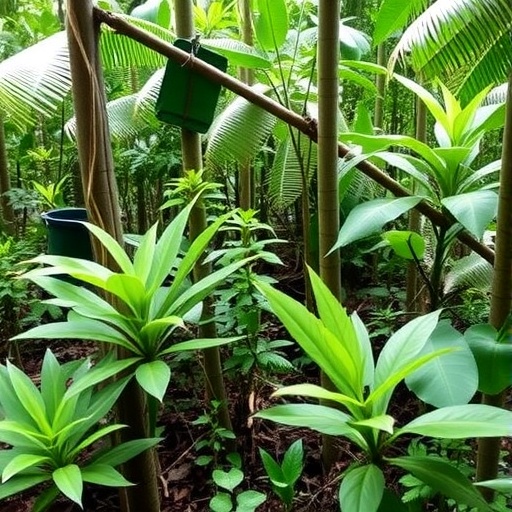
In the heart of the Amazon rainforest, where biodiversity teems and ecological pressures intensify, a novel conservation strategy is emerging. An international team of researchers led by Brazilian scientists has pioneered the concept of “inter situ” collections, a bold approach designed to safeguard threatened plant species by establishing them in wild environments outside their native geographic ranges. This innovative conservation technique offers a compelling new frontier for preserving plant species facing the relentless challenges imposed by climate change, habitat loss, and increasing human activity.
Unlike traditional in situ conservation, which protects species within their original habitats, “inter situ” collections involve deliberately transplanting and cultivating threatened plants in carefully selected sites beyond their endemic distribution. This method strikes a delicate balance between ex situ and in situ conservation. It recognizes the limitations of maintaining species solely within their shrinking natural ranges while avoiding the artificiality and costs associated with ex situ botanical garden collections. By leveraging ecologically suitable alternative habitats, inter situ collections aim to create resilient, sustainable populations in the wild.
The study, conducted in the Amazon, focuses on an exceptional plant species known for its ecological and pharmacological importance. The researchers meticulously harvested seeds from wild populations, undertaking comprehensive propagation trials to optimize germination and growth parameters. Seed harvest timing, viability assessments, and nursery techniques were fine-tuned to maximize successful establishment in new sites. This technical rigor is crucial to overcoming the challenges innate to moved populations such as genetic bottlenecks and environmental stressors.
Once propagated to viable stages, seedlings were transplanted into selected inter situ environments. These locations were chosen based on climatic similarity, soil properties, and absence of antagonistic species, ensuring that new populations would have the ecological framework necessary to thrive independently. Continuous monitoring over several growing seasons has documented robust establishment, physiological adaptations, and reproductive capacity, marking a significant milestone for conservation biology.
This strategic transplantation is not a simple relocation but a nuanced ecological intervention designed to emulate natural processes. The team integrated botanical, soil science, and ecological expertise to model microsite conditions and biotic interactions that influence plant survival and growth. Employing geographic information systems (GIS) and remote sensing assisted in selecting optimal sites with projected climate stability. This multi-disciplinary approach elevates the method’s effectiveness and opens possibilities for scaling to other regions and species.
The potential of inter situ collections to mitigate the risks of extinction is significant. As climate change forces shifts in suitable habitats, many species will find their current ranges increasingly inhospitable. Inter situ conservation offers an anticipatory strategy, placing vulnerable plants ahead of environmental changes in resilient refuges. This proactive stance contrasts with reactive conservation, which often lags behind rapid ecosystem dynamics, providing a vital tool in the biodiversity conservation arsenal.
Researchers also acknowledge the ethical and ecological complexities of introducing species outside their historical ranges. Rigorous risk assessments addressed concerns such as potential invasiveness, disruption of native biota, and genetic contamination of wild populations. The project incorporated adaptive management strategies enabling rapid responses to unintended consequences. This cautious, science-driven approach exemplifies responsible conservation innovation.
In addition to ecological benefits, inter situ collections could facilitate sustainable use of valuable plant species. The Amazon’s flora includes many plants with medicinal properties, and their conservation supports both biodiversity and human well-being. By establishing resilient plant populations, the research supports potential future cultivation and harvesting that aligns with conservation goals, thereby bridging ecological preservation with socioeconomic development.
The funding from Instituto Tecnológico Vale provided the essential resources for this multi-year endeavor, supporting salaries, field operations, and technical analyses. Importantly, the funders maintained independence over research design and publication, ensuring scientific integrity. Transparency about institutional support and conflicts of interest underlines the credibility and replicability of the findings, advancing the global dialogue on plant conservation strategies.
While still in its early stages, the success of this inter situ approach in the Amazon sets a precedent. It invites conservationists worldwide to rethink how endangered species can be safeguarded beyond traditional protected areas. The integration of advanced ecological modeling, propagation knowledge, and field monitoring illustrates a future where conservation is both innovative and landscape-scale, reflecting the complexities of modern environmental challenges.
This pioneering work, published in a leading scientific journal, underscores the urgency and possibility in conservation biology. It demonstrates that through meticulous research and bold experimentation, ecosystems and their unique inhabitants can be protected in an era of unprecedented change. Inter situ collections might well become a cornerstone tactic, complementing existing conservation paradigms and helping to preserve Earth’s botanical heritage for generations to come.
News Publication Date: 3 June 2026
Web References: http://dx.doi.org/10.1371/journal.pone.0349107
References: Escobar et al., 2026, PLOS One, CC-BY 4.0
Keywords
Amazon rainforest, plant conservation, inter situ collections, threatened species, biodiversity, climate change adaptation, seed propagation, ecological restoration, ex situ conservation, in situ conservation, sustainable use, ecological modeling
Cite Scienmag News
Margaret Porter. (June 3, 2026). Conserving Threatened Plant Species by “Inter Situ” Planting: Insights from an Amazon Rainforest Case Study. Scienmag. https://scienmag.com/conserving-threatened-plant-species-by-inter-situ-planting-insights-from-an-amazon-rainforest-case-study/
Margaret Porter. "Conserving Threatened Plant Species by “Inter Situ” Planting: Insights from an Amazon Rainforest Case Study." Scienmag, 3 June 2026, https://scienmag.com/conserving-threatened-plant-species-by-inter-situ-planting-insights-from-an-amazon-rainforest-case-study/. Accessed 4 September 2026.
Margaret Porter. "Conserving Threatened Plant Species by “Inter Situ” Planting: Insights from an Amazon Rainforest Case Study." Scienmag. June 3, 2026. https://scienmag.com/conserving-threatened-plant-species-by-inter-situ-planting-insights-from-an-amazon-rainforest-case-study/


