


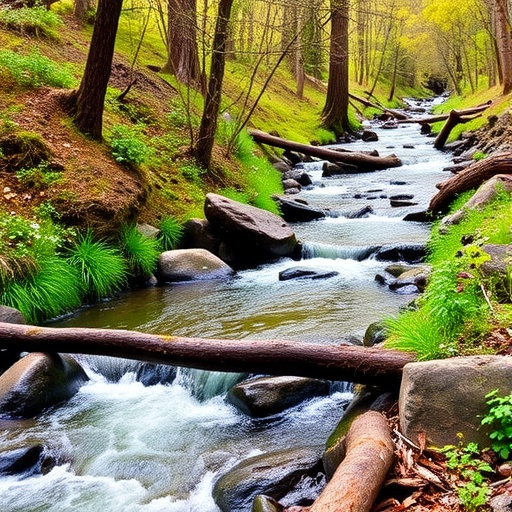
In the verdant expanses of California’s diverse landscapes, the health of watersheds is paramount—not only for maintaining thriving ecosystems but also for sustaining human recreation and safe water usage. Streams and rivers serve as critical lifelines, offering habitat to a multitude of species and purifying water that communities rely upon daily. Assessing the vitality of these aquatic systems traditionally involves labor-intensive and sometimes prohibitive monitoring techniques, which can lead to gaps in critical data about ecosystem health. However, a transformative approach leveraging environmental DNA (eDNA) promises to revolutionize how researchers and resource managers evaluate stream conditions across the Golden State.
Environmental DNA refers to genetic material shed by organisms into their environment, be it water, soil, or air. In aquatic systems, eDNA is constantly deposited through skin cells, scales, mucus, and waste products. Researchers can collect water samples and, using advanced genomic methodologies, decode the myriad species represented in those samples without having to directly observe or capture the organisms themselves. This non-invasive method yields a comprehensive portrait of the biodiversity inhabiting streams, from visible vertebrates to hidden microbial communities, offering unprecedented insights into ecosystem dynamics.
Capitalizing on the potential of eDNA, a groundbreaking initiative led by the University of California, Santa Cruz (UCSC), backed by a $2.2 million grant from the California Department of Fish and Wildlife’s Cannabis Restoration Grant Program, seeks to establish a cutting-edge stream-health index. This novel index will integrate genomics and bioinformatics to create a rapid, precise, and cost-effective tool to monitor aquatic biodiversity at scale. Traditional stream health evaluations can require extensive fieldwork and costly laboratory analyses. The use of eDNA expedites this process, reducing the timeline from weeks or months to mere days while simultaneously providing richer, species-level information that conventional surveys often miss.
The innovation extends beyond sequencing, as the project will incorporate artificial intelligence and geospatial technologies to interpret complex datasets. Machine learning algorithms will sift through millions of DNA sequences, discerning patterns that indicate environmental stressors like pollution, habitat alteration, or climate-induced shifts. By linking biodiversity patterns to specific pressures—ranging from agricultural runoff to wildfire impacts—scientists can develop a predictive and responsive framework applicable across California’s heterogeneous watersheds.
A central feature of this endeavor is its collaborative, community-driven approach. Between May and September, researchers will collect approximately 2,400 water samples from over 400 streams dispersed across 50 watersheds. The project harnesses the energy of trained volunteers, or “community scientists,” who receive standardized training in eDNA collection protocols, ensuring data integrity and wide geographic coverage. This model democratizes environmental monitoring, fostering public engagement and educational outreach while amassing a dataset of unparalleled scope.
The metaphor at the heart of this research likens the eDNA stream assessment to a “blood test” for ecosystems. Just as blood panels reveal the health status of an organism, eDNA sampling exposes the invisible tapestry of life in a waterway, capturing everything from insects and fish to microorganisms. This comprehensive snapshot permits scientists to detect early warnings of ecological decline before visible degradation occurs, enabling preemptive conservation actions rather than reactive measures.
Partnerships are critical to the project’s success. Collaborating with entities like the Southern California Coastal Water Research Project and the California State Water Resources Control Board, the UCSC team ensures that the emerging eDNA-based index aligns and calibrates with established assessment frameworks. This cross-validation fosters confidence in the new methodology and facilitates integration into existing resource management paradigms.
State-of-the-art laboratory techniques underpin the project’s genomics pipeline. High-throughput sequencing platforms enable rapid processing of vast numbers of samples, while stringent quality controls maintain data accuracy. The resultant biodiversity profiles are then processed through user-friendly, cloud-based platforms, developed by eDNA Explorer, a startup emanating from UCSC research. These interfaces transform complex genetic data into actionable, accessible insights for land managers, policymakers, and the public.
Engagement with Indigenous communities, conservation practitioners, and regulatory agencies forms another pillar of the initiative. Their insights help shape the stream health index to reflect varied perspectives on environmental quality and management priorities. This ensures the output is not only scientifically robust but also culturally sensitive and practically relevant—a necessity for enduring environmental stewardship.
Ultimately, this endeavor addresses a critical need in ecological monitoring: scalable, affordable tools to safeguard freshwater biodiversity amid rising anthropogenic pressures and climate change impacts. By harnessing advanced genomics, data science, and community involvement, the project promises to provide California with an early warning system that preserves its rich aquatic ecosystems for generations to come.
As Rachel Meyer, Director of CALeDNA, articulates, the integration of AI, historical datasets, and innovative eDNA assays culminates in a next-generation environmental assessment tool. Its deployment signals a paradigm shift in how freshwater health is monitored, moving from episodic and limited surveys toward comprehensive, continuous, and responsive ecosystem management.
By adopting this multiplexed approach, California positions itself at the forefront of environmental innovation, crafting a model that could be replicated globally. The confluence of technology, community science, and interdisciplinary collaboration exemplifies how modern science can confront complex biodiversity challenges with ingenuity and inclusivity.
News Publication Date: Not specified in the content
Web References:
- California Environmental DNA (CALeDNA) program: http://www.ucedna.com/
- eDNA Explorer: http://www.ednaexplorer.org/
- California Department of Fish and Wildlife Cannabis Restoration Grant Program: https://wildlife.ca.gov/Conservation/Cannabis/Restoration-Grants
- Southern California Coastal Water Research Project: https://www.sccwrp.org/
- California State Water Resources Control Board: https://www.waterboards.ca.gov/
Cite Scienmag News
Margaret Porter. (May 4, 2026). California Department of Fish and Wildlife Awards UC Santa Cruz Funding to Evaluate Stream Health. Scienmag. https://scienmag.com/california-department-of-fish-and-wildlife-awards-uc-santa-cruz-funding-to-evaluate-stream-health/
Margaret Porter. "California Department of Fish and Wildlife Awards UC Santa Cruz Funding to Evaluate Stream Health." Scienmag, 4 May 2026, https://scienmag.com/california-department-of-fish-and-wildlife-awards-uc-santa-cruz-funding-to-evaluate-stream-health/. Accessed 4 September 2026.
Margaret Porter. "California Department of Fish and Wildlife Awards UC Santa Cruz Funding to Evaluate Stream Health." Scienmag. May 4, 2026. https://scienmag.com/california-department-of-fish-and-wildlife-awards-uc-santa-cruz-funding-to-evaluate-stream-health/


