


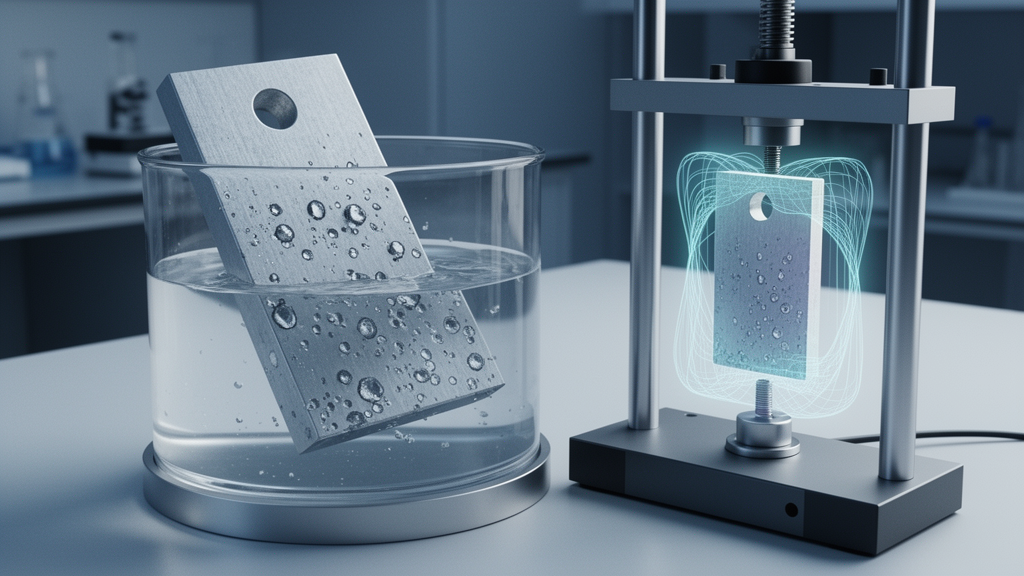
A calibrated corrosion–mechanics model predicted that alcoholate corrosion can reduce the tensile performance of EN AW-1050A aluminium more severely in ductility than in maximum stress, with localized cavities acting as the main weak points. The controlled computational investigation combined previously measured corrosion damage in nominally anhydrous ethanol with stochastic damage fields, diffusion-based metal dissolution and finite-element tensile tests. Across four exposure conditions spanning 95–120 °C, the measured relative mass losses ranged from 10.0% to 20.7%. For the same simulated corrosion fields, the softer H111 temper experienced larger relative reductions in both strength and ductility than the harder H14 condition. The results provide a quantitative method for connecting dry alcoholate corrosion to mechanical degradation, but they are not direct service-life predictions for automotive fuel-system components.
The mechanism examined was a chemically driven, water-free form of aluminium attack rather than the localized electrochemical pitting commonly associated with chloride-containing environments. At elevated temperature, aluminium can react with ethanol to form dissolved aluminium species, alcoholate ions and hydrogen after its protective oxide layer has degraded locally. The overall reaction reported for this process is aluminium plus three ethanol molecules yielding three aluminium ions, three ethoxide ions and one and a half hydrogen molecules. Failure of the passive film at discrete sites makes the attack highly localized instead of producing uniform surface thinning. These cavities can interrupt the load path and concentrate deformation, potentially weakening a component even when the overall mass loss appears moderate. Alcohol blending in transport fuels raises the material-compatibility concern because alcohols are more chemically reactive than non-polar hydrocarbons, while aluminium is used for lightweight fuel lines, injectors and other structural parts.
EN AW-1050A, a wrought aluminium alloy containing 99.5% aluminium, was deliberately chosen as a simplified model material. Its lack of secondary precipitates and comparatively straightforward mechanical behavior make it useful for testing a modelling workflow, although it has less direct relevance to structural and automotive applications than some other aluminium alloys. The experiments used nominally anhydrous, high-purity ethanol heated from 95 to 120 °C in a pressure-rated reactor. These conditions deliberately minimized the influence of water, chloride ions, oxygen and organic acids so that the alcoholate mechanism could be isolated. Two strain-hardened conditions were examined: H14, the half-hard temper, and H111, a less heavily strain-hardened variant. Identical corrosion fields were applied to both, meaning that differences in predicted mechanical response came from their constitutive behavior rather than from a measured difference in corrosion susceptibility. Any possible influence of temper on pit initiation or growth remains untested.
The researchers began with optical images of corroded specimens and converted them into quantitative measures of cavity size. Panoramic images were processed in OpenCV, smoothed with a 15-by-15 Gaussian filter and restricted to the detected circular specimen area. Otsu thresholding separated damaged and undamaged regions, while morphological opening and closing removed spurious objects and small gaps. Marker-controlled watershed segmentation then separated touching regions into individual basins, ensuring that each cavity contributed one value to the statistical analysis without double counting. Each cavity was approximated with packed circles and treated as a hemisphere, with volume estimated from its radius and mass calculated using an aluminium density of 2,700 kg m⁻³. A maximum-depth reconstruction prevented overlapping hemispheres from being added as independent volumes. Residual overlap was below 10% of the summed circle footprints and was attributed mainly to the equivalent-circle representation rather than physical coalescence.
The hemispherical approximation was assessed directly against the segmented damage rather than accepted without measurement. Intersection-over-Union scores ranged from 0.80 to 0.91, Dice coefficients from 0.89 to 0.95 and recall from 0.88 to 0.94 across the four representative specimens. These values showed that the simplified geometry reproduced much, though not all, of the observed morphology. Per-cavity masses were fitted with a two-parameter Weibull distribution whose location was fixed at zero. Asymmetric 95% confidence intervals were estimated with 1,000 bootstrap resamples. The fitted shape parameter remained low, rising only slightly from 0.28 at 95 °C to 0.34 at 120 °C, while the scale parameter increased from 8.74×10⁻⁹ to 2.45×10⁻⁸ kg. Thus, hotter conditions produced cavities with a larger characteristic mass, but the distributions retained a strongly right-skewed form with a long tail. No clear correlation was resolved between the Weibull parameters and exposure time.
Those statistics were projected onto a dogbone tensile specimen with a diameter of 5 mm and a parallel length of 20 mm in a three-dimensional diffusion model implemented in ABAQUS/Standard. Nodal dissolution fluxes followed the Weibull probability density and were scaled until the numerical model reproduced the experimentally measured global mass loss. Concentrations below 40% of the initial value were treated as material with no mechanical load-carrying capacity. The resulting dissolved volume fraction reduced both flow stress and Young’s modulus through a simple rule of mixtures, with nodal concentrations interpolated to integration points for the mechanical analysis. Mechanical response was represented by a Gurson–Tvergaard–Needleman plasticity and continuum-damage model, including accelerated void growth, damage nucleation as a function of accumulated plastic strain and a hardening law based on manufacturer data. The corrosion model used 48,000 eight-node diffusion elements, while the tensile model used 18,500 eight-node stress–strain elements with selective integration.
The principal result was that localized dissolution impaired ductility much more strongly than maximum stress, particularly in H111. For condition #2, representing 16.8% mass loss after 59.9 minutes at 100 °C, the mean predicted maximum stress was 49.8 MPa for H111 and 106.0 MPa for H14 across ten spatial realizations. The corresponding mean strains at maximum stress were 0.102 and 0.014. Across all four conditions, mean maximum stress ranged from 40.5 to 61.7 MPa for H111 and from 98.7 to 109.1 MPa for H14. Relative to the intact materials, H111 retained approximately 47% to 71% of its maximum stress and 25% to 41% of its strain at maximum stress. H14 retained about 86% to 95% of maximum stress and 52% to 66% of the corresponding strain. Failure developed along a band containing corrosion-induced cross-section minima rather than following a prescribed crack path, demonstrating how the spatial arrangement of localized damage could determine the eventual fracture location.
Random placement of the cavities produced a marked statistical difference between strength and ductility. The relative standard deviation of maximum-stress reductions was 1.8% to 11.9% for H111 and 0.59% to 2.7% for H14. By contrast, the relative standard deviation of strain reductions reached 18.7% to 42.4% for H111 and 13.1% to 26.8% for H14. Scattering increased with corrosion severity, most conspicuously at 120 °C, where rare deep or clustered cavities could control failure. The H14 constitutive response filtered geometric randomness more effectively because its greater strain-hardening capacity allowed local load redistribution. The softer H111 condition permitted more localized plasticity and was therefore more sensitive to extreme defects. This comparison concerns how two constitutive states respond to an identical statistical damage field; it does not show that H111 or H14 is intrinsically more susceptible to alcoholate corrosion.
A simple uniform correction based on the remaining cross-sectional area behaved differently across the two tempers. It acted as a conservative upper bound for H111 over the analyzed strain range, but it was not a universal upper bound for H14. In the harder material, strain hardening redistributed stress and produced stress levels that could exceed the uniform-correction prediction at some stages of loading. The study also fitted a preliminary pit-growth expression combining a power law for exposure time with an Arrhenius temperature term. The four-condition fit gave a time exponent of about 0.63 and an apparent activation energy of 6.8×10⁴ J mol⁻¹, the latter within 13% of a previously reported value for this system. However, because the fit used only four correlated experimental conditions, these values were treated as consistency checks rather than robust kinetic constants, and the available data could not independently resolve nonlinear temperature–time interactions.
Several limitations prevent direct transfer of the predictions to real fuel systems. The simulations address uniaxial tension on one dogbone geometry; bending, torsion, internal pressure and thin-walled components could make surface-breaking cavities more damaging than represented here. Predictions may also depend on specimen area because a larger exposed surface samples more extreme cavities. The flux model matches cavity-size statistics and global mass loss statistically, but not the precise number density, surface coverage or three-dimensional geometry of individual defects, and it assumes uncorrelated, non-coalescing growth. Real ethanol–petrol blends contain water, chlorides, oxygen and organic acids that can change passive-film stability, initiation temperatures and reaction rates. Direct experimental tensile validation on alcoholate-corroded EN AW-1050A was also unavailable. The framework therefore remains a controlled computational bridge between measured corrosion and virtual tensile testing. Component-level safety assessment would require in-situ validation, three-dimensional cavity characterization and experiments in which temperature and exposure time are varied independently.
Subject of Research: Computational modelling of alcoholate-corrosion effects on strength and ductility in EN AW-1050A aluminium
Article Title: Computational assessment of strength and ductility loss due to alcoholate corrosion in EN AW-1050A: A calibrated corrosion–mechanics framework
Article References: Gazenbiller, E., Steglich, D., & Höche, D. (2026). Computational assessment of strength and ductility loss due to alcoholate corrosion in EN AW-1050A: A calibrated corrosion–mechanics framework. Results in Engineering, 32, Article 113526. https://doi.org/10.1016/j.rineng.2026.113526
Image Credits: AI Generated
DOI: 10.1016/j.rineng.2026.113526
Keywords: aluminium corrosion, alcoholate corrosion, finite-element modelling, mechanical degradation, ductility loss, stochastic damage, Weibull distribution, ethanol fuel, tensile testing, corrosion mechanics, Computational, assessment
Cite Scienmag News
Denise Maddox. (October 22, 2026). Calibrated model predicts aluminium strength and ductility loss after alcoholate corrosion. Scienmag. https://scienmag.com/calibrated-model-predicts-aluminium-strength-and-ductility-loss-after-alcoholate-corrosion/
Denise Maddox. "Calibrated model predicts aluminium strength and ductility loss after alcoholate corrosion." Scienmag, 22 October 2026, https://scienmag.com/calibrated-model-predicts-aluminium-strength-and-ductility-loss-after-alcoholate-corrosion/. Accessed 22 October 2026.
Denise Maddox. "Calibrated model predicts aluminium strength and ductility loss after alcoholate corrosion." Scienmag. October 22, 2026. https://scienmag.com/calibrated-model-predicts-aluminium-strength-and-ductility-loss-after-alcoholate-corrosion/


