


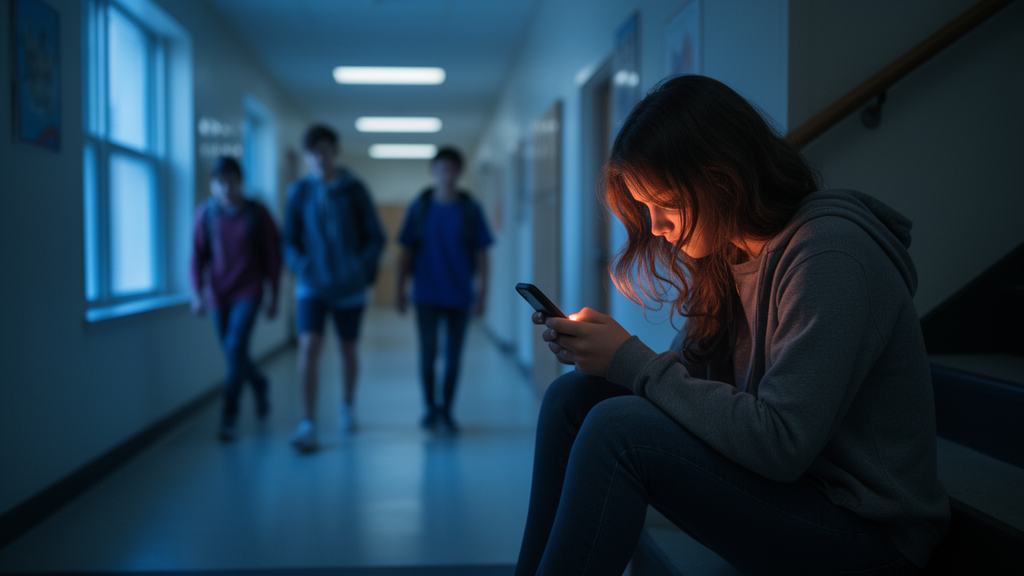
Adolescent well-being does not move along a single track. A new longitudinal study from Spain suggests that teenagers fall into distinct well-being profiles—low, moderate, and high—and that the type of victimization they experience shapes which profile they occupy and whether they slide downward over time. The research, published in Current Psychology, followed 742 students aged 10 to 17 across three measurement waves spaced roughly six months apart, and found that those facing both traditional bullying and cybervictimization simultaneously fared worst.
The research team, led by Josefina Vieta, Xavier Oriol, and Rafael Miranda of the University of Girona, together with César Bazán of the Universidad Peruana de Ciencias Aplicadas, set out to answer a question that average-based studies often obscure: do all adolescents lose well-being as they move through their teenage years, or do some hold steady, improve, or deteriorate while others follow the statistical mean? Prior research has documented a general downward trend in subjective well-being from childhood into middle adolescence, but a growing body of evidence suggests these aggregate declines mask considerable heterogeneity, with some subgroups maintaining stable or even improving trajectories.
To capture that heterogeneity, the researchers turned to person-centered statistical methods rather than the variable-centered approaches that dominate the field. Latent Profile Analysis identifies subgroups of individuals who share similar response patterns across multiple measures, while Latent Profile Transition Analysis tracks how individuals move between those subgroups over time. In this study, the well-being profiles were built from three standardized indicators: the five-item Satisfaction with Life Scale measuring global cognitive life evaluation, the Children’s Worlds Subjective Well-Being Scale capturing student life satisfaction on an 11-point format, and a domain-based scale covering ten life areas including relationships, safety, health, friendships, freedom, and use of time.
The modeling, conducted in R using the tidyLPA package with finite Gaussian mixture models estimated via maximum likelihood, consistently favored a three-profile solution across all three waves. Fit indices including the Bayesian Information Criterion, the Akaike Information Criterion, and the sample-size-adjusted BIC showed their largest improvement moving from two to three profiles, while solutions with four or more profiles produced diminishing returns and shrinking, hard-to-interpret classes. Classification quality was strong, with entropy values ranging from 0.81 to 0.90 across waves—above the 0.80 threshold that typically indicates classification accuracy exceeding 90 percent.
The resulting profiles were replicated at every measurement point. At baseline, 4.9 percent of participants sat in the low well-being profile, 42.1 percent in the moderate profile, and 53.0 percent in the high profile. By the third wave, the low profile had grown to 10.4 percent while the high profile shrank to 48.9 percent, hinting that high well-being during adolescence may be less stable than it first appears. Multivariate analysis of variance confirmed that the profiles differed significantly on all three well-being indicators at each wave, with effect sizes growing from 0.179 at baseline to 0.419 at the final measurement.
The transition analysis revealed an asymmetry that may matter for intervention design. Adolescents in the high well-being profile showed the greatest stability—84 percent remained there from the first to the second wave, and 68 percent from the second to the third. Those in the low profile were far more mobile: only 50 percent stayed put in the first interval, and just 31 percent in the second. Crucially, movement out of the low profile was more often upward to the moderate profile than a leap to the high profile, suggesting that recovery in adolescent well-being tends to be gradual rather than abrupt. Stability also declined overall in the later transition period, indicating increasing mobility as the students aged.
Victimization was measured using school bullying items from the Children’s Worlds survey, asking how often in the previous month students had been hit, insulted, excluded, or targeted by rumors, and three parallel items covering cybervictimization on platforms such as WhatsApp, Instagram, and TikTok. Students were then sorted into exposure groups: no victimization, single-form victimization, or co-occurring victimization. Notably, the co-occurring group was the largest at every wave, encompassing roughly 41 to 45 percent of the sample—meaning nearly half the students reported experiencing both face-to-face and digital peer aggression within the school context.
The regression models, which controlled for age and gender, told a consistent story. Adolescents reporting no victimization had significantly higher odds of belonging to the high well-being profile compared with those facing co-occurring victimization, with odds ratios of 5.04 at the second wave and 5.27 at the third. Those reporting only a single form of victimization occupied an intermediate position, with significantly higher odds of high well-being membership than the co-occurring group at the final wave. When the researchers examined trajectories—stable, declining, or improving—single-form victimization was associated with significantly lower odds of decline relative to co-occurring victimization, lending support to cumulative-risk models in which simultaneous exposure to multiple stressors compounds harm.
The theoretical framing draws on conservation of resources theory, which holds that psychological stress emerges when valued personal and social resources are threatened or lost. Under this view, victimization functions as a chronic interpersonal stressor that erodes the resources adolescents need to sustain well-being. When both traditional and digital victimization co-occur, the resource drain intensifies, making it harder for young people to maintain favorable well-being configurations over time. The findings align with prior poly-victimization research showing dose-response patterns between the number of victimization types experienced and psychological distress.
The study also surfaced demographic patterns. Older adolescents were consistently less likely to belong to the high well-being profile, with odds ratios around 0.66 to 0.72 per year of age, and girls were markedly less likely than boys to occupy the high profile at every wave. Yet neither age nor gender predicted upward transitions, suggesting that demographic variables flag vulnerability but say little about what enables improvement. The authors note that upward movement may depend on protective factors not measured here—supportive relationships, school connectedness, coping resources—pointing toward future research. For schools, the practical message is direct: monitoring well-being over time, and assessing traditional and cyber victimization together rather than in isolation, may help identify the students most at risk of watching their well-being deteriorate.
Subject of Research: Longitudinal associations between traditional victimization, cybervictimization, and trajectories of adolescent subjective well-being using latent profile transition analysis
Article Title: Traditional victimization, cybervictimization, and trajectories of adolescent subjective well-being: A latent profile transition analysis
Article References: Vieta, J., Oriol, X., Miranda, R., & Bazán, C. (2026). Traditional victimization, cybervictimization, and trajectories of adolescent subjective well-being: A latent profile transition analysis. Current Psychology, 45(17), Article 1450. https://doi.org/10.1007/s12144-026-09893-x
Image Credits: AI Generated
DOI: 10.1007/s12144-026-09893-x
Keywords: subjective well-being, adolescence, bullying, cybervictimization, latent profile analysis, latent transition analysis, peer victimization, school bullying, cumulative risk, conservation of resources theory, life satisfaction, longitudinal study
Cite Scienmag News
Glenn Wilkins. (October 15, 2026). Bullying in Person and Online Together Drags Teen Well-Being Down, Year-Long Study Finds. Scienmag. https://scienmag.com/bullying-in-person-and-online-together-drags-teen-well-being-down-year-long-study-finds/
Glenn Wilkins. "Bullying in Person and Online Together Drags Teen Well-Being Down, Year-Long Study Finds." Scienmag, 15 October 2026, https://scienmag.com/bullying-in-person-and-online-together-drags-teen-well-being-down-year-long-study-finds/. Accessed 15 October 2026.
Glenn Wilkins. "Bullying in Person and Online Together Drags Teen Well-Being Down, Year-Long Study Finds." Scienmag. October 15, 2026. https://scienmag.com/bullying-in-person-and-online-together-drags-teen-well-being-down-year-long-study-finds/


