


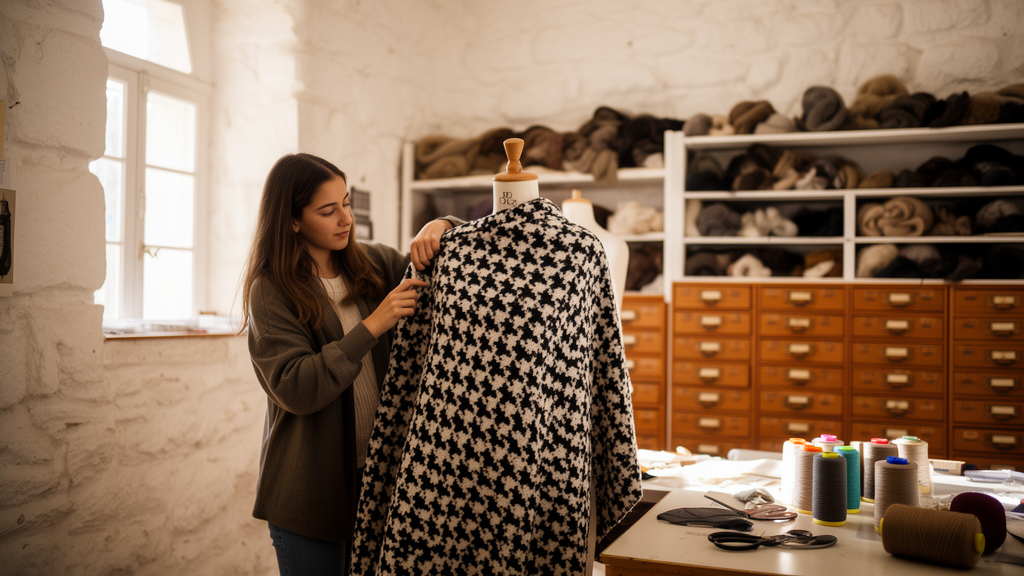
In a classroom unlike most design studios, forty undergraduate fashion design students at the University of Beira Interior in Covilhã, Portugal, spent a semester peering into the past. Their laboratory was not a white-walled atelier but the Wool Museum of the University of Beira Interior, home to an industrial textile archive that preserves the region’s centuries-old wool manufacturing tradition. There, guided by researchers Luísa Vidal and Rita Salvado, the students took a single historical pattern—the houndstooth—and set out to reinvent it for the twenty-first century. The experiment, published in the European Journal of Cultural Management and Policy, offers one of the most detailed accounts yet of how museum archives can be transformed from silent repositories into engines of creative learning.
The study addresses a persistent gap in design education. Although universities hold remarkable textile and clothing collections, teaching has long favoured text and images over direct contact with artefacts. Researchers have noted that students often lack experience in interpreting material culture, and that no clear, replicable structure exists for studying historical objects in the classroom. Vidal and Salvado set out to build exactly that structure: a pedagogical framework rooted in industrial textile heritage, tested under real teaching conditions, and measurable in its outcomes.
The raw material of the exercise was deliberately specific. From the museum’s René Delimbeuf collection, the team selected textile samples that shared three defining characteristics: a composition of 100 percent wool, a Batavian twill weave structure, and a houndstooth pattern design, all dating from 1960. The houndstooth was chosen for its dual significance—it dominated the pages of L’Officiel magazine in 1960 and reappeared prominently in trend forecasts for the 2025 Spring/Summer and Autumn/Winter seasons, giving students a rare opportunity to trace a single motif across more than six decades of fashion history.
The pedagogical engine behind the project was Dee Fink’s Taxonomy of Significant Learning, a framework that treats education as a transformative process integrating foundational knowledge, application, integration, the human dimension, caring, and learning how to learn. From this taxonomy, the researchers constructed a Design Practice Framework with four sequential stages: Comprehend, Replicate, Reinterpret, and Materialise. In the first stage, students explored the archive, studied a 1937 reference textile sample and its debuxo—the technical drawing that guides the arrangement of warp and weft threads—and consulted both historical magazines and contemporary trend publications to situate the pattern in time.
The Replicate stage pushed students from observation into practice. Working first with contrasting markers on paper, they decomposed the houndstooth visually and structurally, identifying formal variables such as technique, scale, and colour alongside conceptual variables like cultural meaning and historical context. They then moved to vertical hand looms, weaving the Batavian twill structure on raw cloth before progressing to two-colour houndstooth fabrics made with recycled wool yarns donated by regional textile factories—a detail that wove sustainability into the very fabric of the exercise.
Reinterpretation was where the creative stakes rose. Each student selected one of five pre-chosen archive references and developed at least four textile surface proposals through hand weaving, manipulating scale, colour, shape, and texture while respecting the colour palette of the original. In parallel, they produced at least four digital print proposals in repeat using Adobe Illustrator and Photoshop, remaining faithful to the colours and forms of the historical pattern. Throughout, students documented their evolving ideas in sketchbooks modelled on the working practice of textile designer Zandra Rhodes, who describes the creative process as a continuum—a visual journey in which drawing functions as a means of thought itself.
To evaluate the results, the researchers turned to the creative thinking theories of Edward de Bono, particularly lateral thinking and the Six Thinking Hats model. Five experts with between nine and fourteen years of professional experience in fashion design, textiles, and academia independently scored the work of ten representative students across six criteria: originality of approach, conceptual provocation, cognitive flexibility, conscious management of the creative process, emotional and intuitive expression, and feasibility and applicability of the result. The scores were encouraging. Averages ranged from 3.7 to 4.0 on a five-point scale, with the highest marks awarded for process management, emotional expressiveness, and the practical viability of the final proposals.
Statistical analysis reinforced the credibility of these findings. Kendall’s coefficient of concordance, calculated at W = 0.624, indicated moderate to good agreement among the five evaluators, suggesting the de Bono-derived grid provided a coherent and reliable framework for assessing creativity. Yet the slightly lower scores in originality and conceptual provocation revealed an instructive tension: students, absorbed in mastering the technical demands of weaving and digital representation, tended to prioritise faithful interpretation of the historical pattern over radical experimentation. The authors suggest that future iterations should build in more explicit strategies for conceptual risk-taking during the early phases of the creative process.
Student questionnaires added a vivid human dimension to the data. Eighty percent of respondents reported full understanding of both the digital and manual processes, and none found either method difficult in the extreme. But the emotional readings diverged in a revealing way: while sixty percent found the digital design process fun, sixty percent rated the hand-weaving experience as very fun, with not a single participant describing it as boring. The tactile, sensory engagement of working wool through a loom generated a depth of motivation that screens could not match, even as digital tools offered speed and precision for testing colour and scale variations. The researchers conclude that the two approaches are complementary, pairing the expressive qualities of craft with the iterative power of digital technology.
Beyond the classroom, the study carries a broader argument about cultural sustainability. By reinterpreting patterns preserved in the Wool Museum, students become agents of heritage regeneration, transferring industrial know-how from the past into contemporary design practice and giving museum collections new functions and meanings. The authors acknowledge limitations—a small sample, a single semester, one pattern type—but see the framework as replicable across institutions and motifs. As fashion education confronts questions of identity, sustainability, and technological change, this Portuguese experiment suggests that the future of design may be woven, quite literally, from the threads of its own industrial past.
Subject of Research: Heritage-based design didactics using historical industrial textile patterns in fashion design education
Article Title: A methodological study in design didactics based on historical patterns of industrial textile heritage
Article References: Vidal, L., & Salvado, R. (2026). A methodological study in design didactics based on historical patterns of industrial textile heritage. European Journal of Cultural Management and Policy, 16, Article 15859. https://doi.org/10.3389/ejcmp.2026.15859
Image Credits: AI Generated
Keywords: fashion design education, textile heritage, houndstooth pattern, cultural sustainability, design didactics, wool museum, hand weaving, digital design, creative thinking, pedagogical framework, Batavian twill, object-based learning
Cite Scienmag News
Courtney Benton. (October 15, 2026). Houndstooth Reimagined: How a Portuguese Wool Archive Is Rewriting Fashion Design Education. Scienmag. https://scienmag.com/houndstooth-reimagined-how-a-portuguese-wool-archive-is-rewriting-fashion-design-education/
Courtney Benton. "Houndstooth Reimagined: How a Portuguese Wool Archive Is Rewriting Fashion Design Education." Scienmag, 15 October 2026, https://scienmag.com/houndstooth-reimagined-how-a-portuguese-wool-archive-is-rewriting-fashion-design-education/. Accessed 15 October 2026.
Courtney Benton. "Houndstooth Reimagined: How a Portuguese Wool Archive Is Rewriting Fashion Design Education." Scienmag. October 15, 2026. https://scienmag.com/houndstooth-reimagined-how-a-portuguese-wool-archive-is-rewriting-fashion-design-education/


