


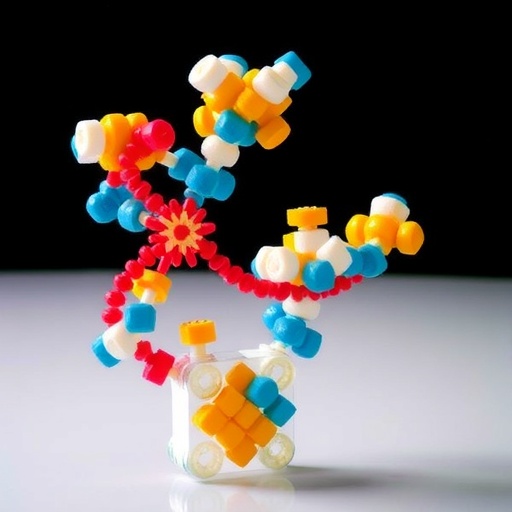
In a major breakthrough for the fields of biotechnology and synthetic biology, researchers at Heidelberg University have unveiled an innovative artificial intelligence (AI) tool capable of revolutionizing the engineering of proteins with customized functionalities. This novel computational model, termed the Protein Domain Insertion Optimizer or ProDomino, harnesses the power of machine learning to accurately predict how distinct protein domains—modular building blocks akin to domino tiles—can be recombined to create unprecedented protein architectures. Such rational design of chimeric proteins opens new horizons in developing tailor-made molecular machines with wide-ranging applications in medicine, synthetic biology, and therapeutic development.
Proteins serve as the fundamental workhorses of the cell, orchestrating myriad biochemical processes vital for life. They are composed of one or more subunits known as domains, each conferring specific structural or functional traits. These domains act as independent yet interconnected modules, enabling proteins to detect environmental cues, catalyze reactions, or mediate signaling pathways. Natural evolution leverages this modularity, progressively recombining domains to yield novel proteins with enhanced or altered capabilities. Drawing inspiration from this evolutionary paradigm, the Heidelberg team sought to simulate and accelerate such recombination artificially, thereby rationally engineering proteins with controllable and desirable features.
Central to this endeavor was the development of an AI-driven platform that can systematically analyze the complex landscape of domain combinations and predict optimal insertion sites for merging domains without compromising protein stability or function. To train and validate their model, the scientists employed a comprehensive dataset derived from over 100,000 proteins, meticulously curated from extensive protein databases. This rich dataset encapsulates a vast diversity of naturally occurring domain architectures, providing a robust foundation for the AI to learn patterns governing successful domain integration within proteins.
ProDomino’s predictive prowess lies in its ability to consider a multitude of structural and functional parameters simultaneously, such as domain compatibility, folding dynamics, and allosteric communication pathways. By simulating potential domain insertions computationally, the AI can forecast how hybrid proteins will behave upon recombination, including whether the engineered protein switch can effectively modulate its activity in response to external signals. This capability marks a significant step beyond traditional trial-and-error protein engineering, heralding a shift towards rational, in silico-guided design.
One of the showcased applications involved coupling chemosensitive sensor domains with the CRISPR-Cas system, a revolutionary genome editing tool. By fusing these sensor modules to the molecular “scissors,” researchers generated allosteric protein switches capable of being toggled on or off by specific chemical stimuli. This innovation substantially enhances the safety profile of CRISPR-based editing by enabling precise temporal and spatial control over gene-editing activity, thereby minimizing off-target effects and unwanted genetic modifications. The successful in vitro validation of these engineered proteins underscores ProDomino’s potential in fine-tuning complex biomolecular systems.
Further emphasizing the versatility of ProDomino, the research team demonstrated the model’s utility in designing proteins sensitive to diverse stimuli, including biochemical signals and environmental factors such as light and temperature. This adaptability paves the way for creating bespoke biosensors, regulatory proteins, and therapeutic agents with switchable functionalities—components that can fundamentally transform approaches in synthetic biology, diagnostics, and targeted therapies.
Prof. Dr. Dominik Niopek, the leading scientist behind this pioneering work at Heidelberg’s Institute of Pharmacy and Molecular Biotechnology, highlighted the transformative nature of their AI model: “Our approach allows us to produce artificial proteins more efficiently and precisely than ever before. By leveraging computational predictions, we bypass laborious experimental screening and steer protein engineering toward rational design.” He envisions that this technology will accelerate the development of protein-based tools that are not only more effective but also customizable, enabling novel therapeutic strategies and biotechnological innovations.
The open-source release of ProDomino reflects the research team’s commitment to fostering collaborative progress in the scientific community. By making the software freely available, they empower researchers worldwide to explore new protein combinations and applications, from customizing enzymes for industrial processes to engineering cellular machines for regenerative medicine. This democratization of advanced protein design tools is expected to catalyze breakthroughs across multiple disciplines.
Underpinning the success of ProDomino is an interdisciplinary fusion of computational biology, protein chemistry, and machine learning. The computational simulation methodologies employed incorporate advanced modeling algorithms that consider the energetic and dynamic complexities of protein folding and domain-domain interactions. This holistic approach not only predicts compatible domain combinations but also anticipates conformational changes critical for allosteric regulation—a key feature for engineering switchable proteins.
The research was generously supported by the European Research Council (ERC), underscoring the importance of funding fundamental scientific innovation. The team’s findings were published on August 4, 2025, in the prestigious journal Nature Methods, where the full technical details and validation experiments are documented.
Looking ahead, the potential implications of ProDomino extend well beyond laboratory research. By enabling precise, programmable control over protein function, this AI-driven approach may underpin next-generation therapies for genetic diseases, innovative biosensors for environmental monitoring, and bespoke enzymes tailored for sustainable industrial applications. The convergence of AI and synthetic biology promises to unlock a new era in which proteins are engineered with the same precision and predictability as electronic circuits, transforming medicine and biotechnology at a fundamental level.
Cite Scienmag News
Gregory Coleman. (August 6, 2025). Building Proteins Like Dominoes: How Artificial Enzymes Are Assembled from Modular Parts. Scienmag. https://scienmag.com/building-proteins-like-dominoes-how-artificial-enzymes-are-assembled-from-modular-parts/
Gregory Coleman. "Building Proteins Like Dominoes: How Artificial Enzymes Are Assembled from Modular Parts." Scienmag, 6 August 2025, https://scienmag.com/building-proteins-like-dominoes-how-artificial-enzymes-are-assembled-from-modular-parts/. Accessed 4 September 2026.
Gregory Coleman. "Building Proteins Like Dominoes: How Artificial Enzymes Are Assembled from Modular Parts." Scienmag. August 6, 2025. https://scienmag.com/building-proteins-like-dominoes-how-artificial-enzymes-are-assembled-from-modular-parts/


