


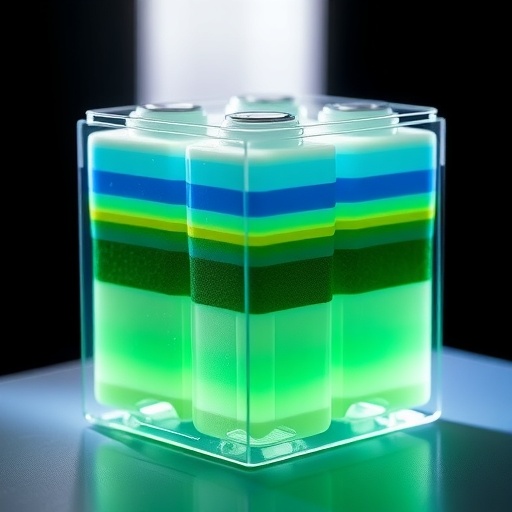
As the world urgently pivots toward sustainable energy solutions, the demand for safer and more efficient lithium-ion battery technologies is reaching unprecedented heights. These batteries are integral to the electrification of transport and the integration of renewable energy systems, yet their rapid scaling presents significant safety challenges. Central among these is the phenomenon known as thermal runaway propagation (TRP), a perilous chain reaction where excessive heat and pressure in one battery cell escalate catastrophically to neighboring cells, triggering fires or explosions. The risks are exacerbated by the battery cells’ increasing energy densities, which intensify thermal events beyond manageable limits.
Addressing this formidable challenge, a team of researchers from the China University of Petroleum-Beijing and the China Academy of Safety Science and Technology, led by Professors Congling Shi and Laibin Zhang, along with collaborators Shuilai Qiu and Jingyao Xu, have engineered a novel composite material designed to halt thermal runaway before it escalates. Their innovative solution leverages a gradient-laminated ceramifiable silicone foam, meticulously crafted to withstand the extreme pressures and temperatures characteristic of TRP scenarios. This advanced material marks a significant departure from conventional thermal protection methods that often trade thermal insulation efficiency for mechanical robustness, or vice versa.
Traditional insulating materials such as organic polymers deliver acceptable thermal resistance but catastrophically fail above temperatures of 300 °C due to structural collapse. Conversely, inorganic materials, while inherently fire-resistant, lack the mechanical integrity to resist the supersonic, high-pressure gas jets—often exceeding 200 m/s velocity and 800 °C temperature—that accompany thermal runaway events. This trade-off leaves battery modules vulnerable to rapid fire propagation and explosive failures, especially in large-scale energy storage configurations.
The groundbreaking composite developed by the team overcomes this dichotomy by integrating a flexible polydimethylsiloxane (PDMS) foam with a robust glass fiber fabric (GFF) scaffold. The PDMS foam serves as a thermally insulating matrix, while the glass fiber reinforcement endows the structure with exceptional mechanical strength and fatigue resistance. The resulting synergy yields a material that not only slows thermal conduction but also actively counters the intense mechanical forces exerted by high-velocity gas jets during thermal runaway.
Fabrication of this composite employs a scalable reactive chemical foaming technique, in which the silicone matrix permeates the silane-modified glass fiber interstices, creating an intimate and highly integrated architecture. Incorporating functional fillers such as ammonium polyphosphate (APP), zinc borate (ZB), kaolin clay, and silica aerogel further enhances performance. These additives synergize to enable ceramification—a transformation process where, upon exposure to intense heat, the composite chemically evolves into a dense, durable ceramic barrier capable of physically blocking high-pressure gases and heat flux.
At the molecular level, the flame retardants catalyze the release of inert gases that dilute combustible volatiles and facilitate char formation. Simultaneously, kaolin and silica aerogel components undergo liquid-phase sintering, forming α-Zn₃(PO₄)₂ glassy phases and SiO₂ frameworks that yield a ceramic-like microstructure. The glass fiber fabric functions as a mechanical firewall, maintaining barrier integrity even when the composite’s foam surface partially degrades. This multilayered defense mechanism is unique; it dynamically adapts under extreme thermal and mechanical stress, preventing catastrophic cell-to-cell failure.
Evaluations of the optimized SF/GFFAPP-ZB-Aero-Kao composite reveal extraordinary thermal and mechanical properties. It exhibits a notably low thermal conductivity of 0.046 W m⁻¹ K⁻¹, nearly halving heat transfer compared to unmodified silicone foams. Mechanical testing underscores remarkable fatigue resistance with 93% stress retention after 1,000 cycles, and stable elasticity across an ultrawide temperature span ranging from −40 °C up to 300 °C. The composite’s flame retardancy is substantiated by a high limiting oxygen index of 33.5% and a UL-94 V-0 rating, confirming its suitability for rigorous fire safety applications.
Beyond laboratory testing, this ultrathin 3 mm composite material demonstrates its prowess in realistic lithium-ion battery module experiments utilizing commercial 37 Ah prismatic cells. When exposed to simulated thermal runaway conditions, the composite effectively impedes high-velocity gas jets and confines the thermal event to a single cell, thus preventing destructive cascade failures that commonly threaten multi-cell assemblies. The integrity of the composite ensures close adherence to aluminum casings, eliminating interfacial air gaps that typically increase thermal resistance and adversely affect overall system safety.
The practical implications of this development are striking. By integrating this gradient-laminated ceramifiable silicone foam protection into lithium-ion battery systems, manufacturers can substantially elevate intrinsic safety without compromising energy density or device form factor. The material’s scalability and compatibility with industrial roll-to-roll processing techniques promise seamless integration into existing battery module fabrication lines, facilitating widespread adoption in energy storage power stations and electric vehicle battery packs.
In addition to mitigating catastrophic failure modes, the composite also contributes to environmental safety by significantly reducing smoke release—up to 87.9% less during combustion—and lowering total heat output by 54.4%. These reductions decrease hazardous emissions and thermal hazards in fire incidents, offering enhanced protection not only to battery systems but also to personnel and infrastructure in proximity to energy storage installations.
Looking forward, the gradient-laminated ceramifiable silicone foam represents an archetype for next-generation smart materials that combine multifunctional thermal, mechanical, and chemical defenses. Its success highlights the potential of combining ceramic-phase transformations with polymer-based flexibility to engineer materials capable of responding dynamically to extreme conditions. Such innovations are poised to redefine safety standards across energy storage technologies, spurring further interdisciplinary research into intrinsically safe battery systems.
This breakthrough stands as a testament to the importance of integrating chemical engineering, materials science, and mechanical design to solve pressing energy technology challenges. As the global shift toward green energy accelerates, such advanced materials will be indispensable in ensuring that energy storage infrastructures remain reliable, safe, and resilient. The collaborative efforts of the China University of Petroleum-Beijing and the China Academy of Safety Science and Technology exemplify how ingenuity at the interface of disciplines can lead to vital technological advancements.
Stakeholders across sectors—ranging from battery manufacturers and energy utilities to vehicle OEMs—are poised to benefit immensely from this innovation. By enabling safer lithium-ion battery storage solutions that do not sacrifice performance or scalability, this ceramifiable silicone foam composite offers a promising pathway to mitigating risks associated with the electrification of transport and increasingly complex energy grids.
Continued research and optimization will likely focus on enhancing the composite’s adaptability to various battery chemistries and module configurations, improving cost-efficiency, and further refining its mechanical and thermal responses. As these developments unfold, the vision of intrinsically safe, high-energy-density lithium-ion batteries moves closer to reality, bolstering global efforts to achieve carbon neutrality and sustainable electrification.
News Publication Date: 21-May-2026
Web References: DOI: 10.1007/s40820-026-02228-2
Keywords
Lithium-ion batteries, thermal runaway, ceramifiable silicone foam, gradient-laminated composite, thermal insulation, energy storage safety, battery module protection, glass fiber fabric, reactive foaming, flame retardancy, high-temperature resistance, thermal runaway propagation
Cite Scienmag News
Faith Mcneil. (June 8, 2026). Building Inherently Safe Lithium-Ion Battery Storage Using Gradient-Laminated Ceramifiable Silicone Foams. Scienmag. https://scienmag.com/building-inherently-safe-lithium-ion-battery-storage-using-gradient-laminated-ceramifiable-silicone-foams/
Faith Mcneil. "Building Inherently Safe Lithium-Ion Battery Storage Using Gradient-Laminated Ceramifiable Silicone Foams." Scienmag, 8 June 2026, https://scienmag.com/building-inherently-safe-lithium-ion-battery-storage-using-gradient-laminated-ceramifiable-silicone-foams/. Accessed 4 September 2026.
Faith Mcneil. "Building Inherently Safe Lithium-Ion Battery Storage Using Gradient-Laminated Ceramifiable Silicone Foams." Scienmag. June 8, 2026. https://scienmag.com/building-inherently-safe-lithium-ion-battery-storage-using-gradient-laminated-ceramifiable-silicone-foams/


