


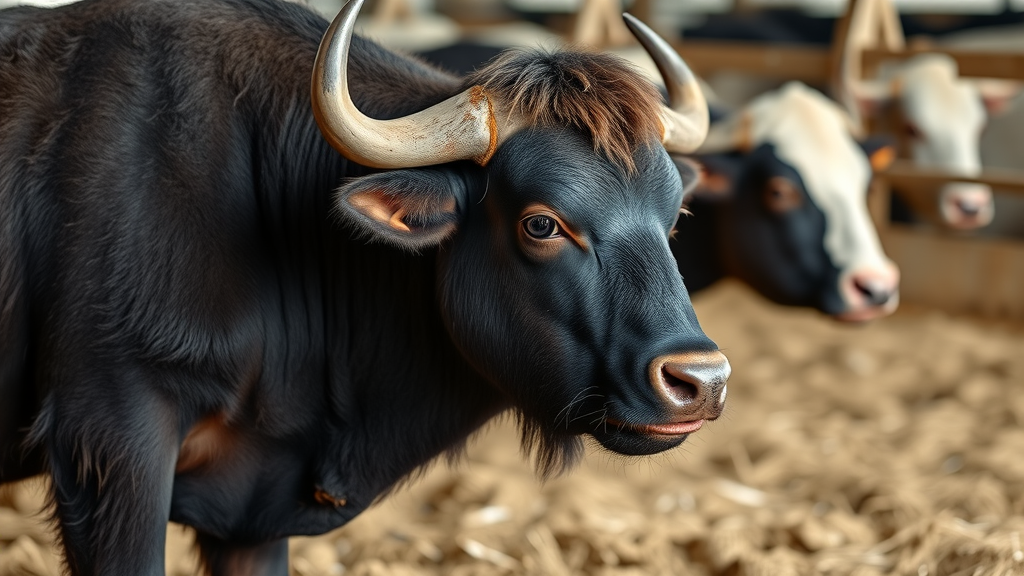
In the global dairy industry, the water buffalo occupies a curious position. It produces more milk than any other animal except the cow, and that milk is prized for its richness, with higher concentrations of fat and protein that make it the backbone of mozzarella and countless other traditional products. Yet the average buffalo yields far less milk per lactation than a modern dairy cow, a bottleneck that has long frustrated breeders and researchers alike. A new study published in BMC Genomics offers a detailed molecular portrait of what separates high-yielding buffaloes from their lower-producing herdmates, and it does so using an unexpected sample type: the milk itself.
The research team, led by scientists at Guangxi University in collaboration with the Guangxi Buffalo Research Institute and international partners, performed an integrated transcriptomic analysis on milk-derived RNA from Murrah buffaloes at mid-lactation. The animals were divided into two clearly separated groups based on lactation performance. High-yield buffaloes produced an average of roughly 3,804 kilograms of milk per lactation, while low-yield animals averaged about 1,928 kilograms, a difference of nearly a factor of two. By sequencing the complete RNA content of milk from both groups, the researchers set out to identify the transcriptional features that accompany, and possibly underpin, this dramatic divergence in productivity.
The choice of milk as the sampling medium is one of the study’s most practical innovations. Mammary epithelial cells and other milk-associated cells are shed continuously into milk, meaning a simple sample of the fluid carries a molecular record of the secretory activity inside the udder. Unlike a mammary gland biopsy, milk collection is non-invasive, repeatable, and stress-free for the animal, which matters both for animal welfare and for the feasibility of scaling such measurements to breeding programs. The study’s authors note that no animals were euthanised, anaesthetised, or subjected to invasive procedures, and that the work was approved by the Animal Experiment Ethics Review Committee of Guangxi University.
Sequencing the milk RNA revealed a remarkably complex transcriptomic landscape. In total, the team identified 17,735 messenger RNAs, the protein-coding workhorses of the cell, alongside 2,641 long non-coding RNAs, 6,668 circular RNAs, and 578 microRNAs. This catalogue of four distinct RNA classes is what makes the study integrated rather than a conventional single-layer gene expression analysis. Long non-coding RNAs and circular RNAs can act as molecular sponges that bind microRNAs, thereby modulating how much protein gets produced from messenger RNA transcripts, a regulatory architecture known as the competing endogenous RNA, or ceRNA, network. Capturing all of these layers simultaneously from the same samples allowed the researchers to begin mapping how they interact.
The comparative analysis between high-yield and low-yield animals produced a coherent biological story. Buffaloes with higher milk output showed coordinated upregulation of genes involved in oxidative phosphorylation, the mitochondrial process that converts nutrients into cellular energy in the form of ATP. Genes tied to glucose metabolism, cellular metabolism in general, and protein synthesis were also elevated in the high-yield group. Taken together, these patterns point to an enhanced bioenergetic and biosynthetic state in the milk-associated cells of productive animals. In essence, the secretory cells of high-yielding buffaloes appear to run a hotter metabolic engine, burning more glucose through their mitochondria and building more protein, which is exactly what one would expect from tissue tasked with secreting roughly twice the volume of milk.
Equally telling was what was turned down. Transcripts associated with signal transduction, transporter activity, and apoptosis-related processes showed reduced expression in the high-yield group. Lower expression of apoptosis-related genes suggests that the milk cells of productive animals may resist programmed cell death, potentially sustaining secretory activity for longer. Reduced signalling and transporter transcripts hint at a shift in cellular priorities: rather than communicating with their environment or shuttling molecules across membranes, the cells of high-yield animals appear to channel resources into synthesis and secretion. The researchers are careful to frame these as associations rather than proven causes, describing the work as an exploratory framework, but the consistency of the metabolic signature across functional categories lends it weight.
By integrating the messenger RNA data with the non-coding RNA layers, the team constructed putative ceRNA networks that connect microRNAs, their messenger RNA targets, and the long non-coding and circular RNAs that sequester them. Within these networks, two candidate genes emerged as potentially associated with milk yield-related cellular pathways: SNX25, which encodes sorting nexin 25, a protein involved in intracellular trafficking, and DHPR, which encodes dihydropyridine reductase, an enzyme in the metabolic recycling pathway. These genes now stand as priority targets for future functional validation, the experimental step needed to determine whether they merely correlate with high yield or actively contribute to it.
The implications for buffalo breeding are potentially significant. Traditional genetic selection for milk yield in buffalo has been slowed by long generation intervals, limited pedigree and genomic records in many producing countries, and the sheer difficulty of measuring lactation traits early in an animal’s life. A transcriptomic marker panel derived from milk, measurable without harming the animal and potentially early in a lactation, could complement genomic selection by providing a functional readout of the actual secretory machinery. If the metabolic and ceRNA signatures identified here hold up in larger cohorts and across breeds, they could help identify high-potential animals sooner and guide the development of genetic improvement strategies tailored to buffalo biology rather than borrowed wholesale from dairy cattle.
The study also contributes a substantial public resource to the emerging field of livestock transcriptomics. Cataloguing nearly 18,000 messenger RNAs and thousands of non-coding transcripts from buffalo milk provides a reference for other researchers studying mammary biology, lactation physiology, and even milk quality traits, since many of the same metabolic pathways that drive yield also influence fat and protein composition. The raw sequencing data have been deposited in the Sequence Read Archive, allowing independent verification and reuse. The work was supported by the Guangxi Key Research and Development Program and the National Natural Science Foundation of China, reflecting the strategic importance of buffalo dairy production in southern China and across South Asia.
As with any exploratory transcriptomic study, caveats remain. The findings describe molecular features associated with divergent yield phenotypes at a single lactation stage in one breed, and the ceRNA networks are computational predictions that require experimental confirmation in mammary cells. The authors themselves position the work as a framework and a source of candidate targets rather than a definitive mechanism. Even so, the study marks a step toward a future in which a routine milk sample, already collected on every dairy farm every day, doubles as a molecular diagnostic window into the animal’s productive capacity. For an industry built on the biology of secretion, reading the transcriptome in the milk itself may prove to be one of the most elegant shortcuts breeding science has found in decades.
Subject of Research: Transcriptomic analysis of milk-derived RNA linked to divergent milk yield in buffalo
Article Title: Integrated transcriptomic analysis of milk-derived RNA associated with divergent milk yield phenotypes in buffalo
Article References: Integrated transcriptomic analysis of milk-derived RNA associated with divergent milk yield phenotypes in buffalo. (n.d.). https://doi.org/10.1186/s12864-026-13363-w
Image Credits: AI Generated
DOI: 10.1186/s12864-026-13363-w
Keywords: buffalo, milk yield, transcriptomics, RNA sequencing, non-coding RNAs, ceRNA network, oxidative phosphorylation, lactation, molecular breeding, gene expression, Murrah buffalo, BMC Genomics
Cite Scienmag News
Juliet Wilcox. (September 24, 2026). Buffalo Milk RNA Reveals the Metabolic Signature of High-Yield Dairy Animals. Scienmag. https://scienmag.com/buffalo-milk-rna-reveals-the-metabolic-signature-of-high-yield-dairy-animals/
Juliet Wilcox. "Buffalo Milk RNA Reveals the Metabolic Signature of High-Yield Dairy Animals." Scienmag, 24 September 2026, https://scienmag.com/buffalo-milk-rna-reveals-the-metabolic-signature-of-high-yield-dairy-animals/. Accessed 5 October 2026.
Juliet Wilcox. "Buffalo Milk RNA Reveals the Metabolic Signature of High-Yield Dairy Animals." Scienmag. September 24, 2026. https://scienmag.com/buffalo-milk-rna-reveals-the-metabolic-signature-of-high-yield-dairy-animals/


