


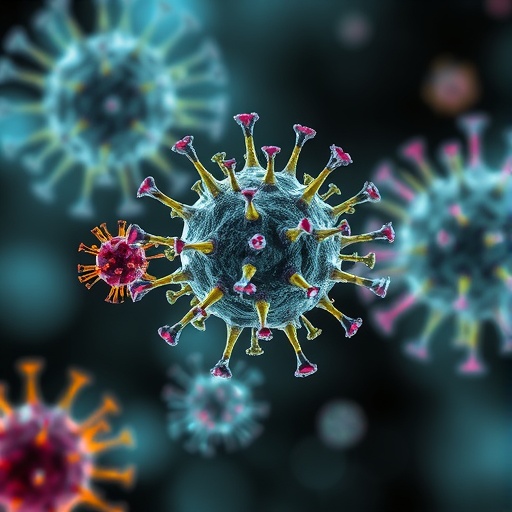
In the vast and complex world of microbial life, viruses that prey on bacteria—known as bacteriophages or simply phages—have long fascinated scientists for their intricate roles in shaping microbial ecology and evolution. Historically, it has been accepted dogma that phage replication and infection are restricted to a narrow host range, often limited to a single bacterial species or closely related strains. This specificity is thought to stem from the molecular precision phages require to recognize and invade their hosts. However, a groundbreaking new study is rewriting this narrative, unveiling a strikingly widespread phenomenon of broad host range phage interactions that traverse multiple bacterial species across diverse ecosystems.
Leveraging cutting-edge proximity-ligation metagenomic techniques—specifically metaHi-C—the research team reconstructed thousands of microbial and phage genomes from various environmental samples, ranging from oceanic water columns to the human gut. This innovative methodology, which captures physical interactions between DNA molecules within the same cellular environment, allowed the researchers to construct a vast contact network detailing virus–host associations at a resolution never before possible. The implications are profound: instead of the once-accepted notion of phage strict host specificity, the study reveals that nearly half of all detected phage genomes associate with multiple bacterial hosts, challenging fundamental assumptions about viral ecology.
MetaHi-C operates by chemically cross-linking DNA strands that are in close spatial proximity within microbial cells, preserving interactions that can then be sequenced and analyzed to infer physical contact between genomes. This method bypasses some of the limitations of traditional viral host prediction techniques that rely on sequence homology or CRISPR spacer matching, which often underestimate the complexity of viral host dynamics. By applying this high-resolution approach across a diverse range of microbial communities, the researchers generated and analyzed 4,975 medium- to high-quality microbial genomes alongside 6,572 phage genomes, yielding an unprecedented map of virus-host connectivity.
What stands out from this extensive dataset is the revelation that a considerable subset of phages possesses multihost potential—interacting not just with one bacterial species but spanning interactions across taxonomically diverse bacteria. This finding suggests that phages exhibit a greater degree of ecological plasticity and evolutionary adaptability than previously appreciated. Such flexibility in host range may enable phages to exploit broader ecological niches, drive horizontal gene transfer more dynamically, and influence microbial community structure in more complex ways.
The ecological ramifications of broad host range phages are far-reaching. In oceanic environments, phages contribute substantially to microbial mortality and biogeochemical cycling, impacting global nutrient flux and carbon cycling. Recognizing that many phages infect a range of bacterial hosts complicates existing models of microbial population control and viral-driven gene flow in marine ecosystems. Similarly, within the human gut microbiome—an ecosystem of critical health importance—the ability of phages to modulate multiple bacterial species could influence host immunity, metabolic pathways, and disease susceptibility, underlining a need to rethink phage-host interactions in clinical contexts.
From an evolutionary perspective, the discovery of multihost phages offers intriguing insights into viral adaptation mechanisms. The capacity to infect diverse hosts could be driven by evolutionary pressures favoring genetic versatility in receptor-binding proteins, allowing phages to overcome bacterial defensive barriers. This adaptability may also facilitate rapid viral spread and genetic exchange, accelerating microbial evolution in environments where bacterial species coexist intimately.
Moreover, the practical implications for phage therapy—a promising alternative to antibiotics—are profound. Phage therapy relies on the specificity of phages to target pathogenic bacteria without disturbing beneficial microbial communities. The revelation that many phages have broad host ranges necessitates a reevaluation of therapeutic strategies, as such phages might inadvertently affect non-target bacterial species, potentially leading to unforeseen ecological or clinical consequences. Conversely, the use of broad host range phages could also enhance therapeutic efficacy by targeting multiple pathogens simultaneously.
The technical breakthrough in this study is not only in the biological findings but also in demonstrating the power of metaHi-C to dissect complex virus-host interactions at ecosystem scales. By reconstructing high-quality genomes and pairing them via physical DNA proximity, the method circumvents reliance on purely computational predictions or culturing, which often miss cryptic or rare interactions. This approach promises to accelerate our understanding of the viral dark matter—the multitude of viral sequences previously unassigned to hosts—opening new frontiers in virology and microbial ecology.
Delving into the dataset, the researchers observed consistent patterns of multihost phage occurrence across geographically and ecologically disparate samples. This universality hints at underlying evolutionary or ecological drivers that promote broad host range phenotypes, possibly linked to microbial community composition, spatial structuring, or environmental pressures. Such insights could inspire future studies exploring how environmental factors modulate phage-host network dynamics.
Importantly, this study also underscores the intricate web of microbial interactions that underpin ecosystem functions. Phages, by virtue of their multihost abilities, may act as hubs of gene flow, exchanging genetic material across bacterial species boundaries and thereby fostering genetic innovation and resilience. This influences microbial community stability, adaptability, and ecosystem health in fundamental ways that remain to be fully explored.
While the discovery splashes new colors onto the canvas of viral ecology, it also raises critical questions. To what extent do multihost phages differ molecularly and structurally from narrow host range counterparts? How do bacterial defense systems, such as restriction-modification and CRISPR-Cas, interface with these broadly infectious phages? Addressing these questions will require integrative approaches combining molecular biology, ecology, and computational modeling.
In summary, this study not only challenges prevailing wisdom about the host specificity of phages but also offers a window into the dynamic complexity of virus-microbe interactions across ecosystems. The realization that broad host range phages are far from rare exceptions but rather common players reshapes our conceptual frameworks and opens avenues for applied and fundamental research alike. From microbial evolution to environmental management and biomedicine, the implications reverberate widely.
As the field moves forward, incorporating methodologies like metaHi-C into routine viral ecology research will likely accelerate discoveries and refine our understanding of microbial network intricacies. In a world where microbiomes influence everything from climate processes to human health, deciphering the viral components and their host associations is crucial to unlocking the full picture.
In this light, the work by Bignaud et al. offers both a technical and conceptual leap. By marrying innovative technology with large-scale ecosystem sampling, they illuminate a hidden dimension of virology, one where phages defy narrow categorization and exemplify a viral world teeming with adaptability, complexity, and ecological significance.
Cite Scienmag News
Gavin Prescott. (September 19, 2025). Broad-Range Phages Thrive Across Diverse Ecosystems. Scienmag. https://scienmag.com/broad-range-phages-thrive-across-diverse-ecosystems/
Gavin Prescott. "Broad-Range Phages Thrive Across Diverse Ecosystems." Scienmag, 19 September 2025, https://scienmag.com/broad-range-phages-thrive-across-diverse-ecosystems/. Accessed 4 September 2026.
Gavin Prescott. "Broad-Range Phages Thrive Across Diverse Ecosystems." Scienmag. September 19, 2025. https://scienmag.com/broad-range-phages-thrive-across-diverse-ecosystems/


