


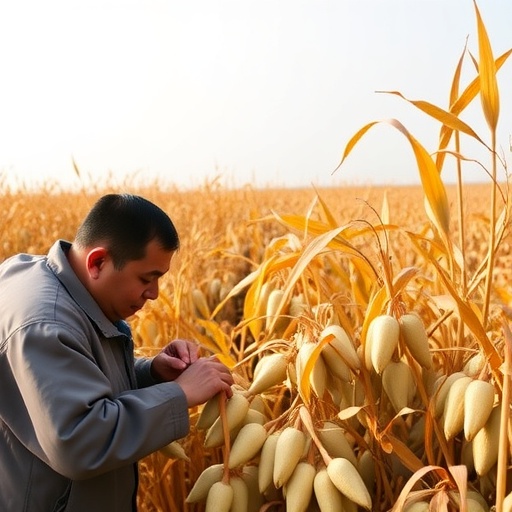
China stands as a dominant force in the global cultivation and consumption of peanuts, a crop widely valued not only for its culinary versatility but also for its significant oil content. Among the various peanut cultivars, high-oil varieties — those boasting oil contents exceeding 55% — have garnered substantial attention due to their promising economic and nutritional potentials. In a groundbreaking study recently published in Reproduction and Breeding, an extensive evaluation of 238 high-oil peanut cultivars across China has shed new light on their agronomic capabilities, disease resistance profiles, and underlying genetic architectures.
This comprehensive analysis spearheaded by Prof. Dr. Dongmei Yin and her colleagues at Henan Agricultural University reveals an intricate balance between oil content and protein levels within these cultivars. The researchers reported an inverse relationship indicating that as oil concentration increases, protein content tends to diminish, thus presenting a nuanced challenge for plant breeders aiming to concurrently enhance both traits. This genetic trade-off underscores the complexity inherent in peanut breeding strategies and suggests that optimizing nutritional quality requires careful consideration of underlying biochemical pathways and resource allocation during seed development.
Beyond compositional characteristics, disease resistance remains a pivotal factor in determining the agronomic value of peanut varieties. In their study, the team systematically assessed resistance to several pervasive diseases, including leaf spot, bacterial wilt, and rust. While many lines exhibited varying degrees of partial resistance, the occurrence of high-level immunity was notably scarce. Interestingly, six cultivars manifested broad-spectrum resistance across five common diseases, highlighting invaluable germplasm resources that could be instrumental in breeding programs geared toward durable pest and pathogen management.
Geographical adaptation emerged as a significant determinant of cultivar performance, with the highest-oil peanuts flourishing predominantly in Northern, Eastern, and Central China. These regions offer unique agroecological conditions characterized by extended growing seasons, pronounced seasonal temperature fluctuations, and soils enriched with nutrients and possessing superior drainage — all factors that synergistically promote oil biosynthesis and accumulation within peanut seeds. This spatial distribution suggests a long history of coevolution between genotype and environment, where indigenous cultivation practices and selective breeding have finely tuned the phenotypic expression of these cultivars.
Of particular interest are the parental lines Kaixuan 016 and CTWE, which have been identified as key contributors to the genetic foundation of high oil content in peanut breeding. These genotypes have facilitated the development of novel germplasm pools exhibiting not only elevated oil percentages but also favorable heritability traits. Their progenies, including the well-documented Luohua series (notably Luohua 21 with 61.04% oil content), exemplify successful breeding outcomes that balance yield potential with compositional quality — a testament to decades of strategic cultivar selection.
However, the study emphasizes that reliance on a narrow genetic base poses inherent risks, particularly in the context of evolving disease pressures and climatic uncertainties. Prof. Yin advocates for the integration of genetic diversity from wild relatives, leveraging modern molecular breeding tools such as marker-assisted selection and genomic prediction to broaden the genetic canvas. This approach could catalyze the generation of peanut cultivars that are not only oil-rich but also resilient against biotic and abiotic stresses, aligning breeding objectives with sustainable agricultural paradigms.
The researchers employed rigorous data and statistical analyses to unravel patterns of trait inheritance and phenotypic correlations, providing actionable insights into the complex interaction networks governing oil and protein synthesis. This analytical framework also uncovered potential genetic markers linked to desirable agronomic traits, paving the way for accelerated breeding cycles and trait introgression.
Crucially, this research holds wide-reaching implications for global food security. As the demand for vegetable oils escalates amidst mounting population pressures and shifting dietary preferences, high-oil peanuts could emerge as a vital crop to diversify oilseed portfolios. Their adaptability to varied environments within China serves as a microcosm reflecting the potential for tailored cultivar development in other peanut-growing regions worldwide.
Moreover, the elucidation of disease resistance mechanisms contributes to integrated pest management strategies, aiding breeders and farmers alike in mitigating yield losses without excessive dependence on chemical controls. Given the environmental and economic costs associated with pesticides, the identification of broad-spectrum resistance cultivars is a critical step toward environmentally sustainable crop production.
The study also sparks intriguing questions about the metabolic trade-offs in seed composition. The inverse relationship between oil and protein content may hinge on shared precursors and metabolic fluxes during seed filling stages, implicating specific enzymatic bottlenecks or regulatory circuits. Ongoing and future research dissecting these pathways at molecular and biochemical levels will be instrumental in overcoming current breeding constraints.
In addition to the agronomic and biochemical perspectives, the study underscores the importance of local farming knowledge and long-term genetic adaptation. The varieties flourishing in particular Chinese agro-ecological niches are the product of both natural selection and human-mediated genetic improvement, highlighting an interplay between biodiversity conservation and agricultural innovation.
Taken together, this research not only maps the current landscape of high-oil peanut cultivar development in China but also charts a forward-looking vision for enhancing crop quality and resilience. By integrating traditional breeding wisdom with cutting-edge molecular tools and a nuanced understanding of genotype-environment interactions, the path to optimized peanut cultivars that meet both nutritional and economic demands becomes clearer.
As global agricultural systems face mounting challenges posed by climate change and emerging pathogens, studies such as this bolster the scientific foundations necessary to engineer crops that can sustainably support human nutrition and livelihoods. The comprehensive nature of this analysis positions it as a cornerstone reference for peanut researchers, breeders, and agronomists aiming to harness the full potential of this vital oilseed crop.
Cite Scienmag News
Alan Morgan. (September 19, 2025). Breakthroughs and Challenges in Breeding China’s High-Oil Peanuts. Scienmag. https://scienmag.com/breakthroughs-and-challenges-in-breeding-chinas-high-oil-peanuts/
Alan Morgan. "Breakthroughs and Challenges in Breeding China’s High-Oil Peanuts." Scienmag, 19 September 2025, https://scienmag.com/breakthroughs-and-challenges-in-breeding-chinas-high-oil-peanuts/. Accessed 4 September 2026.
Alan Morgan. "Breakthroughs and Challenges in Breeding China’s High-Oil Peanuts." Scienmag. September 19, 2025. https://scienmag.com/breakthroughs-and-challenges-in-breeding-chinas-high-oil-peanuts/


