


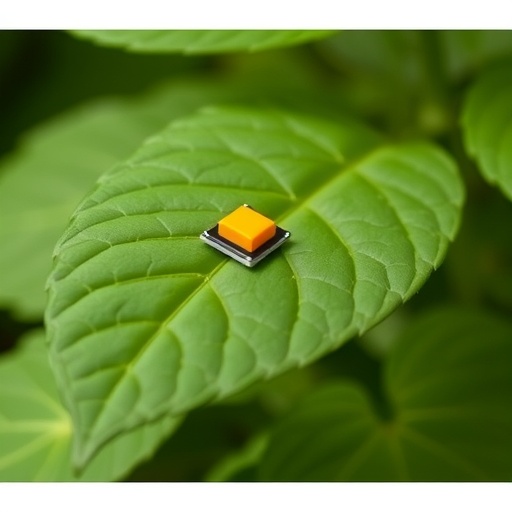
In a groundbreaking advancement for monitoring plant health and ecosystem stability, researchers at The University of Texas at Austin have engineered an innovative electronic tattoo using graphene—offering an unprecedented ability to measure leaf hydration levels with high precision and without causing damage. This novel sensor technology promises to revolutionize how we understand and respond to critical environmental conditions, including drought, agricultural productivity, and wildfire risk.
Traditional methods of assessing plant hydration and water content in foliage have long been hampered by limitations such as destructive sampling and indirect measurement techniques. Conventional approaches often require cutting branches or collecting dried leaves, processes that not only harm plants but also fail to capture real-time, dynamic data from living tissues. The new sensor, however, adheres gently to live leaves, harnessing the extraordinary electrical and mechanical properties of graphene, a two-dimensional form of carbon known for its flexibility, conductivity, and sustainability.
This “electronic leaf tattoo” operates by delivering a minute electrical stimulus to the leaf tissue, prompting ions within the plant cells to migrate in response to the applied field. These ionic movements induce measurable changes in the conductance of the graphene sensor, which directly correlate with the leaf’s water content. The sensor’s ability to engage with the plant physiologically provides a direct window into hydration dynamics at the cellular level—a critical locus of photosynthesis and plant vitality.
Energy efficiency is a hallmark of this technology. The device requires an astonishingly low operational energy of 23 attojoules per conductance update and consumes only 0.23 microwatts during data acquisition. This ultra-low power draw allows the sensors to be paired with modest solar panels, making them feasible for deployment en masse across agricultural fields, forests, or other large ecosystems. The potential for scaling up means real-time monitoring systems could be developed to track water stress over vast landscapes at unprecedented spatial and temporal resolution.
Another remarkable feature of these sensors is their ability to exhibit artificial synaptic behavior. Mimicking the way biological brains process and store information, the graphene devices perform in-sensor computation, drastically reducing the need for energy-intensive wireless transmission to distant data centers. This edge computing capacity imbues the sensors with intelligence, enabling localized data processing and efficient network communication, which is particularly advantageous in remote or resource-limited settings.
This convergence of engineering and ecological science was born through a unique interdisciplinary collaboration catalyzed by UT Austin’s Associate Professor Experimental program, which fosters partnerships across academic divisions. Jean Anne Incorvia, electrical engineering associate professor and specialist in graphene technologies, teamed up with Ashley Matheny, an earth scientist focusing on vegetation-water-soil interactions, to adapt graphene-based proton sensing methodologies for plant hydration monitoring. Their cross-disciplinary initiative was further enriched by experts from chemical and biomedical engineering, contributing to sensor design and environmental integration.
The implications of continuously monitoring live fuel moisture content in leaves extend far beyond agriculture. Live fuel moisture is a leading predictor of wildfire vulnerability, yet historically it has been challenging to measure accurately without destructive sampling. The new sensor enables frequent, non-invasive readings throughout critical periods—early mornings, late afternoons, or during extreme weather events—yielding high-resolution data on plant stress and drought responses. Such detailed insights have direct applications in wildfire forecasting, enabling emergency response teams and environmental managers to make data-driven decisions that can mitigate fire risk and protect ecosystems.
Moreover, the technology holds promise for enhancing agricultural water management, crop yield optimization, and food security. By providing real-time feedback on plant hydration, farmers and agronomists could calibrate irrigation regimes more precisely, leading to water conservation and improved crop health. The combination of this leaf-level data with existing soil and wood moisture measurements could establish comprehensive ecosystem models that inform sustainable land-use practices amid changing climate conditions.
To explore the synergy across plant water compartments, the researchers plan to integrate this leaf sensor technology with prior frameworks monitoring soil and wood hydration. This holistic approach could unlock detailed knowledge of plant water transport mechanisms and their responses to environmental stress, thus refining predictive models related to drought and forest health. Understanding these interrelations is key to anticipating how forests will react to ignition events and subsequent fire propagation.
The sensor’s robust design and functional versatility also open pathways to diverse applications in plant sciences and environmental monitoring. Its capacity to adhere to delicate leaf surfaces without damage ensures that plant physiology is unaffected during measurement, which is vital for longitudinal studies tracking growth, photosynthesis, and stress over time. The potential to deploy adaptive sensor networks across biomes may transform how scientists monitor ecological resilience, carbon cycling, and vegetation dynamics on regional and global scales.
This pioneering research published in Nano Letters represents a significant leap in embedding nanotechnology within ecological and agricultural domains. By marrying graphene’s cutting-edge material properties with the urgent need for precise environmental monitoring, the team at UT Austin has crafted a powerful tool capable of addressing some of the most pressing challenges facing plant ecosystems today. As climate variability intensifies, technologies like this electronic leaf tattoo could become indispensable allies in safeguarding both natural landscapes and human food systems.
The interdisciplinary team spearheading this innovation includes Jean Anne Incorvia and Ashley Matheny, alongside graphene specialist Deji Akinwande and biomedical engineer Dmitry Kireev, supported by researchers Utkarsh Misra, Philip Varkey, Ning Liu, Samuel Liu, and chemical engineer Benjamin K. Keitz. Their collaborative effort underscores the importance of cross-field partnerships in advancing scientific frontiers and translating lab-based discoveries into real-world solutions.
As this technological breakthrough moves from experimental validation towards field deployment, it sets a new standard for sensor miniaturization, energy efficiency, and ecological integration. The capacity to collect, process, and transmit critical hydration data from living plants in real time heralds a new era in plant science, enhancing predictive models for wildfire risks, driving agricultural innovation, and supporting ecosystem management in an increasingly uncertain environmental future.
Cite Scienmag News
Alan Morgan. (March 31, 2026). Breakthrough Sensor Enables Real-Time Measurement of Leaf Hydration in Plants. Scienmag. https://scienmag.com/breakthrough-sensor-enables-real-time-measurement-of-leaf-hydration-in-plants/
Alan Morgan. "Breakthrough Sensor Enables Real-Time Measurement of Leaf Hydration in Plants." Scienmag, 31 March 2026, https://scienmag.com/breakthrough-sensor-enables-real-time-measurement-of-leaf-hydration-in-plants/. Accessed 4 September 2026.
Alan Morgan. "Breakthrough Sensor Enables Real-Time Measurement of Leaf Hydration in Plants." Scienmag. March 31, 2026. https://scienmag.com/breakthrough-sensor-enables-real-time-measurement-of-leaf-hydration-in-plants/


