


“With the method we developed, we can make things visible that no one has seen before,” says Prof. Sebastian Loth, Managing Director of the Institute for Functional Matter and Quantum Technologies (FMQ) at the University of Stuttgart. “This makes it possible to settle questions about the movement of electrons in solids that have been unanswered since the 1980s.” However, the findings of Loth’s group are also of very practical significance for the development of new materials.
Tiny changes with macroscopic consequences
In metals, insulators, and semiconductors, the physical world is simple. If you change a few atoms at the atomic level, the macroscopic properties remain unchanged. For example, metals modified in this way are still electrically conductive, whereas insulators are not. However, the situation is different in more advanced materials, which can only be produced in the laboratory: Minimal changes at the atomic level cause new macroscopic behavior. For example, some of these materials suddenly change from insulators to superconductors, i.e. they conduct electricity without heat loss. These changes can happen extremely quickly, within picoseconds, as they influence the movement of electrons through the material directly at the atomic scale. A picosecond is extremely short, just a trillionth of a second. It is in the same proportion to the blink of an eye as the blink of an eye is to a period of over 3000 years.
Recording the movement of the electron collective
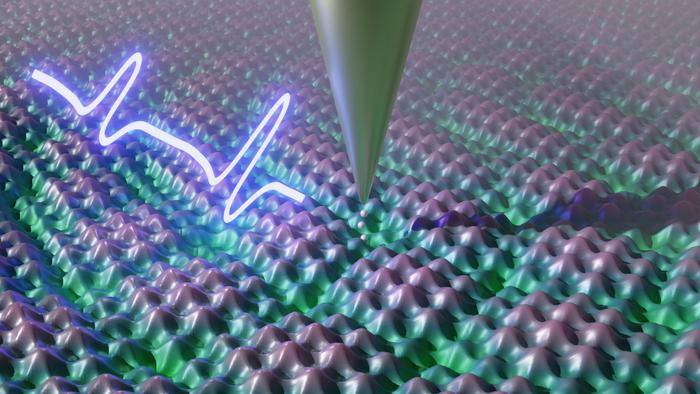
Loth’s working group has now found a way to observe the behavior of these materials during such small changes at the atomic level. Specifically, the scientists studied a material consisting of the elements niobium and selenium in which one effect can be observed in a relatively undisturbed manner: the collective motion of electrons in a charge density wave. Loth and his team investigated how a single impurity can stop this collective movement. For this purpose, the Stuttgart researchers apply an extremely short electrical pulse, which lasts just one picosecond, to the material. The charge density wave is pressed against the impurity and sends nanometer-sized distortions into the electron collective, which cause highly complex electron motion in the material for a short time. Important preliminary work for the results now presented was done at the Max Planck Institute for Solid State Research (MPI FKF) in Stuttgart and at the Max Planck Institute for the Structure and Dynamics of Matter (MPSD) in Hamburg, where Loth had been conducting research before he was appointed to the University of Stuttgart.
Developing materials with desired properties
“If we can understand how the movement of the electron collective is stopped, then we can also develop materials with desired properties in a more targeted manner,” Loth explains the potential of the results. Or to put it another way: As there are no perfect materials without impurities, the microscopy method developed helps to understand how impurities should be arranged in order to achieve the desired technical effect. “Design at the atomic level has a direct impact on the macroscopic properties of the material,” says Loth, describing the significance of the research findings. The effect could be used, for example, for ultra-fast switching materials in future sensors or electronic components.
An experiment repeated 41 million times per second
“There are established methods for visualizing individual atoms or their movements,” explains Loth. “But with these methods, you can either achieve a high spatial resolution or a high temporal resolution.” For the new Stuttgart microscope to achieve both, the physicist and his team combine a scanning tunneling microscope, which resolves materials at the atomic level, with an ultrafast spectroscopy method known as pump-probe spectroscopy.
In order to make the necessary measurements, the laboratory setup must be extremely well shielded. Vibrations, noise, and air movement are harmful, as are fluctuations in room temperature and humidity. “This is because we measure extremely weak signals that are otherwise easily lost in the background noise,” Loth points out. In addition, the team has to repeat these measurements very often in order to obtain meaningful results. The researchers were able to optimize their microscope in such a way that it repeats the experiment 41 million times per second and thus achieves a particularly high signal quality. “Only we have managed to do this so far,” says Loth.
About Prof. Sebastian Loth
Physicist Sebastian Loth (45) has been leading the research group “Physics on the Atomic Scale” at the Institute for Functional Matter and Quantum Technologies (FMQ) at the University of Stuttgart since 2017. He is currently also the managing director of the institute. After completing his doctoral degree studies at the Georg August University of Göttingen in 2007, Loth spent three and a half years as a Feodor Lynen Fellow of the Alexander von Humboldt foundation at the IBM Almaden Research Center in San Jose, USA. From 2011 until his appointment as a professor at the University of Stuttgart, he headed a Max Planck Research Group at the Max Planck Institute for the Structure and Dynamics of Matter in Hamburg. In September 2015, he was awarded an ERC Starting Grant.

Credit: Shaoxiang Sheng, University of Stuttgart(FMQ)
“With the method we developed, we can make things visible that no one has seen before,” says Prof. Sebastian Loth, Managing Director of the Institute for Functional Matter and Quantum Technologies (FMQ) at the University of Stuttgart. “This makes it possible to settle questions about the movement of electrons in solids that have been unanswered since the 1980s.” However, the findings of Loth’s group are also of very practical significance for the development of new materials.
Tiny changes with macroscopic consequences
In metals, insulators, and semiconductors, the physical world is simple. If you change a few atoms at the atomic level, the macroscopic properties remain unchanged. For example, metals modified in this way are still electrically conductive, whereas insulators are not. However, the situation is different in more advanced materials, which can only be produced in the laboratory: Minimal changes at the atomic level cause new macroscopic behavior. For example, some of these materials suddenly change from insulators to superconductors, i.e. they conduct electricity without heat loss. These changes can happen extremely quickly, within picoseconds, as they influence the movement of electrons through the material directly at the atomic scale. A picosecond is extremely short, just a trillionth of a second. It is in the same proportion to the blink of an eye as the blink of an eye is to a period of over 3000 years.
Recording the movement of the electron collective
Loth’s working group has now found a way to observe the behavior of these materials during such small changes at the atomic level. Specifically, the scientists studied a material consisting of the elements niobium and selenium in which one effect can be observed in a relatively undisturbed manner: the collective motion of electrons in a charge density wave. Loth and his team investigated how a single impurity can stop this collective movement. For this purpose, the Stuttgart researchers apply an extremely short electrical pulse, which lasts just one picosecond, to the material. The charge density wave is pressed against the impurity and sends nanometer-sized distortions into the electron collective, which cause highly complex electron motion in the material for a short time. Important preliminary work for the results now presented was done at the Max Planck Institute for Solid State Research (MPI FKF) in Stuttgart and at the Max Planck Institute for the Structure and Dynamics of Matter (MPSD) in Hamburg, where Loth had been conducting research before he was appointed to the University of Stuttgart.
Developing materials with desired properties
“If we can understand how the movement of the electron collective is stopped, then we can also develop materials with desired properties in a more targeted manner,” Loth explains the potential of the results. Or to put it another way: As there are no perfect materials without impurities, the microscopy method developed helps to understand how impurities should be arranged in order to achieve the desired technical effect. “Design at the atomic level has a direct impact on the macroscopic properties of the material,” says Loth, describing the significance of the research findings. The effect could be used, for example, for ultra-fast switching materials in future sensors or electronic components.
An experiment repeated 41 million times per second
“There are established methods for visualizing individual atoms or their movements,” explains Loth. “But with these methods, you can either achieve a high spatial resolution or a high temporal resolution.” For the new Stuttgart microscope to achieve both, the physicist and his team combine a scanning tunneling microscope, which resolves materials at the atomic level, with an ultrafast spectroscopy method known as pump-probe spectroscopy.
In order to make the necessary measurements, the laboratory setup must be extremely well shielded. Vibrations, noise, and air movement are harmful, as are fluctuations in room temperature and humidity. “This is because we measure extremely weak signals that are otherwise easily lost in the background noise,” Loth points out. In addition, the team has to repeat these measurements very often in order to obtain meaningful results. The researchers were able to optimize their microscope in such a way that it repeats the experiment 41 million times per second and thus achieves a particularly high signal quality. “Only we have managed to do this so far,” says Loth.
About Prof. Sebastian Loth
Physicist Sebastian Loth (45) has been leading the research group “Physics on the Atomic Scale” at the Institute for Functional Matter and Quantum Technologies (FMQ) at the University of Stuttgart since 2017. He is currently also the managing director of the institute. After completing his doctoral degree studies at the Georg August University of Göttingen in 2007, Loth spent three and a half years as a Feodor Lynen Fellow of the Alexander von Humboldt foundation at the IBM Almaden Research Center in San Jose, USA. From 2011 until his appointment as a professor at the University of Stuttgart, he headed a Max Planck Research Group at the Max Planck Institute for the Structure and Dynamics of Matter in Hamburg. In September 2015, he was awarded an ERC Starting Grant.
Journal
Nature Physics
Method of Research
Experimental study
Subject of Research
Not applicable
Article Title
Breakthrough in quantum microscopy: Stuttgart researchers are making electrons visible in slow motion
Article Publication Date
15-Jul-2024
Cite Scienmag News
Katie Riggs. (July 16, 2024). Breakthrough in quantum microscopy: Stuttgart researchers are making electrons visible in slow motion. Scienmag. https://scienmag.com/breakthrough-in-quantum-microscopy-stuttgart-researchers-are-making-electrons-visible-in-slow-motion/
Katie Riggs. "Breakthrough in quantum microscopy: Stuttgart researchers are making electrons visible in slow motion." Scienmag, 16 July 2024, https://scienmag.com/breakthrough-in-quantum-microscopy-stuttgart-researchers-are-making-electrons-visible-in-slow-motion/. Accessed 4 September 2026.
Katie Riggs. "Breakthrough in quantum microscopy: Stuttgart researchers are making electrons visible in slow motion." Scienmag. July 16, 2024. https://scienmag.com/breakthrough-in-quantum-microscopy-stuttgart-researchers-are-making-electrons-visible-in-slow-motion/

