


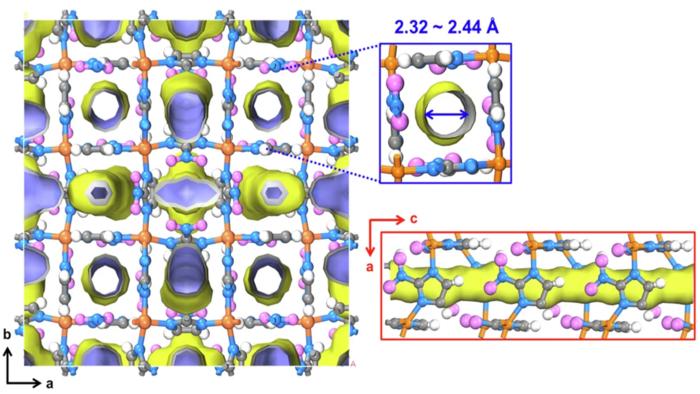
A groundbreaking advancement in materials science has emerged through the introduction of a novel copper-based zeolite imidazolate framework (Cu-ZIF-gis), showcasing unparalleled capabilities in the separation of deuterium (D2) from hydrogen (H2) at the remarkably elevated temperature of 120 K. This new threshold is noteworthy as it exceeds the liquefaction point of natural gas, contributing to the potential for large-scale industrial applications. The research, heralded by teams from esteemed institutions, including the Ulsan National Institute of Science & Technology (UNIST), Helmholtz-Zentrum Berlin, Heinz Maier Leibnitz Zentrum (MLZ), and Soongsil University, explores the ramifications of such developments, showing promise for economically viable production methods for D2 leveraging the current liquefied natural gas (LNG) infrastructure.
The significance of deuterium, a stable hydrogen isotope, is profound. It is utilized to enhance the durability and luminous efficiency of various semiconductor applications as well as in display devices. Moreover, deuterium serves as a pivotal fusion fuel for energy production. In the backdrop of rising deuterium demand, the conventional methods to separate it from hydrogen through cryogenic distillation at temperatures plummeting to 20 K pose serious challenges regarding efficiency and accessibility. While prior endeavors have utilized metal-organic frameworks (MOFs) for this separation, many of these frameworks falter in performance at elevated temperatures.
The research team behind the Cu-ZIF-gis framework demonstrated exceptional performance in deuterium separation even in this high-temperature context. Traditionally, most MOFs are at their best around 23 K, and their separation efficiency declines sharply as temperatures ascend towards 77 K. In a turning point, the new copper-based framework exhibits remarkable stability and effectiveness even at 120 K, posing a significant leap in the design and application of MOFs in gas separation technologies.
Innovatively, the researchers discovered that the material’s excellent performance results from the expansion of its lattice structure as temperature rises. At extremely low temperatures, the pores of this emerging MOF are insufficiently sized to allow H2 molecules to pass. Yet, upon elevating the temperature, the lattice expands, increasing the pore dimensions, which facilitates the interaction and separation of hydrogen molecules. This phenomenon operates through a mechanism known as quantum sieving, where heavier molecules experience less resistance and can navigate through the material more effectively at lower temperatures.
Key experimental validation supports this claim. In-situ X-ray diffraction (XRD) and quasi-elastic neutron scattering (QENS) experiments conducted at the Institut Laue-Langevin (ILL) in Grenoble provided critical insights, confirming both the temperature-driven expansion of the lattice framework as well as the distinct diffusivity of hydrogen isotopes. These advanced techniques highlighted the dynamic behavior and interactions of H2 and D2 within the nanoporous structure, illuminating how these behaviors vary at different temperatures.
Moreover, the thermal desorption spectroscopy (TDS) experiments indicated a stable process of D2 separation at advanced temperatures, underpinning the reliability and practical application of this innovative material. This paves the way for sustainable isotope separation technologies, exploiting the existing LNG cryogenic infrastructure to mitigate energy consumption and elevate efficiency in separation processes.
The advancements in this research hold not only academic but also industrial promise. Professor Oh, a driving force behind this work, articulated that the Cu-ZIF-gis framework presents lower energy requirements and improved separation efficiency compared to conventional processes, which typically operate at much lower temperatures. This crucial aspect presents a tangible method for integrating sustainable practices within current industrial frameworks, easing the transition towards greener production methods.
Dr. Jitae Park emphasized the potential for applying these findings to fuel innovation in sustainable isotope separation technologies, showcasing how established LNG infrastructure can be adapted to meet growing demands for D2. This convergence of cutting-edge research and practical industry applications signifies a vital step in both material science and energy sustainability, resonating with global calls for eco-friendliness and efficiency.
In the study, Dr. Margarita Russina accentuated the pivotal role of QENS, which enabled a detailed examination of molecular motion in MOFs. The technique has afforded the research team unique insights into the interactions between hydrogen isotopes and the porous material, elucidating nanoscale phenomena that drive macroscopic implications in material properties and separation efficiency.
As this research garners attention, it reaffirms the necessity for ongoing exploration in the realm of metal-organic frameworks and other advanced materials, specifically in how they can resolve practical challenges in isotope separation and contribute to the broader narrative surrounding clean energy. The potential impact of these findings reaches far beyond the laboratory, with industries possibly leveraging insights gained from the studies to improve processes related to not only deuterium production but also other vital hydrogen-related technologies.
The collaborative nature of this research underscores the interconnectedness of scientific disciplines, binding chemists, physicists, and engineers into a united goal of enhancing energy production methods and realizing sustainable solutions. Researchers and institutions globally are called to further explore material innovations, propelling studies linked to D2 separation towards practical deployment.
With the publication of these findings in the esteemed journal Nature Communications, the scientific community is now better positioned to harness the capabilities of Cu-ZIF-gis, shaping the future of isotope separation and pushing the frontiers of material performance at elevated temperatures.
In conclusion, the Cu-ZIF-gis material heralds a novel approach to solving existing challenges in hydrogen isotope separation technology. It serves as a testament to the power of interdisciplinary cooperation in advancing scientific research, reinforcing the potential for significant industrial impacts stemming from innovative materials science.
Keywords
Porous materials, deuterium separation, hydrogen isotope, metal-organic frameworks, Cu-ZIF-gis, energy efficiency, quantum sieving, cryogenic distillation.
Cite Scienmag News
Bethany Barker. (March 19, 2025). Breakthrough in High-Temperature Materials for Enhanced Deuterium Separation. Scienmag. https://scienmag.com/breakthrough-in-high-temperature-materials-for-enhanced-deuterium-separation/
Bethany Barker. "Breakthrough in High-Temperature Materials for Enhanced Deuterium Separation." Scienmag, 19 March 2025, https://scienmag.com/breakthrough-in-high-temperature-materials-for-enhanced-deuterium-separation/. Accessed 4 September 2026.
Bethany Barker. "Breakthrough in High-Temperature Materials for Enhanced Deuterium Separation." Scienmag. March 19, 2025. https://scienmag.com/breakthrough-in-high-temperature-materials-for-enhanced-deuterium-separation/


