


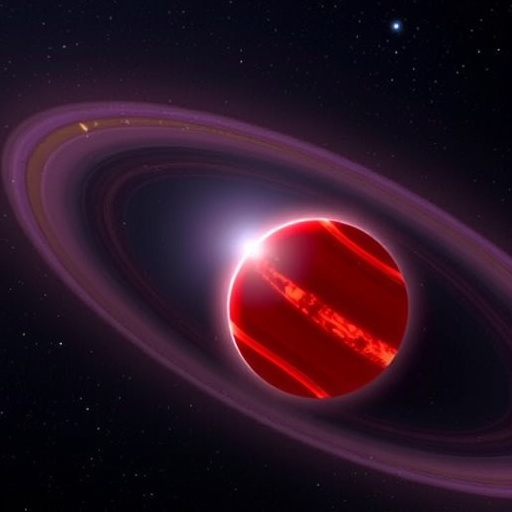
In a significant advancement for astrophysics and our understanding of stellar formation, an international research team has successfully imaged a brown dwarf companion, designated as J1446B, orbiting the nearby M dwarf star LSPM J1446+4633. Located approximately 55 light-years away from Earth, this remarkable discovery adds a crucial piece to the puzzle of how low-mass stellar and substellar companions interact within our galaxy. M dwarfs, which constitute more than half of the stars in the Milky Way, have historically been viewed as predominantly single entities. However, this finding challenges that notion and underscores the vital role of advanced observational techniques in revealing the complexities of stellar companionship.
Brown dwarfs, like J1446B, are fascinating celestial objects that straddle the boundary between the lightest stars and the heaviest planets. With a mass of approximately 60 times that of Jupiter, J1446B orbits its host star at a distance roughly 4.3 astronomical units (AU), which corresponds to about four and a half times the average distance from the Earth to the Sun. It completes one orbit around its red dwarf host every 20 years—a long timescale that offers interesting insights into the dynamics of such systems. What makes J1446B particularly intriguing are the observed brightness fluctuations of about 30%, indicative of active atmospheric processes that may be akin to weather phenomena, such as clouds and storms, found on Earth.
This groundbreaking accomplishment is a testament to the integration of multiple, cutting-edge observational methodologies. The research team employed a synergistic approach that included radial velocity measurements from long-term spectroscopy, high-resolution direct imaging, and astrometric acceleration data from the Gaia spacecraft. The Subaru Infrared Digicam (IRD) played a crucial role in obtaining precise radial velocity data, which are essential for understanding the gravitational influences between the star and its companions. Additionally, the advanced adaptive optics capabilities of the W. M. Keck Observatory facilitated the clear imaging of J1446B, even at the small separation from the star.
Astrometric acceleration measurements from Gaia provided further necessary data to untangle the complexities of determining the mass and orbit of J1446B. By utilizing Kepler’s laws in conjunction with the collected data, the researchers achieved a level of accuracy in characterizing the dynamical mass and orbital parameters that was previously unattainable. Individual methods, such as radial velocity alone, kept researchers at an impasse regarding mass and orbital inclination; however, the combination of imaging and astrometry resolved these questions definitively.
Historically, similar studies have established the effectiveness of merging astrometric acceleration data from missions like Hipparcos and Gaia with direct imaging to identify and analyze companion objects. Nonetheless, the limitations of the Hipparcos mission in measuring the faint signals of red dwarfs have impeded progress in this area, leaving a gap in our understanding of low-mass stellar systems. The current study stands as the first instance of utilizing exclusively Gaia-derived acceleration data to characterize a brown dwarf companion, effectively marking a new era in the exploration of these elusive celestial bodies.
The significance of J1446B extends beyond its mere discovery: it serves as an important benchmark for testing prevailing theories concerning brown dwarf formation and atmospheric models. With the potential for future spectroscopic observations, researchers look forward to mapping atmospheric dynamics and exploring the weather patterns of this intriguing brown dwarf. Such studies could reveal complex physical processes that govern the behavior of atmospheres on low-mass companions, providing valuable insights into both planetary and stellar evolution.
This breakthrough also speaks volumes about the synergy between ground-based and space-based observatories, showcasing how these platforms can work in concert to unveil hidden details of the cosmos. As technology continues to evolve, the prospect of detecting similar companions around other M dwarfs appears promising, promising a wealth of new discoveries that could reshape our comprehension of stellar systems and planetary formation. Such findings will not only enhance our knowledge of brown dwarfs but could also have profound implications for the search for life beyond our solar system.
In conclusion, the discovery of J1446B signifies a pivotal step forward in the field of astrophysics. It strengthens the understanding of the frequency and properties of low-mass companions and emphasizes the need for continuing innovations in observational techniques. This study represents a stunning example of how collaborative efforts in the scientific community can lead to breakthroughs that deepen our understanding of the universe. With ongoing research, the potential for exciting new findings about the nature of brown dwarfs and their interactions with host stars is vast.
Keywords
Brown dwarfs, M dwarfs, J1446B, stellar formation, substellar companions, observational techniques, astrophysics, near-infrared imaging, Gaia mission, radial velocity measurements.
Cite Scienmag News
Grant Pearson. (October 21, 2025). Breakthrough in Astronomy: Brown Dwarf Detected Orbiting a Red Dwarf with Combined Efforts of Ground and Space Telescopes. Scienmag. https://scienmag.com/breakthrough-in-astronomy-brown-dwarf-detected-orbiting-a-red-dwarf-with-combined-efforts-of-ground-and-space-telescopes/
Grant Pearson. "Breakthrough in Astronomy: Brown Dwarf Detected Orbiting a Red Dwarf with Combined Efforts of Ground and Space Telescopes." Scienmag, 21 October 2025, https://scienmag.com/breakthrough-in-astronomy-brown-dwarf-detected-orbiting-a-red-dwarf-with-combined-efforts-of-ground-and-space-telescopes/. Accessed 3 September 2026.
Grant Pearson. "Breakthrough in Astronomy: Brown Dwarf Detected Orbiting a Red Dwarf with Combined Efforts of Ground and Space Telescopes." Scienmag. October 21, 2025. https://scienmag.com/breakthrough-in-astronomy-brown-dwarf-detected-orbiting-a-red-dwarf-with-combined-efforts-of-ground-and-space-telescopes/


