


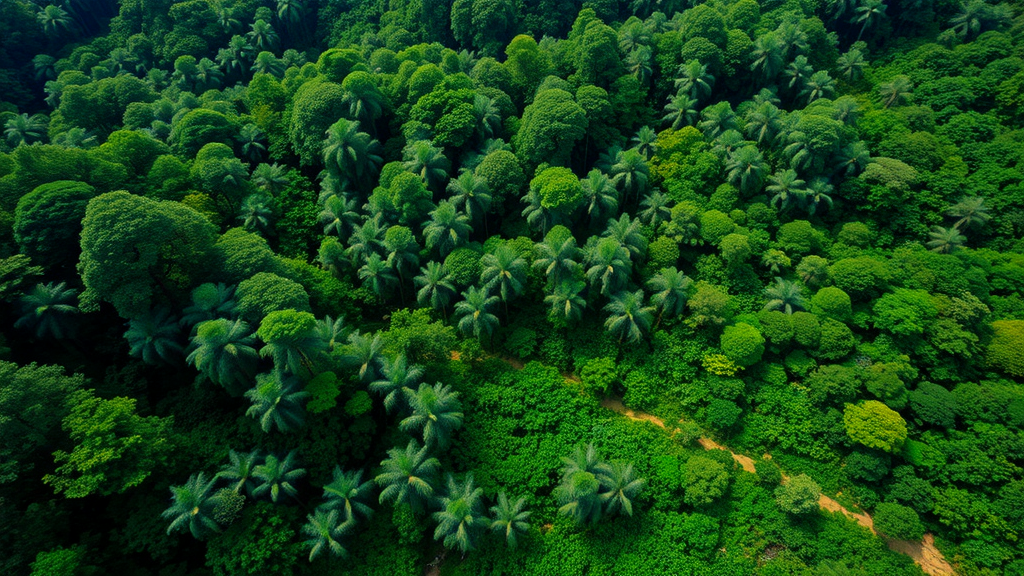
Brazil’s Atlantic Forest is one of the most beleaguered biodiversity hotspots on Earth, a once-vast rainforest reduced over centuries of human occupation to fragments scattered across farms, pastures and plantations. Now a new study of the Central Atlantic Forest Corridor, a conservation initiative spanning southern Bahia and Espírito Santo, has mapped two fundamental dimensions of the region’s carbon cycle at unprecedented scale — and found that they tell strikingly different stories. The research, published in Environmental Monitoring and Assessment, combined more than two decades of satellite-derived productivity data with soil carbon maps covering 13.3 million hectares, revealing a profound decoupling between what the landscape photosynthesizes above ground and what it buries in the ground below.
The team, led by Romario Oliveira de Santana of the Chico Mendes Institute for Biodiversity Conservation, working with colleagues at the University of São Paulo and the Federal University of Acre, drew on gross primary productivity (GPP) estimates from the MODIS satellite instrument at 500-meter resolution and soil organic carbon (SOC) stocks from Brazil’s MapBiomas Soil initiative, which estimates carbon in the top 30 centimeters of soil at 30-meter resolution using machine learning trained on field observations. After harmonizing the datasets onto a common grid and classifying the landscape into six land use categories — forest, natural nonforest formation, agriculture, pasture, forestry plantations and mixed-use mosaics — the researchers analyzed annual records from 2001 through 2023.
The productivity side of the ledger behaved as expected. Natural forests recorded the highest average GPP at 2.89 kilograms of carbon per square meter per year, followed closely by commercial forestry plantations at 2.78. Agricultural fields and pastures trailed well behind, at roughly 2.0 kilograms per square meter per year. The Kruskal–Wallis test confirmed these differences were highly significant, and the pattern aligns with global findings that forest conversion reduces landscape-level photosynthetic capacity — one international analysis cited in the study estimated that historical agricultural expansion has cut global GPP by approximately 4.4 percent.
The soil carbon side of the ledger, however, defied intuition. The richest stocks, averaging 88.3 tonnes per hectare with enormous variability, occurred not under towering rainforest but in natural nonforest formations — the grasslands, savannas and open ecosystems that conservation assessments often overlook. Forests held intermediate stocks of 56.0 tonnes per hectare, while agriculture, pasture and plantations carried the lightest carbon loads. High aboveground productivity, in other words, did not translate into high belowground carbon storage.
Statistical modeling drove the point home. Simple regressions between GPP and SOC within each land use class explained very little variation — the strongest relationship, in agricultural areas, accounted for only about 12 percent of the variance, and in natural nonforest formations the relationship was statistically indistinguishable from zero. Multiple regression models incorporating soil clay content and land use explained roughly 38 percent of variation in each variable, underscoring that soil texture and management history, not current photosynthesis, largely govern where soil carbon accumulates.
Perhaps the study’s most methodologically significant twist came when the researchers confronted a problem that plagues landscape-scale ecology: spatial autocorrelation. Both GPP and SOC showed pronounced clustering, with Moran’s I averaging 0.578 for productivity and 0.704 for soil carbon. Conventional regression residuals remained strongly spatially structured, particularly for SOC. Fitting spatial error models year by year collapsed the residual autocorrelation to near zero and slashed the Akaike information criterion by thousands of points — but it also dissolved the GPP–SOC relationship. After properly accounting for spatial dependence, the effect of productivity on soil carbon was significant in only 3 of 23 years. Much of the apparent coupling detected by naive models was shared spatial structure, not ecology.
The temporal analysis added a further layer of divergence. Regional GPP showed no significant directional trend across the 23-year record, fluctuating year to year but remaining functionally stable — although natural forests stayed consistently productive while forestry plantations declined significantly. Estimated SOC, by contrast, crept upward at the regional scale until the end of the 2010s before dipping in recent years, and beneath that aggregate trend lay a patchwork: significant declines in agriculture, plantations and natural nonforest formations, a significant rise in pasture, and near-stability in forests. Productivity and soil carbon, the authors conclude, operate on different clocks — one responding within seasons to light, water and canopy structure, the other accumulating and eroding over decades through decomposition, mineral association and land management.
By classifying every pixel against regional median values for both variables, the study produced a map of four functional regimes that reads like a diagnosis of the corridor’s ecological health. Ecological hotspots — areas combining high productivity and high soil carbon — clustered overwhelmingly in forest ecosystems, which accounted for 66.9 percent of their extent. The low-functionality regime, where both variables fall short, was dominated by pasturelands, which made up 82.2 percent of its area and formed the principal landscape matrix across inland sections. Two intermediate regimes — carbon-dominated and productivity-dominated — filled the gaps, each with its own characteristic land use signature. The association between regimes and land use was, statistically speaking, about as strong as associations get.
The implications ripple outward from southern Bahia. For conservation planners, the message is that satellite greenness alone cannot identify a landscape’s most valuable carbon reservoirs; open natural ecosystems with modest tree cover may be quietly safeguarding enormous belowground stocks and should not be dismissed as degraded land. For restoration strategists, the pasture-dominated low-functionality zones emerge as prime candidates for improved management and ecological recovery, though the authors caution that site-specific assessments must guide priorities. And for anyone banking on tropical forests to offset emissions, the study offers a sobering technical reminder: planting something green does not guarantee that carbon will stay in the ground. Carbon persistence depends on organo-mineral stabilization, aggregate protection and the slow choreography of soil chemistry — processes that no satellite can see, but that this integrated spatial framework now brings into focus.
Subject of Research: Spatial relationships between gross primary productivity and soil organic carbon across land use systems in the Atlantic Forest of Brazil
Article Title: Environmental monitoring of soil carbon and ecosystem productivity across land use systems in the Atlantic Forest of Brazil
Article References: de Santana, R. O., Trindade, L. R. S. L. C., & Delgado, R. C. (2026). Environmental monitoring of soil carbon and ecosystem productivity across land use systems in the Atlantic Forest of Brazil. Environmental Monitoring and Assessment, 198(10), Article 1100. https://doi.org/10.1007/s10661-026-15952-4
Image Credits: AI Generated
DOI: 10.1007/s10661-026-15952-4
Keywords: Atlantic Forest, soil organic carbon, gross primary productivity, land use change, remote sensing, MODIS, MapBiomas, spatial autocorrelation, carbon cycle, tropical ecology, ecological restoration, pasture degradation
Cite Scienmag News
Gavin Prescott. (September 23, 2026). Brazil’s Atlantic Forest Hides a Carbon Surprise Beneath Its Grasslands. Scienmag. https://scienmag.com/brazils-atlantic-forest-hides-a-carbon-surprise-beneath-its-grasslands/
Gavin Prescott. "Brazil’s Atlantic Forest Hides a Carbon Surprise Beneath Its Grasslands." Scienmag, 23 September 2026, https://scienmag.com/brazils-atlantic-forest-hides-a-carbon-surprise-beneath-its-grasslands/. Accessed 4 October 2026.
Gavin Prescott. "Brazil’s Atlantic Forest Hides a Carbon Surprise Beneath Its Grasslands." Scienmag. September 23, 2026. https://scienmag.com/brazils-atlantic-forest-hides-a-carbon-surprise-beneath-its-grasslands/


