


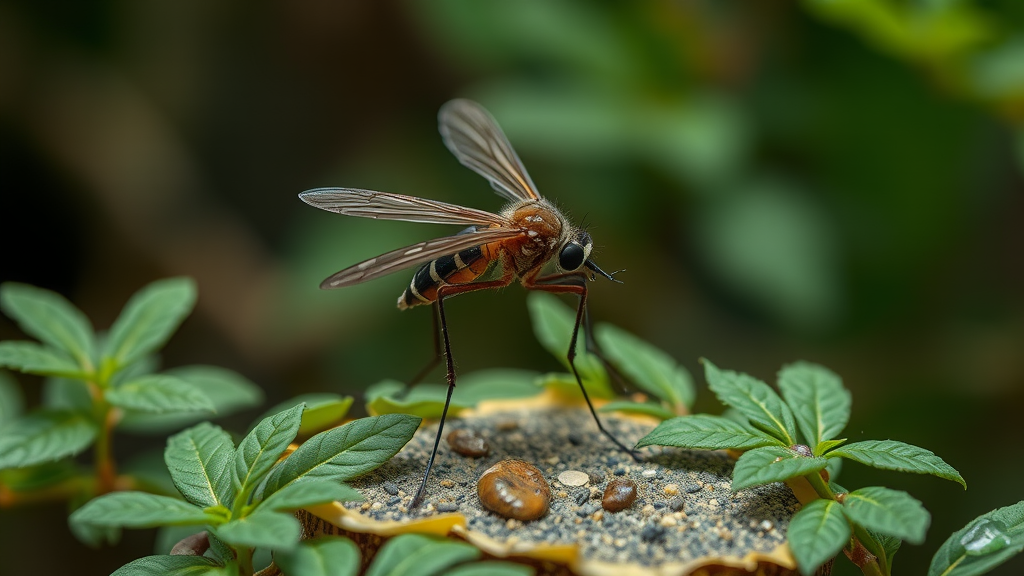
A long-term study in Brazil’s Atlantic Forest has revealed that sustainable farms may be doing far more than producing food and restoring trees: they are quietly shaping the communities of mosquitoes that live among us, including some of the most medically important disease vectors in the Americas. Researchers who spent more than three years collecting mosquito larvae and pupae from an agroforestry farm in Rio de Janeiro state documented 38 species across 10 genera, a level of diversity that rivals, and in some cases exceeds, what has been recorded in supposedly pristine forest fragments. The findings, published in The Science of Nature, suggest that agroforestry systems occupy a critical and underappreciated position at the interface between wild ecosystems and human landscapes, with consequences that could reshape how scientists think about arbovirus surveillance in tropical agricultural regions.
The research team, led by Cecília Ferreira de Mello and Jeronimo Alencar of the Oswaldo Cruz Foundation, worked at Terra Boa Farm in the municipality of Silva Jardim, a roughly three-hectare agroecological plot where açaí palms and peach palms are cultivated alongside native trees. Between June 2022 and December 2025, the team carried out 43 monthly sampling events totaling 86 hours of collection effort. Rather than focusing on a single habitat type, as most previous studies have done, they systematically sampled five distinct larval environments: three natural ones, namely bromeliads, bamboo internodes, and fallen peach palm leaf bracts, and two artificial ones, a plastic tarp laid on the ground where rainwater pooled in its depressions, and a 200-liter polyethylene water barrel. None of these habitats were introduced by the researchers; they were all features already present in the working farm.
In total, the team collected 5,314 immature mosquitoes. The genus Culex dominated numerically, accounting for 53.8 percent of all specimens, followed by Limatus at 16.6 percent and Wyeomyia at 16.2 percent. Just five species, Culex iridescens, Culex pleuristriatus, Limatus durhamii, Wyeomyia edwardsi, and the Asian tiger mosquito Aedes albopictus, together made up nearly 80 percent of everything captured. The statistical analysis, which included individual-based species accumulation curves computed with rarefaction and extrapolation methods, bipartite interaction networks linking each species to each habitat, and cluster analysis based on Jaccard dissimilarity, revealed a community structured far more tightly than chance alone would predict. Each habitat type hosted a recognizable assemblage of specialists, a pattern ecologists describe as niche partitioning.
The natural habitats overwhelmingly won the diversity contest. Bromeliads, bamboo internodes, and peach palm bracts together yielded 4,175 specimens, or 78.6 percent of the total, and supported 34 of the 38 recorded species. Twenty-six species occurred exclusively in natural habitats. Bromeliads alone produced 2,031 individuals from 22 species, with the specialists Cx. pleuristriatus and Wy. edwardsi making up more than four-fifths of the bromeliad catch. Bamboo internodes, dominated by Cx. iridescens at 72.4 percent of their fauna, supported 21 species and even harbored predatory larvae of Toxorhynchites trichopygus, a genus whose adults do not bite and whose larvae may help regulate populations of other mosquitoes by preying on them. The species accumulation curves for natural habitats did not reach an asymptote, hinting that the true richness of these phytotelmata, particularly in the unsampled forest canopy, is likely even higher.
The artificial habitats told a very different story. The plastic tarp and the water barrel together accounted for 1,139 specimens but only 12 species, just four of which were exclusive to artificial containers. The water barrel was nearly barren, yielding a mere 22 individuals of six species, with Aedes albopictus making up almost two-thirds of them. The tarp, by contrast, was a productive breeding ground, hosting 1,117 specimens from nine species, dominated by Li. durhamii and Ae. albopictus, which together represented 83.7 percent of its mosquito fauna. Perhaps most striking was the consistent presence of Culex quinquefasciatus, the southern house mosquito, a species typically confined to urban and heavily degraded environments, breeding in plastic tarps embedded within a farm surrounded by preserved forest. The authors interpret this as evidence of increased ecological plasticity under agroforestry management conditions.
The epidemiological implications are where the study becomes genuinely alarming for public health. Among the species recorded were Haemagogus leucocelaenus and Haemagogus janthinomys, the primary vectors of sylvatic yellow fever virus in the Americas, colonizing bamboo stands within the farm. The team also documented Sabethes identicus, a rarely recorded species considered a secondary yellow fever vector. Brazil experienced a major yellow fever outbreak between 2016 and 2018 driven by these very mosquito genera, and the presence of their larvae in an agricultural landscape adjacent to protected areas such as the Poço das Antas ecological reserve suggests that agroforests could serve as staging grounds where sylvatic vectors and farmworkers come into close contact.
Then there is Aedes albopictus, the Asian tiger mosquito, which emerged as the study’s great generalist. It was the only species detected in all five habitat types, thriving equally in natural bromeliads and bamboo, in ephemeral peach palm bracts, and in human-made tarps and barrels. This versatility matters because Ae. albopictus is a recognized bridge vector, capable of moving pathogens between sylvatic transmission cycles in wildlife and urban cycles in human populations. Recent laboratory work has demonstrated its competence for yellow fever virus, raising concerns about possible reemergence of urban yellow fever in Brazil. A mosquito that breeds in both the forest and the farmyard, and that readily bites humans, represents precisely the kind of conduit through which arbovirus spillover could occur.
The cluster analysis of species composition added a layer of ecological nuance. Bromeliads and bamboo internodes, both stable, long-lasting natural phytotelmata, hosted the most similar communities, as did peach palm bracts and the plastic tarp, both of which are relatively ephemeral, sun-exposed pools. The water barrel stood apart from everything else, hosting the most distinct assemblage. This pattern indicates that oviposition site selection by gravid female mosquitoes is far from random: it is governed by water chemistry, shading, container geometry, and chemical cues, with each habitat type acting as an environmental filter that sorts the regional species pool into distinct local communities.
Importantly, the authors are not arguing against agroforestry. These systems are widely promoted as sustainable alternatives to deforestation and monoculture, reconciling agricultural production with biodiversity conservation, and the sheer diversity of mosquitoes recorded at Terra Boa Farm, including many specialized, non-vector species, underscores their ecological value. Instead, the researchers propose practical management measures that farmers can adopt without destroying the natural habitats that sustain predators and specialists. Unused plastic tarps should be inspected, rolled up, or properly disposed of after rainfall to eliminate breeding sites for Ae. albopictus and Cx. quinquefasciatus. Water storage barrels should be tightly sealed or fitted with fine mesh screens. Meanwhile, bromeliads and bamboo internodes should be left intact, because they support natural enemies such as Toxorhynchites larvae and specialized non-vector species that contribute to ecosystem stability and may competitively displace vector taxa.
The study also lays out a clear agenda for future research. Because the current work assessed larval communities rather than adult infection status, the authors call for molecular screening of mosquitoes for arboviruses and longitudinal studies of vector-host contact at the forest-agriculture interface. Such work would move beyond theoretical assessments of vector potential and allow direct measurement of pathogen spillover risk. As agroforestry expands across the Atlantic Forest as a policy tool for ecological restoration and income generation, understanding these landscapes as eco-epidemiological interfaces, where sylvatic pathogen cycles, vectors, domestic animals, and agricultural workers converge, will be essential for balancing the conservation benefits of sustainable farming against the public health risks that come with bringing forest and humanity closer together.
Subject of Research: Mosquito community structure in natural and artificial larval habitats within an Atlantic Forest agroforestry system in Rio de Janeiro, Brazil
Article Title: Phytotelm and anthropogenic mosquitoes: community structure in natural and artificial habitats in an Atlantic Forest agroforestry system, Rio de Janeiro, Brazil
Article References: de Mello, C. F., Müller, G. A., de Alcantara Azevedo, W. T., Gil-Santana, H. R., Araújo, T. R., Pimentel, R., & Alencar, J. (2026). Phytotelm and anthropogenic mosquitoes: community structure in natural and artificial habitats in an Atlantic Forest agroforestry system, Rio de Janeiro, Brazil. The Science of Nature, 113(5), Article 113. https://doi.org/10.1007/s00114-026-02162-8
Image Credits: AI Generated
DOI: 10.1007/s00114-026-02162-8
Keywords: mosquitoes, Culicidae, phytotelmata, agroforestry, Atlantic Forest, Aedes albopictus, Haemagogus, yellow fever, arbovirus spillover, larval habitats, bromeliads, vector surveillance
Cite Scienmag News
Drew Townsend. (September 23, 2026). Brazilian Agroforests Harbor Surprising Mosquito Diversity and Disease Vector Risks. Scienmag. https://scienmag.com/brazilian-agroforests-harbor-surprising-mosquito-diversity-and-disease-vector-risks/
Drew Townsend. "Brazilian Agroforests Harbor Surprising Mosquito Diversity and Disease Vector Risks." Scienmag, 23 September 2026, https://scienmag.com/brazilian-agroforests-harbor-surprising-mosquito-diversity-and-disease-vector-risks/. Accessed 5 October 2026.
Drew Townsend. "Brazilian Agroforests Harbor Surprising Mosquito Diversity and Disease Vector Risks." Scienmag. September 23, 2026. https://scienmag.com/brazilian-agroforests-harbor-surprising-mosquito-diversity-and-disease-vector-risks/


