


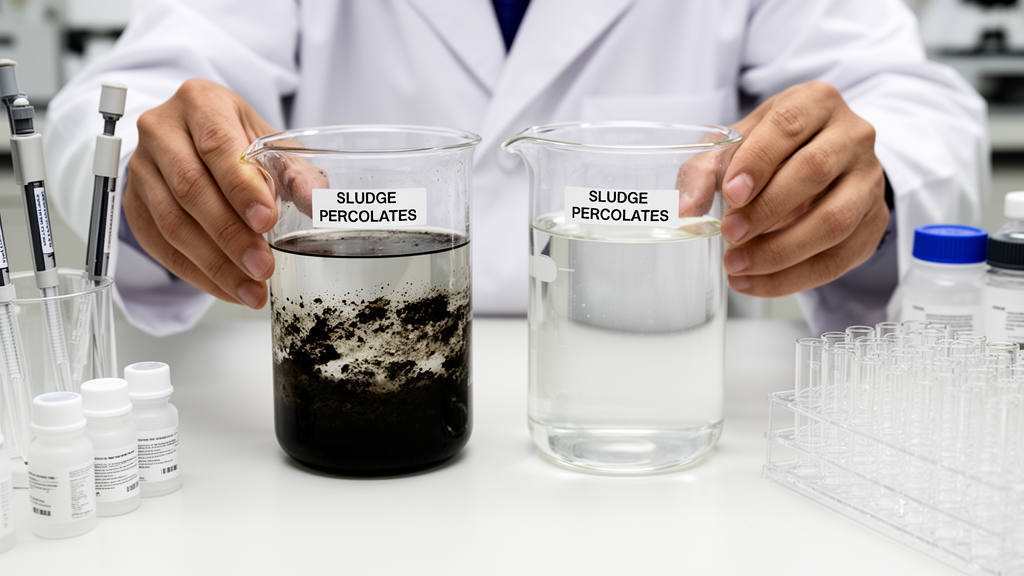
A Brazilian pilot-scale study found that the acute toxicity of percolate from water treatment plant sludge depended strongly on how the sludge was dewatered and whether it was blended with clayey soil. Neat centrifuged sludge produced 94% growth inhibition in the freshwater microalga Raphidocelis subcapitata, while the same sludge incorporated at 50% into soil produced only 3% inhibition. By contrast, naturally dried sludge and its 50% soil mixture each maintained inhibition above 72% during four quarterly tests.
The experiment measured biological effects in laboratory algae; it did not directly assess risks to people or entire ecosystems. The investigators designed the experiment to examine water passing through sludge under conditions intended to resemble geotechnical reuse. Sludge from drinking-water purification has been proposed for uses including landfill cover, pavement bases and sub-bases, ceramic products, lightweight aggregates and concrete.
Its proposed applications can provide technical or economic benefits, but those advantages do not by themselves establish environmental safety. The principal concern examined here was vertical percolation through a soil-sludge matrix, through which dissolved substances could potentially move toward groundwater or surface-water runoff. The sludge came from a conventional water treatment plant in Brazil’s São Paulo Metropolitan Region, where aluminum sulfate and a cationic polymer were used as coagulants.
Material from the clarification and filter-backwash stages entered an equalization tank at about 2% solids and a stabilization tank at about 4% solids. A decanter centrifuge operating at 2,500–3,000 rpm and approximately 1,500–2,000 times gravitational acceleration produced a cake with about 18% solids. A portion of that cake was naturally dried for 20 days in an open-air, waterproofed bed, increasing its solids content to about 50%.
Drying occurred at a mean temperature of 22 ± 4 °C and relative humidity of 70 ± 10%, with the material periodically turned. Composite triplicate samples were collected after centrifugation and natural drying to characterize the two processing outcomes. Five cylindrical PVC reactors, each 80 cm high and 30 cm in diameter, represented potential reuse conditions.
Every column contained a 5 cm gravel base, a 35 cm substrate layer and a 2 cm gravel cap, with a separate container below to collect percolate. The five treatments were neat centrifuged sludge, naturally dried sludge, a 50% centrifuged-sludge and clayey-soil mixture, a 50% naturally dried-sludge and soil mixture, and soil alone. The 50% incorporation rate was based on previously reported technical feasibility for adding up to that proportion of sludge to clayey or sandy soils.
The raw clayey soil was used without chemical treatment; clods were physically comminuted, and the substrate was mixed and manually compacted with a 3 kg roller. The reactors operated for one year in a closed space. Weekly additions of distilled water were calculated with a water-balance method from the treatment plant’s historical precipitation series, allowing the researchers to simulate tropical rainy and dry periods while avoiding chemical variability in natural rainwater.
Collected liquids were preserved with identification and their containers replaced monthly. This quarterly schedule was selected to cover both broad seasonal regimes while accommodating laboratory capacity, sample-preservation requirements and the cost of outsourced analyses. For each assay, exponentially growing R. subcapitata cells were exposed to a 50% dilution of a reactor’s percolate for 72 hours.
The initial cell density was 1.5 × 10⁴ cells per milliliter, and cells were counted at the beginning and end of each test with an Improved Neubauer-Bright Line hemocytometer viewed at 400× magnification. Percolate and laboratory-control conditions were tested in triplicate, and sensitivity testing with potassium dichromate confirmed that the algae were suitable for toxicity testing. Because the observations did not meet normality assumptions, the researchers used Friedman and Kruskal–Wallis nonparametric tests, followed by Dwass–Steel–Critchlow–Fligner comparisons among reactors.
Every percolate treatment significantly reduced algal density relative to the laboratory control, but the size of the biological response differed markedly among treatments. The Kruskal–Wallis test identified a highly significant difference among reactors, with χ² = 120, five degrees of freedom and p < 0.001. The reported epsilon-squared effect size was 0.839, indicating a very strong association between reactor composition or drying treatment and algal density.
Post-hoc analysis found no significant difference between naturally dried sludge and its soil mixture, with p = 0.973, or between the soil-only treatment and the centrifuged-sludge mixture, with p = 0.972. The researchers therefore distinguished the two dewatering outcomes rather than treating sludge and soil mixtures as a single uniform category. Metal measurements were consistent with greater attenuation when centrifuged sludge was mixed with soil.
Concentrations of copper, iron, magnesium, manganese, nickel and zinc were higher in percolate from neat centrifuged sludge than in percolate from its 50% clay mixture; differences for copper, nickel and zinc were reported as large as 100%. The researchers noted that clay has a high specific surface area and cation-exchange capacity and contains iron and aluminum oxides, processes that can immobilize metal ions through adsorption, ion exchange and surface complexation. The lower aqueous concentrations provide a possible geochemical explanation for the reduced toxicity, but the experiment did not identify a single cause of the algal response.
Residual organic coagulants, polyelectrolytes and other possible non-metal toxic drivers were not quantified. The liquid chemistry varied over the year but did not produce a statistically significant seasonal change in the biological endpoint. Percolate pH ranged from 6.45 to 8.36, a near-neutral interval in which pH-induced acid leaching was therefore considered unlikely to be the primary driver of metal mobility in this setup.
Conductivity in reactors containing centrifuged sludge peaked at 1,482 microsiemens per centimeter, which the authors associated with soluble ions released from the sludge matrix. Manganese had the highest metal concentrations in reactors containing sludge, while aluminum, barium, copper, magnesium, manganese, nickel, lead and zinc were detected in analyzed percolate. Cobalt, chromium and cadmium remained below instrument detection limits of 0.00020, 0.00020 and 0.00005 milligrams per liter, respectively.
The seasonal comparison produced a Friedman-test result of χ² = 6.19, with three degrees of freedom and p = 0.103, indicating no statistically significant difference between the quarterly rainy- and dry-season results. This stability in the algal endpoint did not mean that the percolate lacked hazard: all treatments reduced algal density relative to the control. It instead showed that the broad seasonal scenarios tested did not explain the larger differences associated with dewatering method and soil incorporation.
The study also exposed a difference between the biological behavior observed in the simulated columns and the physical-chemical approach used to classify the waste in Brazil. Brazilian standard NBR 10004 classifies water treatment plant sludge as non-hazardous and non-inert without requiring ecotoxicological testing. The results support the authors’ argument for incorporating biological assessment when sludge is considered for geotechnical reuse.
They do not establish that every permitted application would contaminate groundwater or surface water, nor do they quantify risks beyond the organisms and conditions tested. Rather, they show that a classification based on physical and chemical parameters alone did not capture large differences in the acute response of R. subcapitata to actual reactor percolate. Several limitations restrict how far the results can be generalized.
Each treatment was represented by one reactor because the columns were large, operationally complex and required long-term monitoring, while the ecotoxicity dataset comprised only four quarterly sampling events, each tested in triplicate. The experiment used sludge from one treatment plant, one donated clayey soil and distilled water rather than natural rainfall. Additional work would require more frequent sampling, tests with other organisms such as benthic Chironomus, measurements of residual organic coagulants, polyelectrolytes and emerging organic contaminants, and comparisons with pristine soil and neat sludge.
Such studies would help separate the contributions of the two matrices and clarify the processes governing percolate toxicity. The present pilot experiment nevertheless provides a field-simulated assessment of the actual liquid released by reused sludge rather than relying only on aggressive laboratory leaching extracts.
Subject of Research: Acute ecotoxicity of field-simulated percolates from water treatment plant sludge used in geotechnical soil mixtures
Article Title: Toxicity of percolates from geotechnical applications with water treatment sludge incorporation
Article References: de Almeida Nascimento, G., Rodgher, S., Formiga, J. K. S., & Fiore, F. A. (2026). Toxicity of percolates from geotechnical applications with water treatment sludge incorporation. Environmental Science and Pollution Research. https://doi.org/10.1007/s11356-026-38303-9
Image Credits: AI Generated
DOI: 10.1007/s11356-026-38303-9
Keywords: water treatment sludge, geotechnical reuse, percolate toxicity, soil-sludge mixture, Raphidocelis subcapitata, microalgae, metal attenuation, ecotoxicity testing, Brazilian waste regulation, environmental safety, Toxicity, percolates
Cite Scienmag News
Violet Maxwell. (October 21, 2026). Brazil pilot study finds sharply different toxicity in sludge percolates. Scienmag. https://scienmag.com/brazil-pilot-study-finds-sharply-different-toxicity-in-sludge-percolates/
Violet Maxwell. "Brazil pilot study finds sharply different toxicity in sludge percolates." Scienmag, 21 October 2026, https://scienmag.com/brazil-pilot-study-finds-sharply-different-toxicity-in-sludge-percolates/. Accessed 21 October 2026.
Violet Maxwell. "Brazil pilot study finds sharply different toxicity in sludge percolates." Scienmag. October 21, 2026. https://scienmag.com/brazil-pilot-study-finds-sharply-different-toxicity-in-sludge-percolates/


